🌬 Tent Wind Load Calculator
Calculate wind force, roof uplift, and stake load for any tent using ASCE engineering standards. Stay safe on every campsite.
0.00 psf
0.02–0.15 psf
0.16–0.54 psf
1.36+ psf
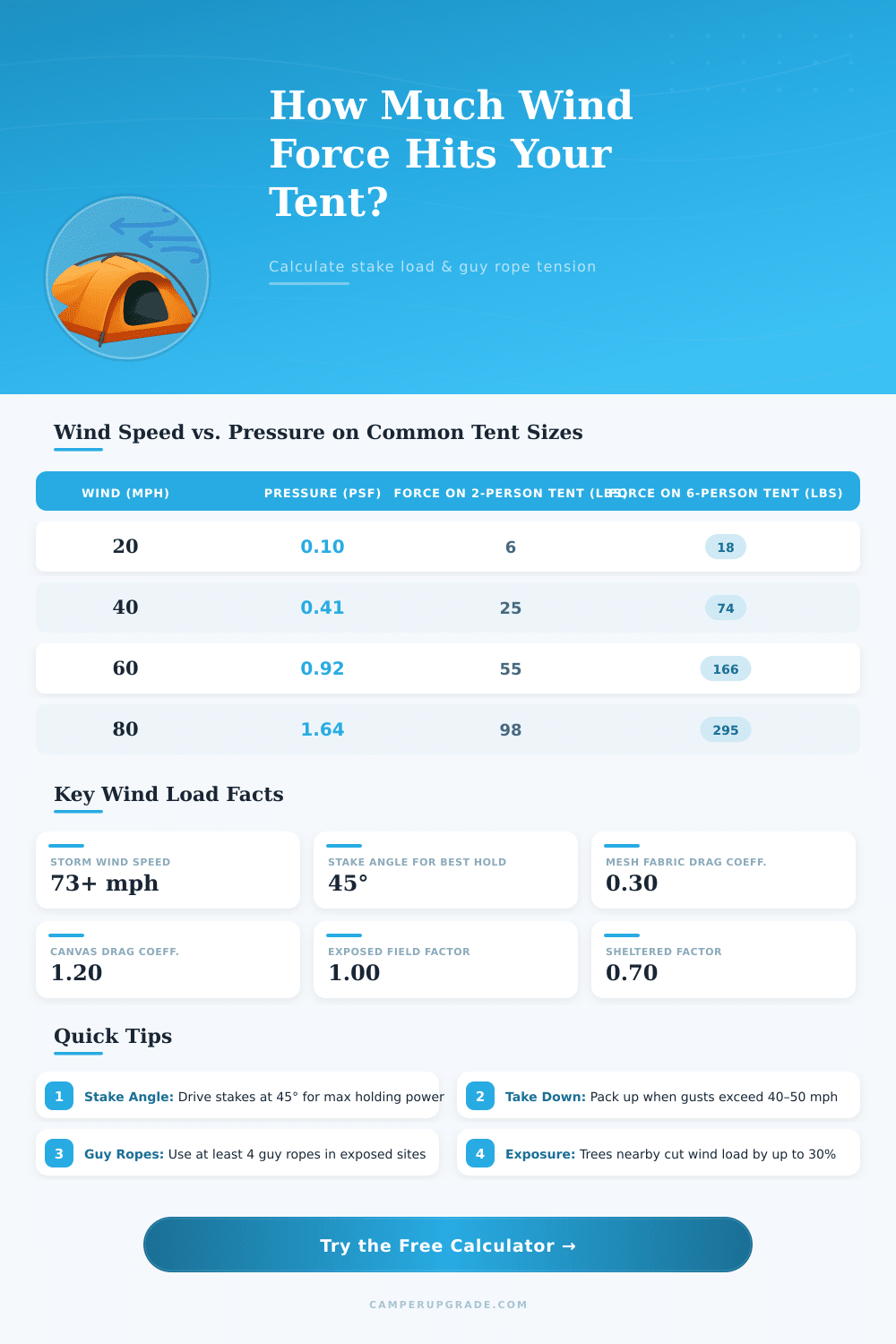
| Wind Speed (mph) | Pressure (psf) | Force – 2-Person Tent (lbs) | Force – 6-Person Tent (lbs) | Conditions |
|---|---|---|---|---|
| 10 | 0.026 | 2 | 5 | Light Breeze |
| 20 | 0.102 | 6 | 18 | Moderate Breeze |
| 30 | 0.230 | 14 | 41 | Fresh Breeze |
| 40 | 0.410 | 25 | 74 | Strong Breeze |
| 50 | 0.640 | 38 | 115 | Near Gale |
| 60 | 0.922 | 55 | 166 | Gale |
| 75 | 1.440 | 86 | 259 | Strong Gale |
| 90 | 2.074 | 124 | 374 | Storm |
| Material | Stake Pull-Out Force (lbs) | Guy Rope Break Strength (lbs) | Best Use |
|---|---|---|---|
| Aluminum | 80–120 | 200–400 | Backpacking, fair weather |
| Steel (Nail) | 150–250 | 500–900 | Car camping, general use |
| Titanium | 130–200 | 400–700 | Ultralight, high-wind alpine |
| Plastic / Peg | 40–80 | 150–250 | Soft ground, mild conditions |
| Snow Picket | 200–500 | 600–1200 | Snow, sand, soft terrain |
Wind can make or destroy your camping. How well a tent lasts depends on its design, materials, build quality, site conditions and how well it is set up. There is no single answer because different tents are made for various levels of resistance
Here is something wild about wind. If the speed of the wind grows from 10 knots to 40 knots, it becomes only four times faster. Even so, the pressure on the tent does not grow only four times, but exactly sixteen times.
How Wind Affects Your Tent
That means the tent must be sixteen times stronger, not only four. The wind-burden grows much more quickly than the wind itself.
Many tents colapse already at winds of only 15 to 20 mph. Popular canopy-tents, if they are well secured, can last light winds to 20 mph. Most of such tents tolerate breezes around 30 mph, and more rugged models last gusts to 40 mph.
Average event tents usually bear wind to 30 mph, but for windier conditions one can rent more rugged versions.
Stakes make a big difference. Most tents without stakes last wind only to 20 mph, but with them that figure jumps to 40 mph. The force of the anchors, the design, the direction of the wind and the quality of the stakes all matter.
The power of the stakes and if the tent works as a sail or lets the wind pass have big impact on the result.
Professional tents usually are made to last steady winds of 60 mph and gusts to 80 mph. Some certified models even reach 70 to 90 plus mph. Mountain tents, if they are correctly set up and tied, are ready for high winds and heavy snows.
Dome tents, also called geodesic, are very efficient for spreading the windy pressure through the hole structure.
Wind does not deal only about speed. When the wind strengthens, grows the risk of flying trash, falling branches or other objects that could damage the tent or hurt the folks. Many sources about outdoor events consider winds above 20 to 30 mph as challenging for camping.
Windy burden is steady pressure, while gusts are sudden bursts that can cause more losses than steady wind.
Big tents have more surface, which makes them more easily blowable. Consider several small tents instead of one big one. If one leaves the rainfly off when it is not required, the wind can pass through the vents, which makes the tent more aerodynamic and less shaky.
Windy ratings are important for outdoor events because they help to protect guests and staff and meet the demands of local authorities. Materials, the force of the poles, weights and the design all play a rolein the resistance.