Tent Vestibule Size Calculator
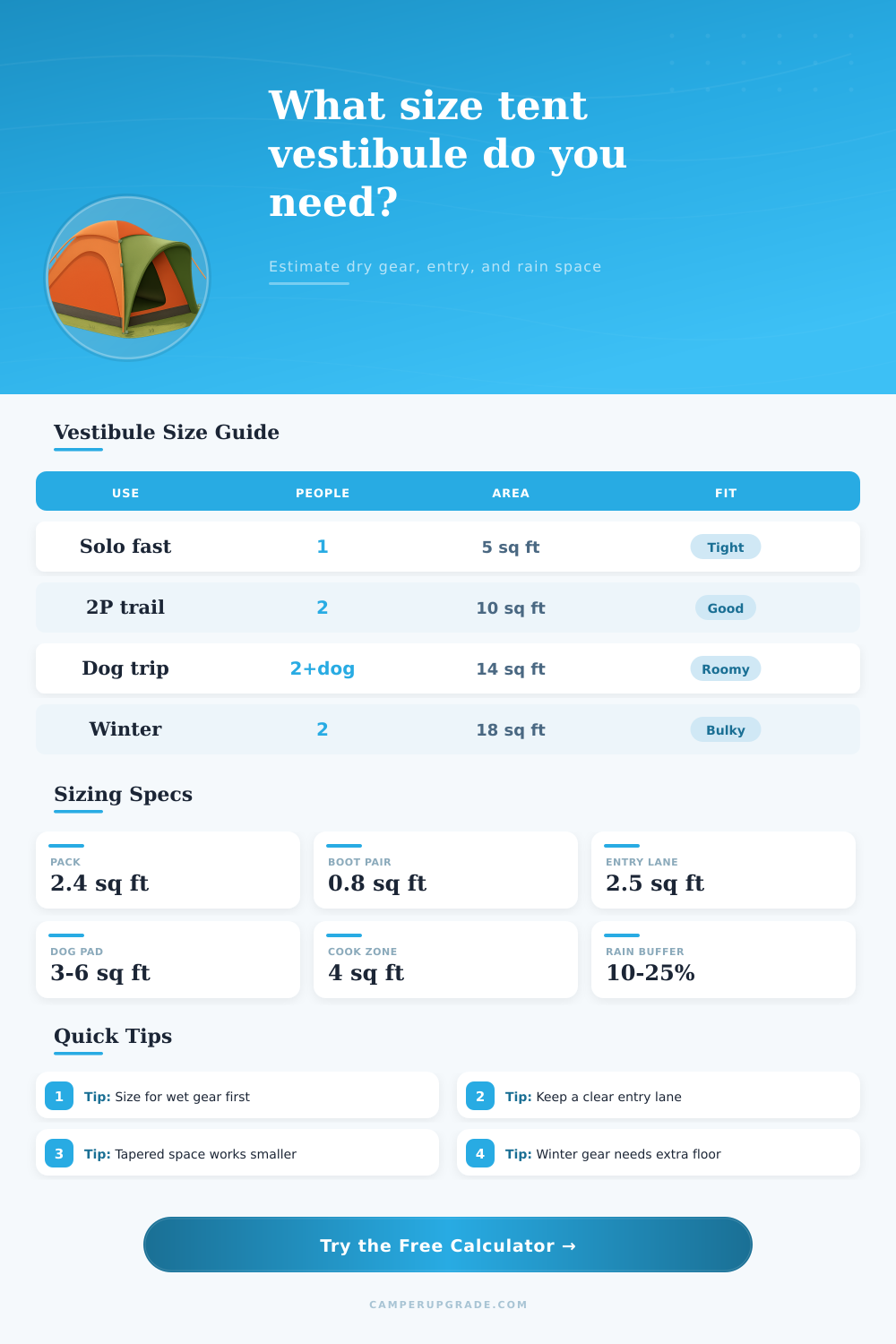
Estimate how much covered vestibule area your tent needs for packs, boots, wet layers, a dog pad, stove staging, and a usable doorway without treating every square foot as equally useful.
🏕Vestibule Scenario Presets
📏Tent Vestibule Inputs
📊Vestibule Planning Spec Grid
📋Vestibule Reference Tables
| Gear Item | Typical Area | Metric | Notes |
|---|---|---|---|
| 30-45L pack | 1.8 sq ft | 0.17 sq m | Compact trail kit |
| 50-70L pack | 2.4 sq ft | 0.22 sq m | Standard backpack |
| Expedition pack | 3.1 sq ft | 0.29 sq m | Bulky cold kit |
| Boot pair | 0.75 sq ft | 0.07 sq m | Toes tucked inward |
| Wet layer set | 0.9 sq ft | 0.08 sq m | Drip space, not hanging space |
| Medium dog pad | 4.5 sq ft | 0.42 sq m | Separate from gear |
| Vestibule Use | Good Area | Metric | Fit Comment |
|---|---|---|---|
| Solo fastpack | 4-6 sq ft | 0.37-0.56 sq m | Pack and shoes only |
| Solo storm | 7-9 sq ft | 0.65-0.84 sq m | Wet layers fit |
| Two-person trail | 9-12 sq ft | 0.84-1.11 sq m | Two packs and entry lane |
| Two plus dog | 13-17 sq ft | 1.21-1.58 sq m | Dog pad stays clear |
| Winter two-person | 18-24 sq ft | 1.67-2.23 sq m | Boots, shells, snow tools |
| Family or basecamp | 24+ sq ft | 2.23+ sq m | Shared wet entry |
| Shape | Formula | Usable Factor | Best For |
|---|---|---|---|
| Rectangle | depth x width | 0.88-0.92 | Boxy tunnel tents |
| Trapezoid | d x (a+b) / 2 | 0.78-0.86 | Common backpacking fly |
| Triangle | base x height / 2 | 0.66-0.78 | Wedge door vestibule |
| Two side pods | one side x count | 0.80-0.90 | Two-door tents |
| Custom trace | measured area | choose factor | Irregular fly layouts |
| Preset | People | Raw Area | Likely Rating |
|---|---|---|---|
| Solo fastpack | 1 | 5.8 sq ft | Efficient |
| 2P backpacking | 2 | 10.2 sq ft | Balanced |
| 2P plus dog | 2 | 15.8 sq ft | Roomy |
| Bikepacking duo | 2 | 18.5 sq ft | Bulky gear |
| Winter pulk | 2 | 24.0 sq ft | Storm ready |
| 4P basecamp | 4 | 35.0 sq ft | Shared entry |
💡Vestibule Sizing Tips
A tent’s vestibule are the covered area located outside of a main sleeping area of a tent. The vestibule is used to store gear such as wet clothing, boot, and backpacks. A vestibule is important for a tent because it ensure that the interior of the tent stays dry.
If the vestibule of a tent is too small, a person may have difficulty storing their gear. However, if the vestibule is too large, the tent may be unnecessarilly heavy or bulky for travel. The amount of space that a person require for a vestibule depend on the amount of gear that a person will be carrying into the tent and the type of weather that the person will encounter while traveling.
How Much Space Do You Need for a Tent Vestibule
For instance, a person who is traveling alone and in fair weather may only need a small amounts of space for the vestibule for their backpack and shoes. However, if a person is traveling with another person or with a dog, then more vestibule space will be required. Additionally, more vestibule space is needed if the weather are expected to be rainy because a person will have more gear and wet clothing that need to be stored outside of the tent.
This article includes a calculator that can help a person to determine the amount of space that will be necessary for the vestibule of there tent. The calculator will take into account the gear that a person will have and the shape of the tent. The shape of the tent will impact the amount of space that will be available in the vestibule for a person to use.
For example, if the tent has low edges created by the shape of the tent’s fly, then the vestibule will have low edges as well. These low edges may prevent people from using that space to store items such as backpacks. The efficiency of the tent can help to account for these low edges.
Thus, the efficiency will ensure that the measurement for the vestibule take into account the amount of space that will be usable in the vestibule. Another factor that a person must consider is how that vestibule will be use. For instance, if the tent is to be used for winter travel, then there will be additional gear that that person will require for that person to travel in the winter including snow tools, pad, and stoves.
Thus, an individual will need to decide what portion of the tent vestibule will be used for gear and what portion will be used as an entry lane. An entry lane is the portion of the vestibule that allows for a person to enter or exit the tent. An entry lane must be clear of any gear for a person to easy move in and out of the tent.
Many people may think that each portion of the vestibule is of use, but that is not true of all gear. For instance, the low edges of the vestibule are useful for placing a person’s shoe in the vestibule, but they are not of use for placing items like tall dog beds or backpacks in the vestibule. To account for this, the calculator includes a buffer percentage.
This buffer percentage will ensure that the vestibule does not become too small for a person if they are not organized and encounter worse weather then they had originally planned for their trip. One more detail that a person must consider is the coverage of a groundsheet for the tent. A groundsheet is used to protect the floor of the tent from the ground.
The tent floor will protect the persons gear from getting dirty or wet. With the calculator, a person can determine how much of the tent vestibule floor they want to protect with a groundsheet. Finally, the calculator will provide a rating for the vestibule of the tent.
The rating will indicate whether the vestibule for the tent is considered to be tight, workable, comfortable, or even roomy for the person who will use the tent. If the vestibule is rated as tight, then the person must take care in how they arrange their gear to ensure that there is an entry lane for the person to move in and out of the tent. A roomy vestibule will allow for extra spaces for any additional gear or people who may travel in the tent.
These rating will allow for the comparison of different tents.