Tent Rainfly Coverage Calculator
Estimate rainfly coverage, minimum overhang, exposed wall area, and wind-driven rain angle margin from tent size, fly size, vestibule extension, pitch gap, rain angle, wind direction, target overhang, and seam allowance.
Rainfly coverage estimate
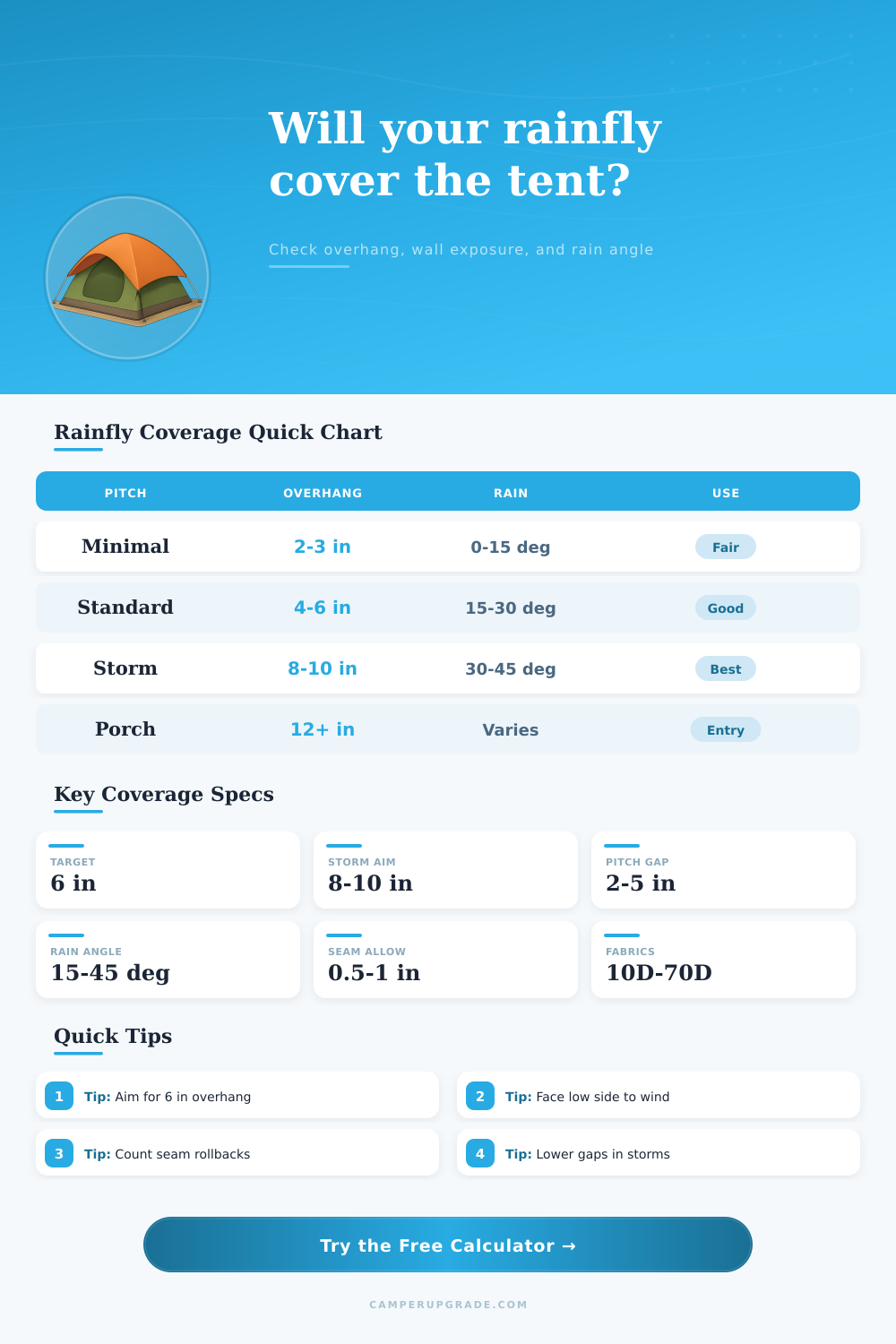
| Pitch condition | Target overhang | Pitch gap | Coverage note |
|---|---|---|---|
| Fair-weather shade or dew | 2-3 in | 4-8 in | Works for airflow, but wind-driven rain can reach mesh or wall fabric. |
| Standard three-season rain | 4-6 in | 3-5 in | Common backpacking target when the fly is tensioned close to the body. |
| Storm pitch | 8-10 in | 1.5-3 in | Better splash and angled-rain margin when side panels face wind. |
| High ventilation pitch | 6-8 in | 6-10 in | Needs more edge projection because the raised fly lets rain drift under. |
| Vestibule entry coverage | 12+ in | 2-5 in | Entry protection depends on front extension more than side overhang. |
| Rain angle | Wind feel | Extra drift from 3 in gap | Planning use |
|---|---|---|---|
| 0°-10° | Mostly vertical rain | 0-0.5 in | Coverage is mainly about splash and roof runoff. |
| 15°-25° | Light to moderate wind | 0.8-1.4 in | Good default for ordinary campsite rain. |
| 30°-40° | Strong side push | 1.7-2.5 in | Lower the fly and favor the windward overhang. |
| 45°-55° | Hard wind-driven rain | 3.0-4.3 in | Storm margins matter more than nominal fly dimensions. |
| 60°+ | Severe exposed pitch | 5.2 in or more | Use a sheltered site or a lower, larger fly if possible. |
| Fly fabric | Typical denier | Common HH rating | Coverage behavior |
|---|---|---|---|
| Silnylon ultralight fly | 10D-20D | 1,200-3,000 mm | Can stretch when wet, so re-tension and keep edge margin. |
| Silpoly backpacking fly | 20D-40D | 1,500-3,000 mm | Lower wet stretch helps hold planned overhang shape. |
| PU polyester family fly | 68D-75D | 1,200-2,000 mm | Stable panels, but short stock flies often need lower pitch gaps. |
| Oxford polyester tarp fly | 150D-300D | 2,000-5,000 mm | Heavier fabric can protect cabin tents with larger edges. |
| Canvas or polycotton fly | 8-12 oz | Water-shedding treatment | Breathable and quiet, but heavy wet fabric needs firm tension. |
| Setup | Tent footprint | Fly panel | Typical goal |
|---|---|---|---|
| 2-person dome | 7.2 x 4.6 ft | 8.3 x 5.8 ft | Balanced 3-season coverage with small vestibule. |
| 3-person trail tent | 7.5 x 6.2 ft | 8.8 x 7.4 ft | Better side coverage for wider sleeping pads. |
| Family dome tent | 10.0 x 9.0 ft | 11.0 x 10.0 ft | Moderate fly coverage over a broad wall area. |
| A-frame tarp pitch | 8.0 x 4.5 ft | 10.0 x 8.0 ft | Large side overhang with exposed ends. |
| Cabin tent fly | 12.0 x 10.0 ft | 13.0 x 11.5 ft | High walls need conservative rain angle margin. |
| Rooftop tent fly | 8.0 x 5.0 ft | 9.0 x 6.5 ft | Small pitch gap, good edge control. |
Rain can enter a tent when the wind push the water past an edge of the rainfly, and rain can also enter a tent if the rainfly does not provide enough overhang for the tent walls. Many peoples is unaware that the rain has entered there tent until the rain reaches their tent walls. In order to prevent rain from enter a tent, an individual must have an understanding of how overhang, pitch gap and the angle of the wind work together to keep a sleeping tent dry from the elements of rain.
The distance between the rainfly and the tent wall is crucial in determining if the rain will hit the tent walls or not. If the edge of the rainfly is too close to the tent walls, the rain will hit those walls. Rain does not always fall straight down in the camping environment.
How to Keep Rain Out of Your Tent
The movement of the wind can alter the downpour. Because the rain moves at an angle due to the movement of the wind, the rain will travel a further distance under the rainfly then if the rain fell straight down into the tent. By using a calculator, an individual can determine how much rain will travel under the rainfly to the tent.
The calculator requires the individual to enter the dimension of the tent and the angle of the rain that is expected. The angle of the rain and the wind will determine how much rain will fall under the rainfly to the tent. Additionally, the direction of the wind will determine the part of the tent that will fill with rain first.
The calculator uses the variables for the tent and the rain to determine how much rain will fall under the rainfly. The length of the tent and the width of the tent must remain dry. The length and the width of the rainfly will determine how much rainfly fabric will cover the tent.
However, there will be a loss of length and width due to the seams on the rainfly. Additionally, the extension of the vestibule will allow for coverage on one end of the tent; however, it will not provide coverage on the opposite end of the tent. The pitch gap will create space for the rain to fall under the rainfly.
How far the rainfly extends from the tent determines the amount of overhang that the rainfly provides. A six-inch overhang is desired for three-season tents. However, eight to ten inches of overhang is required for storms to be encountered.
An area of the tent is exposed to the rain that is not covered by the rainfly. This area is referred to as the exposed wall area. If the tent has a short overhang on the rear of the tent and if the rain has a long and steep angle, the exposed wall area will be large and allow for the rain to fall onto the tent walls.
The shortfall on each edge of the tent multiplied by the pitch gap and the wind multiplier can calculate the amount of exposed wall area. Additionally, if the exposed wall area is larger than five square feet, the rainfly must be lowered to allow the rainfly to provide coverage of the tent walls. Seams and the fabric that the tent is made of may impact the overhang of the rainfly.
For example, if the rainfly has rolled hems or edges bound with fabric, there will be a loss of length or width of the rainfly. Additionally, if the fabric is nylon, the nylon may stretch when it absorbs the rainwater. If the rainfly fabric stretch, there will be a decrease in the overhang that the rainfly makes for the tent.
Additionally, the score for the coverage of the tent by the rainfly will also decrease. The direction of the wind can change the overhang that is the most important for the tent. For example, when the wind is moving into the vestibule of the tent, there is an overhang for the front extension and the rear edge of the tent.
Additionally, a side wind will test the strength of the long walls of the tent. Additionally, if the tent has a short side overhang, the tent could be exposed to rain on the sides. The calculator will use the multiplier for the wind direction for the score for the coverage of the tent by the rainfly.
Many individuals make mistakes when measuring the rainfly for their tent. For example, some use the size of the rainfly as noted on the tent tag; however, that size does not include the length of the seams. Additionally, another mistake is to set the pitch of the rainfly too high for the tent.
If the rainfly is pitched too high, there will be a greater pitch gap that allows the rain to reach the tent. An individual can gain an understanding of the variables of the tent and the rainfall from calculator reference tables. These tables can help an individual decide if the rainfly should be lowered on the tent.
While the rainfly tent cover calculator accounts for many variables, there are others that an individual should be made aware of. For instance, sloped ground may impact the tent in that it may tilt the tent to one side. The tent tilting could affect the way that the rain lands on the tent.
Another variable is the presence of tree or boulders nearby that may impact the wind patterns around the tent. The change in the wind patterns could change the direction in which the rain falls on the tent. Additionally, if the rainfly fabric is aged or repaired it may not provide the same amount of tension to the tent fabric as a fresh rainfly.
The tension of the rainfly could change the way in which it covers the tent. It is important for an individual to make a habit of checking the weakest edge of a tents rainfly. For example, the weakest edge will have the smallest overhang of rainfly over the tent walls.
Additionally, adding the length that the rain may travel due to the angle of the rain to the overhang of the rainfly can determine the overhang of rain to provide coverage for the tent walls. If the amount of overhang is greater than the tents target overhang, then it is likely that the tent will remain dry. If the margin is negative, one of the guy lines or stakes of the tent must be adjusted.
The adjustment will provide greater overhang for the tent walls to remain dry inside the tent.