Tent Pole Shock Cord Length Calculator
Estimate the relaxed shock cord cut length for segmented tent poles using pole sections, section length, stretch target, knot allowance, ferrule seating loss, pole count, cord diameter, and spare allowance.
| Stretch target | Relaxed cord factor | Feel during assembly | Best use |
|---|---|---|---|
| 15% | Path / 1.15 | Gentle pull | Cold weather, older tips, fragile carbon |
| 20% | Path / 1.20 | Moderate pull | Short brow poles and small tents |
| 25% | Path / 1.25 | Firm pull | Most dome and tunnel tent poles |
| 30% | Path / 1.30 | Snappy pull | Long family tent poles with many sections |
| 35% | Path / 1.35 | Very tight | Use only when hardware is smooth and strong |
| Cord diameter | Typical pole outside diameter | Pull character | Fit note |
|---|---|---|---|
| 2.0 mm | 6 to 7 mm | Light | Check small end tips before ordering. |
| 2.5 mm | 7 to 8.5 mm | Light-medium | Often fits backpacking tent pole bores. |
| 3.0 mm | 8.5 to 11 mm | Medium | Common for aluminum replacement work. |
| 3.5 mm | 10 to 13 mm | Medium-strong | Leave room for knots or washers. |
| 4.0 mm | 12 mm plus | Strong | Measure bore clearance at ferrules. |
| Allowance item | Typical input | Calculator effect | When to change it |
|---|---|---|---|
| Knot allowance | 4 to 6 in | Added after stretch math | Increase for beads, washers, or bulky knots. |
| Ferrule loss | 0.5 to 1 in | Subtracted at each joint | Use actual overlap if sections seat deeply. |
| Spare allowance | 8 to 12% | Added to total buy length | Raise it when repairing several old poles. |
| Stretch target | 20 to 30% | Shortens relaxed cord | Lower it for cold trips or delicate pole ends. |
| Preset scenario | Sections | Section length | Starting cord estimate |
|---|---|---|---|
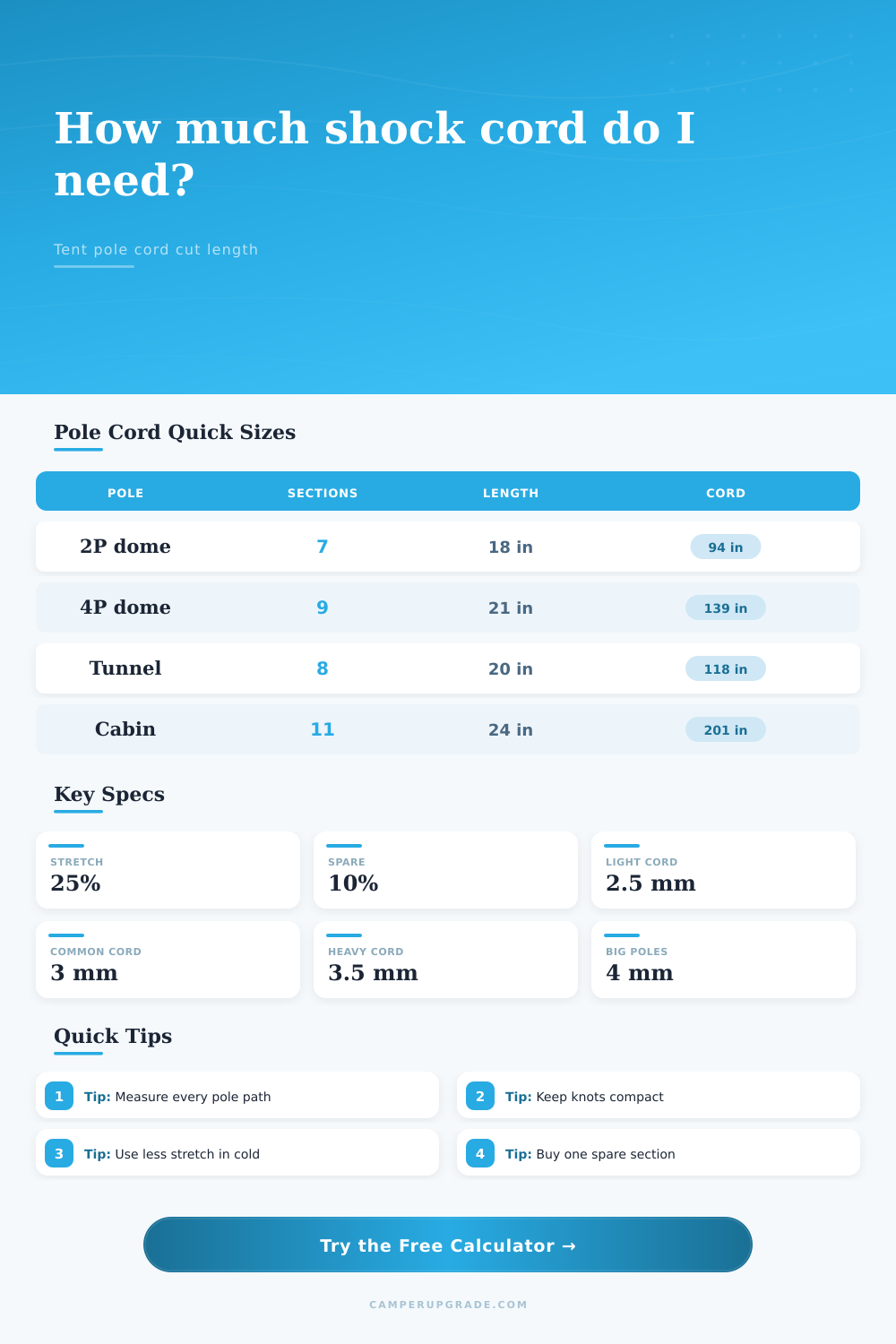
| Solo dome 7 mm | 6 | 17 in | About 78 in per pole |
| 2P backpacking dome | 7 | 18 in | About 96 in per pole |
| 3-season crossover | 8 | 19 in | About 116 in per pole |
| 4P family dome | 9 | 21 in | About 143 in per pole |
| Cabin roof pole | 11 | 24 in | About 201 in per pole |
There’s a certain sound that only campers know: the snap of your tent pole cord. Snap, then flailing around on the tent floor. It happen to all camper at some point. After years of silent tension and exposure to the elements, the cord inside your tent pole finally give way. Fixing it isn’t as easy as replacing the cord, either; it’s a precise process of getting length right.
Get it wrong and your poles won’t remain assembled or will stretch and bow out from under tension long before you set up camp. Tent poles is stretched just right. If you get the length wrong by ignoring ferrule loss, the cord will be to long and the pole will be loose and floppy. If there is not enough stretch it will hurt your wrists when you go to fit the sections together. The tent pole wants to hold itself up on its own but needs the stretch cord to take the shock of fitting them together.
How to Fix Your Tent Pole Cord
That’s where the stretch goal comes in. Twenty-five percent is nice and tight without being painful. Get near thirty-five percent and you start risking hurting your wrists. So what does that mean? Well, the calculator on the page takes care of that math if you enter in length of each section and how many there are. But knowing why those numbers shift makes it more than a good repair, it makes it last.
The overall length is also affected by the loss of ferrules. Poles are made in sections that slide together. They don’t add up as you might expect because of metal overlap, the total inner length of the assembled pole is less then the sum of its parts. This means your cord is now to long. Now your pole looks like it’s all put together but feels flimsy. Also, tension will be distributed poorly across the joints. It’ll sag in the breeze due to poor distribution of tension.
Underestimating the knot slack required can cause the cord to fall back through the tube once threaded. It is a small point, but it affects final fit.
Cold is also a factor. As it gets cold, rubber and elastomers will get stiffer. A cord that feels “just right” in your warm garage can become stiff and breakable in the frost. So many veteran campers will opt for less stretch for their winter outings. It makes setting up the tent easier by requiring less physical exertion from those numb fingers. The page has a reference table showing different tension levels based off real world feel.
Diameter is critical but often misunderstood. Simply put, thicker cord doesn’t always perform better. This creates more friction. So if the shock cord are a bit too thick for the bore in your poles, you’re going to fight it and the sections won’t slide into place as easy as they should. Don’t go outside the diameter that matches the specs on your pole. For example, if original cord was three millimeters, don’t think four millimeters would of hold up better. Chances are, it’ll simply be tougher to use.
Cutting: Don’t cut your cord until you measure out real lengths. Some replacement poles may have both long and short pieces mixed up; avoid averaging them since that can lead to a cumulative error in length. The occasional piece that’s way off from the others should be treated as an individual measurement. Better to buy more cord and trim it down than realize half-way through that you’re short.
Always cut long and try it on the pole. Shave off small amounts at a time, tying a temporary knot first. Assemble the pole and keep shaving until all the pieces pull together without stressing the end tips.
A well corded tent pole is invisibly convenient. It does not demand attention. Stands up all on its own. Lets you erect your shelter in the rain or dark with no problem at all. The time taken to make sure it’s long enough pays off later.
Watch the pole stand straight up when you snap in the new cord and know that math paid off. Tension holds, the shelter goes up and now you’re ready for the night.