Campsite Tent Pad Size Calculator
Check whether a tent pad is large enough for your tent body, rainfly, vestibules, guyline or stake zone, door clearance, slope, obstructions, and multi-tent campsite layout.
Tent pad fit estimate
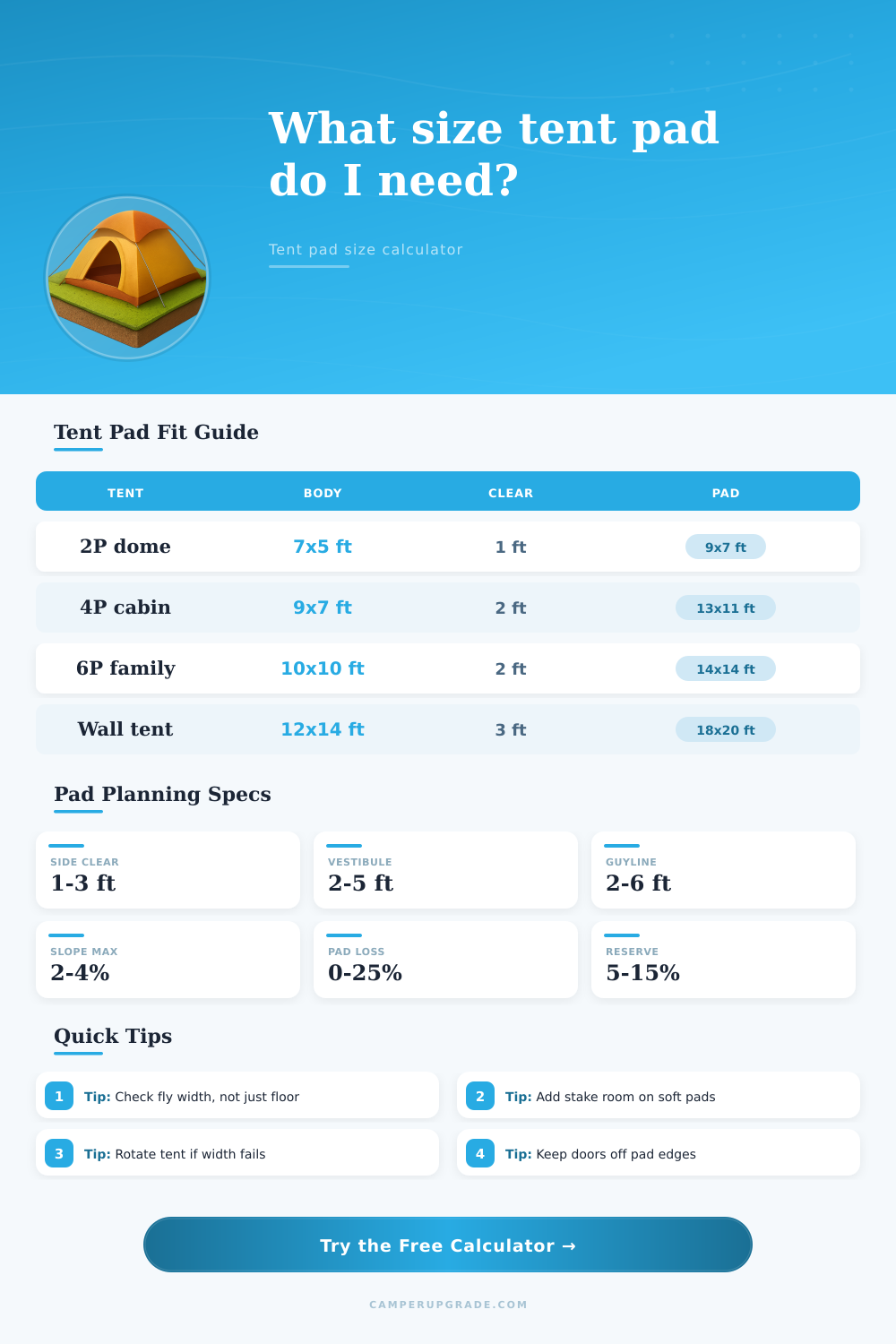
| Tent or shelter | Typical body size | Usable pad target | Why the extra space matters |
|---|---|---|---|
| Solo or 2-person backpacking tent | About 7 ft by 4 ft to 7.5 ft by 5 ft | About 9 ft by 7 ft | Small vestibules, stake angles, and a little room to enter without stepping off the flat pad. |
| 3- to 4-person dome tent | About 8 ft by 7 ft to 9 ft by 8 ft | About 12 ft by 11 ft | Rainfly pullouts and door swing usually need more width than the floor dimensions show. |
| 6-person cabin tent | About 10 ft by 10 ft | About 14 ft by 14 ft | Tall walls catch wind, so guyline reach and edge clearance become more important. |
| Large family tent with screen room | About 14 ft by 10 ft to 17 ft by 10 ft | About 20 ft by 15 ft | Screen rooms and awnings behave like vestibules and can make a listed pad too short. |
| Canvas wall tent | About 10 ft by 12 ft to 14 ft by 16 ft | About 18 ft by 20 ft or larger | Stake lines, stove-jack setbacks, and tight pitch geometry need generous edges. |
| Pitch feature | Typical added distance | When to increase it | When it may shrink |
|---|---|---|---|
| Rainfly overhang | 4 in to 12 in per side | Full-coverage fly, high vents, storm pitch, or drip line kept on pad. | Single-wall tent or fly can drip outside the gravel pad. |
| Front vestibule | 2 ft to 5 ft | Boot storage, packs, dog space, or cooking gear kept outside the inner tent. | Minimal awning or vestibule can extend over allowed edge space. |
| Guyline reach | 2 ft to 6 ft | Windy exposed pad, tall cabin walls, wall tent, or soft soil stakes. | Freestanding tent with no required guy points in calm weather. |
| Door clearance | 1 ft to 2 ft | Family traffic, wet boots, dogs, kids, or two-door tents. | Backpacking tent with one careful user and no gear at the door. |
| Listed pad | Good fit | Marginal fit | Usually too tight |
|---|---|---|---|
| 8 ft by 8 ft | Solo bivy or small 1P tent | Narrow 2P without vestibules | Most 3P or wide 2P tents |
| 10 ft by 10 ft | Most 2P and compact 3P tents | Small 4P dome with little stake room | Cabin tents and screen-room shelters |
| 12 ft by 12 ft | Many 4P dome tents | Small 6P square cabin tent | Long family tents with screen rooms |
| 15 ft by 15 ft | Most 6P cabin tents | Short family tents with large vestibules | Wall tents with long guy lines |
| 20 ft by 20 ft | Large family tents or two small tents | Canvas wall tents with careful guying | Multiple large tents plus gear shelters |
The most basic (and sometimes surprisingly elusive) question when picking a campsite is whether tent I’m bringing is going to fit on that flat spot. Length and width is listed. However, those numbers don’t show how much space is take up by vestibules and a rainfly. They also don’t account for stakes at an angle or the room you need to stand inside without stepping off pad. The calculator above figures all that out for you and lets you know if the rectangle advertised on paper will be achievable in real life.
So, we have to start with body dimensions, but often those don’t even come close to telling complete tale. Seven by five may be floor size of your tent but the fly will likely go out several inches beyond this on all sides. Add a pack & boot vestibule and now you’re adding another two or three feet (at least) in one dimension. How much clear space is there around the door? Is it flush with the pad so you have to balance unsteadily on a rock or root each time you come and go? The calculator treats these extra measurements as part of actual space that must fit within usable area, rather than just extras.
How to Check If Your Tent Will Fit
The second penalty is slope and pad surface. Listings almost never talk about this, but a supposedly mild 2-percent grade can cause a sleeping bag to inch across the pad towards either wall all night. Deep duff or soft sand alters distance you should of place stakes from the fly. By reducing actual usable area of the pad based off those variables, the tool also adjusts for them when measuring against tent needs. This alone frequently makes an apparently large pad only work in a certain orientation.
Then there’s multi-tent sites. If you want two little backpacking tents in one area, put them side by side with an aisle between. Four tents becomes a grid and the aisles shrink fast. You can input how many tent are in your setup and the calculator will size the aisle for you. The output tells you if listed pad is going to handle the added traffic without having doors opening on top of each other, or people walking off the flat spot.
The perfect rectangle in your reservation image doesn’t match real world of campground camping much at all. Even if stated size looks good enough a small dip, an inconveniently located utility pole, or that pesky tree root, can rob your space of a bit of usable space. With the tool’s obstruction feature you can set the percentage loss to be applied prior to calculation. It reminds me that what looked like a great flat spot during the day might gets smaller after you lay out gear and guy lines.
So what is the result? The math is easy. Measure your tent, including any attached extensions that touch the ground or need headroom. Use those measurements to create a “footprint,” then lay it on top of pad before making reservations. Use the calculator to do the math when you know true size. Then use your own judgment regarding slope, surface and desired comfortably buffer in case the weather gets nasty.