Tent Occupancy Calculator
Estimate realistic sleeper capacity, pad layout fit, usable floor area per person, inside gear margin, vestibule relief, and shoulder comfort from the actual tent floor and sleeping pad dimensions.
Tent occupancy estimate
| Advertised size | Typical floor area | Tight sleeper count | Comfortable use |
|---|---|---|---|
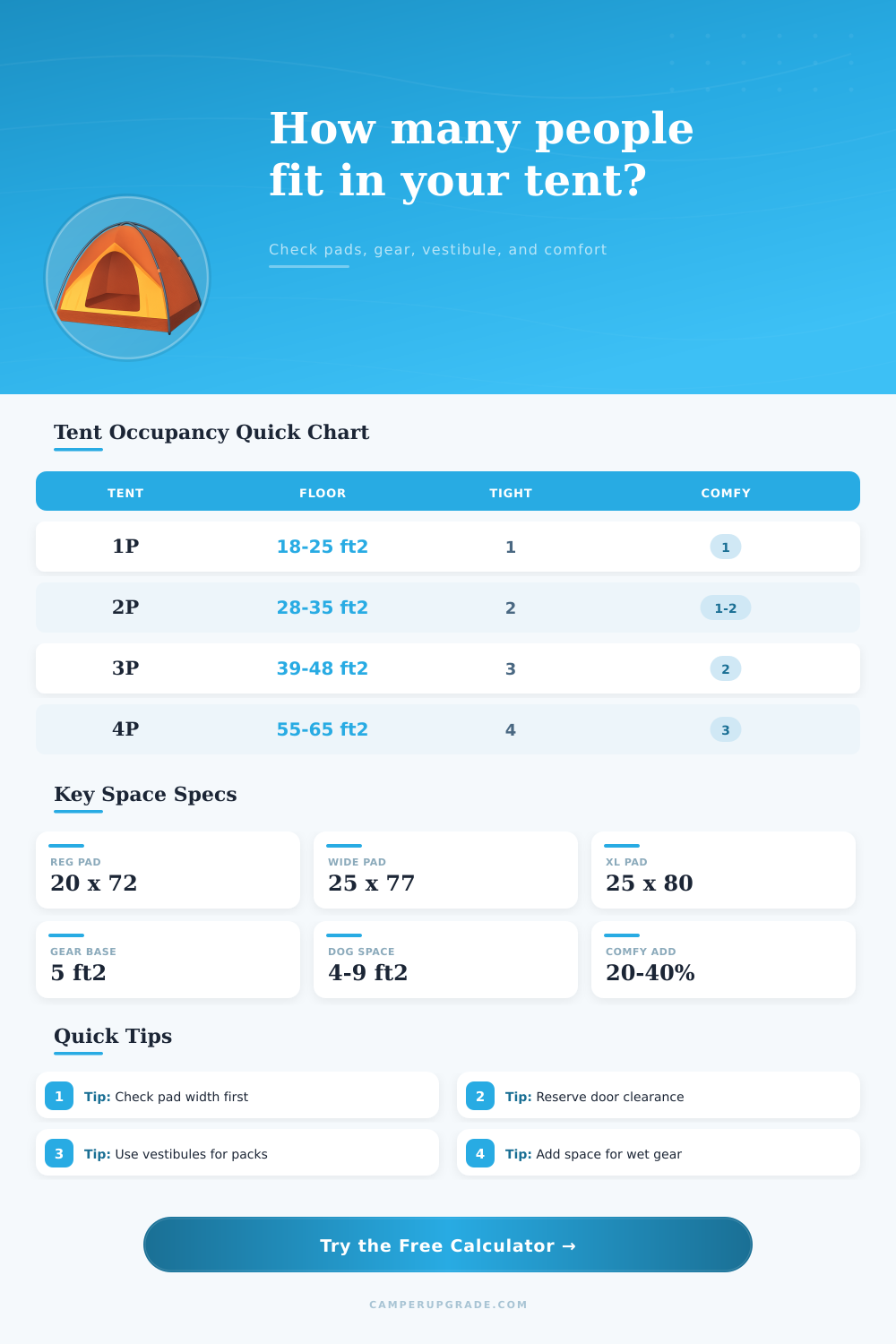
| 1-person backpacking tent | 18-25 sq ft | 1 regular pad | 1 sleeper with minimal gear |
| 2-person backpacking tent | 28-35 sq ft | 2 regular pads | 1-2 sleepers depending on pad width |
| 3-person backpacking tent | 39-48 sq ft | 3 regular pads | 2 adults or 2 plus a dog |
| 4-person dome tent | 55-65 sq ft | 4 regular pads | 3 adults or family with child gear |
| 6-person cabin tent | 85-100 sq ft | 6 close pads | 4-5 campers with gear inside |
| 8-person cabin tent | 120-140 sq ft | 8 close pads | 5-6 campers with room to move |
| Pad type | Common size | Pad area | Occupancy note |
|---|---|---|---|
| Short mummy pad | 20 x 48 in | 6.7 sq ft | Saves length but leaves legs or pack off pad |
| Regular mummy pad | 20 x 72 in | 10.0 sq ft | Standard backpacking fit for tight ratings |
| Regular rectangular pad | 20 x 72 in | 10.0 sq ft | Needs the same floor as a regular mummy pad |
| Wide rectangular pad | 25 x 77 in | 13.4 sq ft | Often turns a tight 2P into a roomy 1P |
| Long wide pad | 25 x 80 in | 13.9 sq ft | Check both tent length and wall slope |
| Double sleeping pad | 50 x 78 in | 27.1 sq ft | Fits many 3P floors better than tight 2P floors |
| Comfort factor | Planning style | Floor feel | Best use |
|---|---|---|---|
| 0-10% | Minimum pad fit | Shoulder-to-shoulder | Fast trips with little gear inside |
| 15-25% | Balanced camping fit | Some elbow room | Most backpacking and weekend tents |
| 30-45% | Comfort fit | Space for clothing and movement | Rainy trips, pets, kids, bulky sleep systems |
| 50-80% | Roomy base camp fit | Generous floor margin | Long trips, large pads, cabin tents |
| Gear inside setting | Inside area estimate | Vestibule role | Use when |
|---|---|---|---|
| 0-15% | 0-0.75 sq ft per sleeper | Nearly all packs outside | Dry weather or big vestibules |
| 25-40% | 1.25-2.0 sq ft per sleeper | Boots and packs partly outside | Typical double-wall tents |
| 50-70% | 2.5-3.5 sq ft per sleeper | Vestibule handles wet or hard goods | Cold, wet, or bear-country organization |
| 80-100% | 4.0-5.0 sq ft per sleeper | Little reliable vestibule storage | Single-wall shelters or exposed camps |
When you unroll a tent at a campsite, the capacity of the tent may not match the actual space within the tent. While the tent may advertise that it is a two-person or three-person tent, the space within the tent may not provide enough space for two adult to sleep on sleeping pads. The space within many tents is tapered, which limits the space that each person can have within the tent while they is sleeping.
The calculator allow you to enter the measurements of the tent, sleeping pads, and gear. Using these dimensions, the calculator will provide information regarding the actual sleeping space within the tent. The capacity of the tent is not always measured at the width of the tent’s shoulder zone; thus, the calculator will also allow you to input the comfort factor for the tent.
See How Many People Really Fit in a Tent
This comfort factor will allow the calculator to determine whether the tent is measured at its widest point (when camping with no gear) or at the narrowest point (when camping with gear and potentially including room for pets). Another calculation that may be performed uses the information gathered by the calculator to provide information regarding the floor area that each person will have within the tent. The floor area per person will take into account the area that gear will take up within the tent.
Additionally, if the sleeping individuals within the tent are children or dogs, the calculator will take that into account in providing the measurement of the area that each person will have within the tent. While the tent may have ample space for two adults, if the sleeping adults has to share the sleeping area with children or dogs, they may not have as much space as they would like within the tent. The calculator will provide information regarding the fit of the sleeping pads that will be used within the tent.
The sleeping pads should be able to lie flat on the tent floor, and the sleeping individuals should be able to lie on the sleeping pad without their shoulders but in contact with another sleeping individual. If an individual has broad shoulders, a twenty-inch sleeping pad may end up in contact with the sleeping individual’s shoulder, which may disrupt there sleep while camping. Another calculation that should of been performed with the information from the tent size calculator is to determine the gear margin.
The gear margin will take into account the amount of space that will be taken up by gear within the tent. If there is not much space within the tent for gear, it may be necessary to pack some of the gear into the sleeping bag to make room for the gear within the tent. The more gear that will be within the tent, the more higher the percentage of the gear margin will be.
Thus, a higher percentage for the gear margin will reduce the sleeper count that can be expected within the tent. The reference tables can provide information regarding the actual comfort factors for the tents that are advertised. For instance, if individuals are planning a camping trip with only a few items and are traveling light (a fast-and-light trip), only a fifteen-percent comfort factor will be needed within the tent.
However, if there will be children going camping, or if it is a rainy season camping trip, a thirty-five-percent comfort factor will be required within the tent. These reference tables can help individuals understand the different comfort factors for the tent sizes so that they can decide on which sleeping tent will best suit their camping trip. There are a variety of variables outside of the tent size calculator that will impact the comfort within the tent.
For instance, the vestibule may be used to store items; however, this area will only be helpful if it remain dry. Additionally, the dog may lie neatly on the sleeping pad at home; however, when within the tent, the dog may take up more space than the sleeping adults will allow. Children require more space than adults do while sleeping, especially within the smaller space within a tent.
These variables are difficult to account for in advance; however, they have the potential to impact the sleeping comfort within the tent. The comfort factor that is entered will account for the variables mentioned above. For instance, if the percentage for the comfort factor is increased, this will allow space within the tent for sleeping or other camping activities.
Should the percentage of the comfort factor be decreased, individuals may be willing to sacrifice some comfort to save weight or to increase the sleeping space for others within the tent. This option allows individuals to see how the tent may appear with a high comfort factor or a low comfort factor. Many campers may not account for the actual sleeper count within a tent until they arrive at the campsite and begin to load their sleeping gear into the tent.
However, by using the tent size calculator and accounting for the dimensions of the sleeping pads and gear that will be within the tent, an individual can find out the sleeper count for the tent. This will help individuals to change their sleeping plan to accommodate for the space within the tent. For instance, they may find that the sleeping pad that they are planning to use is too narrow for the sleeper count for which they have planned.
There are a variety of small frictions in camping that may be difficult to define in advance; however, they can potentially impact the comfort within the tent. For instance, one might have to open their pack within the tent; they may have gear that does not dry while camping, or their dog may lie on the sleeping pad of two sleeping campers. These small issues may impact the memories that they have of their camping trip.
However, by using the tent size calculator to define each camper’s sleeping pad and gear preferences, these small frictions may be avoided altogether. The math will not eliminate the potential of these small frictions; however, they will be eliminated before the campers leave for their trip.