Tent Safe Heater BTU Calculator
Estimate tent heat loss, safe heater output, ventilation flow, and fuel or wattage demand for cold-weather camping.
| Fabric / shelter | Modeled U-factor | Base ACH | Best calculator use |
|---|---|---|---|
| Single-wall nylon/poly | 1.25 BTU/hr-ft²-°F | 2.2 | Ultralight tents, tarptents, frost-prone shells |
| Double-wall backpacking tent | 1.05 BTU/hr-ft²-°F | 1.8 | Most 2P to 4P camping tents with fly |
| Four-season fabric / snow skirt | 0.90 BTU/hr-ft²-°F | 1.5 | Mountaineering tents with better draft control |
| Canvas wall tent | 0.65 BTU/hr-ft²-°F | 1.2 | Large tents with stove jack or vented heat |
| Insulated ice shelter | 0.45 BTU/hr-ft²-°F | 0.9 | Quilted pop-up shelters and insulated hubs |
| Screen room with clear panels | 1.45 BTU/hr-ft²-°F | 3.0 | Leaky shoulder-season enclosures |
| Heat or fuel reference | Accurate conversion | Calculator formula | Practical reading |
|---|---|---|---|
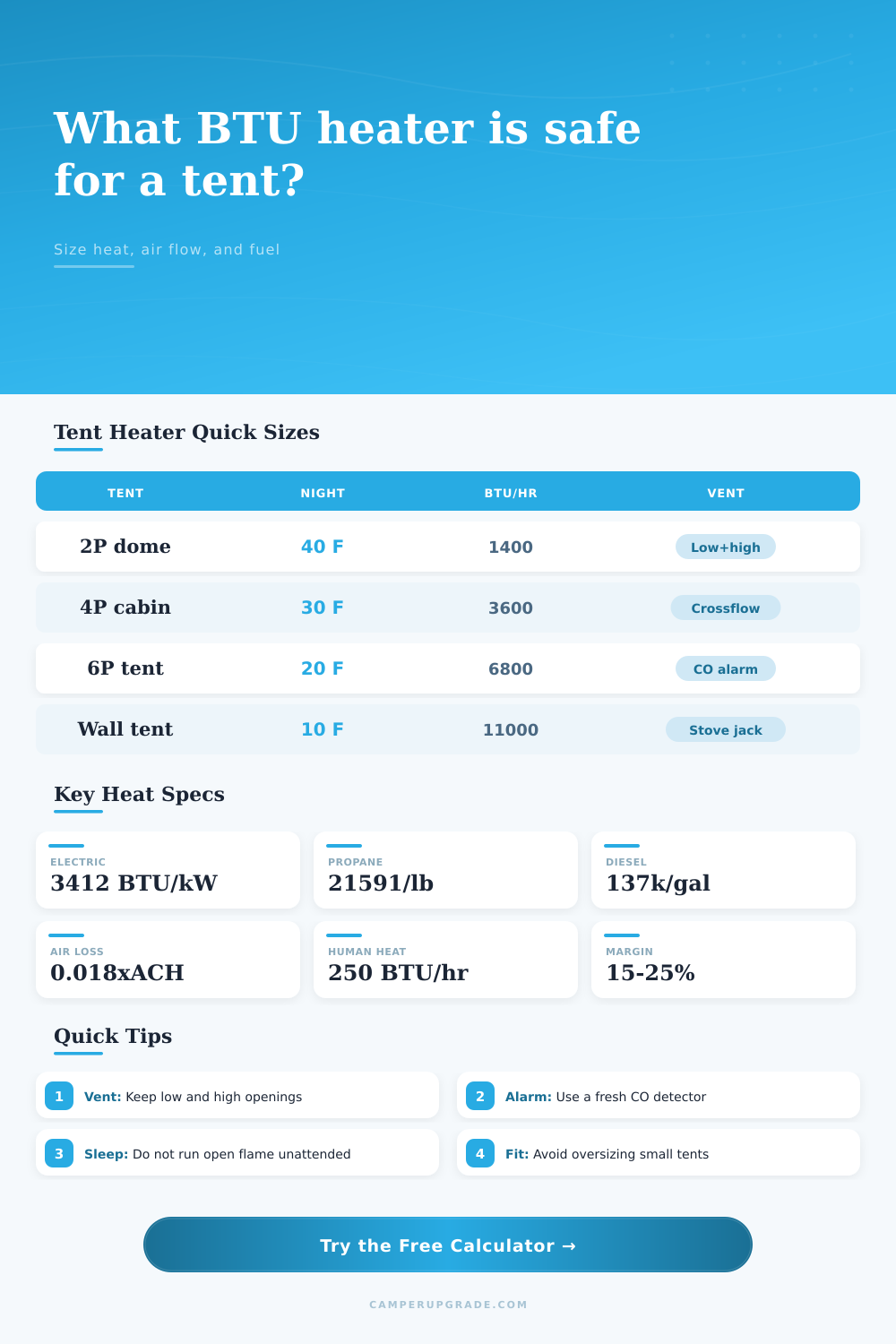
| Electric resistance heat | 1 watt = 3.412 BTU/hr | Watts = BTU/hr ÷ 3.412 | A 1,500 W heater is about 5,118 BTU/hr |
| Propane energy content | 1 lb = 21,591 BTU | lb/hr = BTU/hr ÷ 21,591 | A 1 lb cylinder is a small reserve |
| Propane liquid gallon | 1 gal = about 91,500 BTU | gal/hr = BTU/hr ÷ 91,500 | Useful for bulk tank runtime |
| Diesel fuel heat content | 1 gal = about 137,000 BTU | gal/hr = BTU/hr ÷ 137,000 | Vented heaters deliver only part as room heat |
| Air exchange heat loss | 0.018 x ft³ x ACH x °F | BTU/hr = volume x ACH x 0.018 x delta T | Ventilation and wind can dominate small tents |
| Awake occupant heat | About 250 BTU/hr each | Occupant credit = people x 250 | Do not count this during sleep safety planning |
| Modeled tent volume | 20°F rise | 35°F rise | 50°F rise |
|---|---|---|---|
| 100 ft³ small 2P tent at 1.8 ACH | 65 BTU/hr air loss | 113 BTU/hr air loss | 162 BTU/hr air loss |
| 250 ft³ 4P tent at 1.8 ACH | 162 BTU/hr air loss | 284 BTU/hr air loss | 405 BTU/hr air loss |
| 500 ft³ 6P tent at 2.0 ACH | 360 BTU/hr air loss | 630 BTU/hr air loss | 900 BTU/hr air loss |
| 900 ft³ wall tent at 1.2 ACH | 389 BTU/hr air loss | 680 BTU/hr air loss | 972 BTU/hr air loss |
| Vent / safety condition | Model effect | Combustion note | Calculator interpretation |
|---|---|---|---|
| Low vent plus roof vent | Adds 0.30 ACH | Minimum airflow model only | Use only with heater manual approval |
| Cracked door/window crossflow | Adds 0.55 ACH | Better dilution, more heat loss | Default for indoor-rated propane sizing |
| Wide high-low cross ventilation | Adds 0.90 ACH | Improves fresh-air exchange | Use for high-output radiant heaters |
| Stove jack with makeup air | Adds 1.10 ACH | Only for compatible hot tents | Do not use in ordinary nylon tents |
| CO alarm in occupied tent | No heat-load credit | Essential backup, not ventilation | Alarm does not make an unsafe heater safe |
Electric Ceramic
Best use: powered sites, small tents, dry vestibules.
CO risk: none from the heater.
Limit: 1,500 W circuit gives about 5,118 BTU/hr.
Indoor-Rated Propane
Best use: awake use with listed ODS and tip-over protection.
CO risk: combustion source; ventilation and alarm required.
Formula: propane lb/hr = BTU/hr ÷ 21,591.
Vented Diesel
Best use: larger base camps with exhaust outside.
CO risk: reduced only when exhaust is sealed outdoors.
Formula: gal/hr = BTU/hr ÷ 137,000 before efficiency.
Hot-Tent Stove
Best use: canvas or rated stove-jack shelters.
CO risk: high if flue, draft, or makeup air fails.
Limit: requires spark clearance and awake tending.
Winter tent camping can be enchanting when your nose doesn’t freeze off and your fingers don’t turn blue. It’s then that you see what separates a warm night from getting out alive. Controlling heat loss require containing warmth on the inside while excluding cold on the outside. It’s basic: a balance of heaters, insulation, and air exchange.
By understanding how they interact, you’ll avoid purchasing overly heavy (or too small) gear.
How to Stay Warm in Winter Camping
How big is your shelter? Your tent will heat up faster (and lose heat faster with even a slight breeze) if it’s a little tiny two-person dome vs. A big canvas wall tent. When you enter dimensions into the calculator, it calculate the numbers for you. But the takeaway here is that you’re filling a bucket with a hole in it. Your seams, your vents, and the actual fabric are the holes in your bucket. If you have single-wall nylon, there’s zero insulation because there’s no air gap between layers, it’ll leak heat really fast. Double-wall tents does better. Canvas is pretty good too because its density offers decent resistance to heat transfer. The thicker the barrier, the less energy you expend keeping it warm.
The biggest mistake most campers make is with ventilation. Don’t be tempted to close all of your vents in an effort to conserve fuel: combustion heaters needs oxygen to operate cleanly. Without sufficient airflow, carbon monoxide creeps into the space and goes undetected. Your oxygen exchange is a key feature of these heaters, your safety margin is important. Notice how various ventilation methods affect your heat load in reference table. A seemingly minor gap (cracked door) can cause twice the fuel expenditure in a cold environment due to constant draft. Accept more fuel if necessary, but don’t risk carbon monoxide in your sealed tent.
Surprisingly, the human body is an incredibly good heater. A single awake adult emit roughly 250 BTU per hour. That adds up fast inside of small shelter. Two people in a tent may be able to offset half of their heating requirements simply by being there. But don’t bank on it when trying to get some shuteye; your metabolism will plummet as soon as you’re out cold. Using body heat at night can be a dangerous idea. To play it safe, assume that you’re getting zero help from humans and build your heater around the coldest possible scenario. Even if you camp alone or the temperature drops below what you expected, you’ll still have plenty of heat.
So what do you use? That depends on how heavy you want to be and where your power comes from. An electric heater uses electricity so either a hook up at a campground or some sort of generator. Propane heaters can be hauled around and will heat things up but there needs to be good venting. If you have more space a diesel stove will be very efficient but should also be routed out properly. You’ll find that each has their pros/cons with regards to weight, cost, and safety. What matters most is to match the fuel to the capabilities of the tent. Just because you can get X amount of BTU doesn’t mean you can throw a wood stove in a lightweight backpacking tent.
Preparation is key when cold weather camping. Guesswork doesn’t work. You can’t outsmart Mother Nature. Stop guessing by measuring your tent, look at the weather and determine your heat needs. It transforms it from disaster into an engineering problem that you can manage. Once you know where heat leaves your shelter, you can manage those gaps without compromising safety. Whether you have a big diesel heater or just a little burner for making hot water, it’s all the same. You want to be warm without risking your safety or the safety of those around you. That is what makes winter camping fun and not torturous. Watch your fuel, keep your vents open, and let the math do its thing.