Tent Guyline Tension Calculator
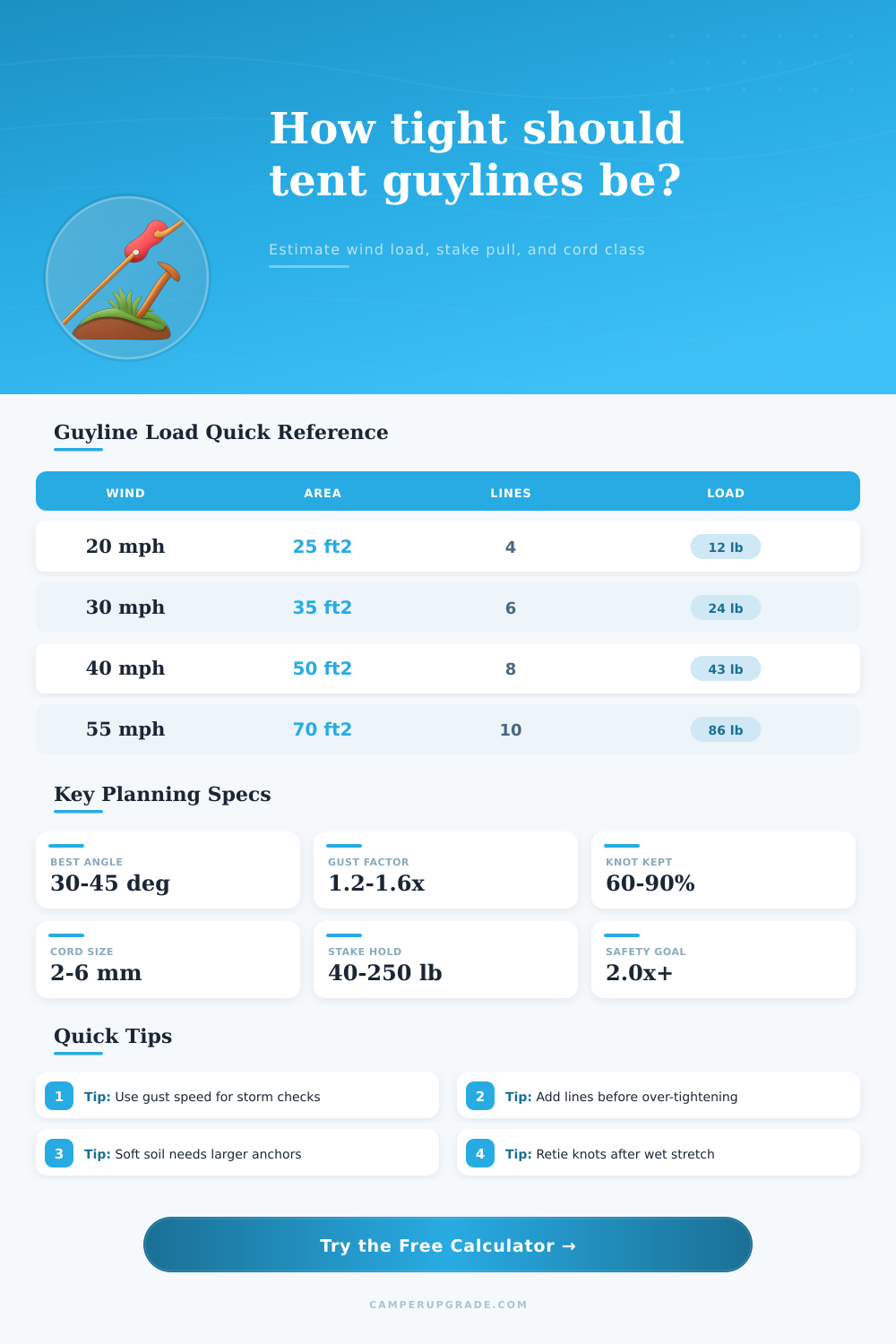
Estimate tent line tension, stake load, safety factor, and recommended cord class from wind speed, panel area, guyline angle, cord material, knot efficiency, gusts, and stretch.
Guyline load estimate
| Wind speed | Pressure before Cd | Load on 35 ft2 panel | Planning note |
|---|---|---|---|
| 15 mph | 0.58 psf | 20 lb | Light exposed camp check |
| 25 mph | 1.60 psf | 56 lb | Fresh breeze on broad panels |
| 35 mph | 3.14 psf | 110 lb | Strong gust territory |
| 45 mph | 5.18 psf | 181 lb | Many tents need storm pitch |
| 55 mph | 7.74 psf | 271 lb | Consider lowering or striking shelter |
| Guyline angle | Line multiplier | Horizontal hold | Anchor behavior |
|---|---|---|---|
| 20 deg | 1.06x | 94% | Strong outward hold with low uplift |
| 30 deg | 1.15x | 87% | Good storm balance for many tents |
| 45 deg | 1.41x | 71% | Common pitch, more upward pull |
| 60 deg | 2.00x | 50% | High tension and high stake uplift |
| Cord material | Typical stretch | Strength behavior | Best guyline use |
|---|---|---|---|
| Polyester | Low | Stable wet and in sun | Most tent and tarp guylines |
| Nylon | Medium-high | Absorbs shock, stretches wet | Windy loads with retensioning |
| HMPE / Dyneema | Very low | High strength, little give | Ultralight lines with good knots |
| Paracord | Medium | Useful, but knot bulk matters | General camp backup cord |
| Polypropylene | Medium | Floats, weaker under UV | Temporary fair-weather lines |
| Safety factor | Interpretation | Action | Typical cause |
|---|---|---|---|
| Under 1.0x | Over limit | Do not use this setup | Too few lines or weak anchors |
| 1.0x to 1.5x | Thin reserve | Add anchors or reduce exposure | Storm gusts, high angle |
| 1.5x to 2.5x | Usable planning range | Inspect and retension often | Normal exposed pitch |
| 2.5x or more | Healthy reserve | Monitor weather changes | Good anchors and enough lines |
When the wind move a tent, the wind is pushing against the tent’s fabric. The fabric pulls on the guylines, and the guylines are transferring the force of the wind into the ground through the stakes or deadmen. The calculator can calculate the math behind these forces.
The calculator takes into account the wind speed, the area of the tent panels, the angle of the guylines, and the details of the cords to calculate the total tension on each guyline, the total load on the stake, and a safety factor based on the strength of the cords or stakes. These calculations allows for individuals to avoid guesswork when setting up the tent. Each of the inputs into the calculator have a specific meaning in the context of a tent site.
How Wind Affects Tent Guylines and Stakes
The wind speed is the rate at which the wind is moving. A gust factor is used to calculate the impact of brief periods of increased wind speeds on the tent. A gust factor of 1.3 is common in areas that experience strong winds, but a factor of 1.5 is generally used when the wind is expected to include isolated gusts.
The area of the tent panels is the total area of the tent that is exposed to the wind. The sides and the tent ends is an important part of the total area of the tent panels. The angle of the guylines affects the amount of tension in the lines.
A shallow angle means that there is more tension in the guyline, but a steeper angle means that the tension is reduced. The diameter of the guy line is used to calculate the strength of the cord, and the efficiency of the knot is used to calculate the breaking strength of that cord after it is tied into the guyline. The outputs of the calculator help to answer specific questions about the tent setup.
The line tension is the force that each guyline will experience based on the entered wind speed. The stake load is the total amount of force that the stake will experience, which is the result of both the horizontal component of the guyline tension and the vertical component of that tension. The safety factor is the ratio of the stake load to the weaker of the cord or stake.
Safety factors under 1.5 indicates that the tent is close to the limit of it’s setup, but factors above 2.5 indicate that there is a safety margin before the tent will fail. Tent campers can use the recommended cord class to ensure that there current cord is appropriate for the calculated load. Each of the variables can be further adjusted to take into account the specific environment in which the tent will be erected.
If the soil is soft, the stake holding power will be lower. A lower stake holding power will result in a lower safety factor. If the cords that are to be used for the tent guylines are Dyneema, the knot efficiency will need to be raised because Dyneema cords tend to hold more of their strength when tied into a knot.
If the tent panels contain mesh panels, the drag coefficient will drop and the total load on the tent will decrease due to the mesh allowing the wind to pass through the tent fabric. The angle that the guylines will form with the tent is a major factor in how the tent will perform when encountering the wind. Angles of 30 degrees are often suggested for the guylines.
Reducing the angle to 20 degrees will increase the tension in the guyline only slight, but the stakes will be required to fight the force that exists in the guylines in almost entirely horizontal directions which is helpful for those camping on sandy ground. Angles of 45 degrees will result in an increase in the uplift force that acts against the stakes, which can lead to longer stakes or deadmen to support the tent. The type of cord that is to be used for the tent will affect how the tent reacts to the wind.
Polyester cords do not change their strength when wet and are able to maintain their strength when exposed to tension. For these reasons, many tent makers use polyester. Nylon has a higher stretch than polyester but absorbs gusts in the wind.
The stretch of nylon lines, however, will cause the tent fly to move in and out of the tent if the lines are not retightened. HMPE lines have a higher strength for their diameter but have less stretch than nylon. This means that any load placed upon the tent will be directly transmitted to the stakes.
A short length of shock cord can be placed into an HMPE line to allow the line to move slightly without the shelter moving. The holding power that is provided by the stakes will vary at different camp sites. A Y-shaped tent stake will hold ninety pounds when placed in firm soil.
However, it may hold less than forty pounds when placed in sand. Deadmen and snow pickets depend on the area of the buried object to provide the holding power for the tent. These values can be manipulated with the calculator to allow campers to understand if the anchor points are a potential limiting factor for the tent or if the cords are the limiting factor.
Many people tend to make mistakes when setting up there tents. For instance, people may tighten one of the guylines until it is very tight but the stake on the opposite side of the tent may not be able to handle the load. Another common mistake is to count the number of guylines on the tent but to not consider that only the windward guylines will be under tension.
If only half of the tent guylines are designed to absorb the wind load, the safety factor will drop. It is better to add lines than to try to create one line that can absorb more load than the tent was designed to handle. In addition to these setup mistakes, the effects of wetting the tent and the UV exposure to the tent lines should also be considered.
For instance, four percent stretch in the cord is common when the tent is dry. However, after being exposed to the sun for a period of time the stretch can be eight percent. This additional stretch allows the tent to move further before the guy lines pick up the load.
The movement can lead to fatigue of the tent fabric and guyline knots. Therefore, the tension should of been checked after the first rain and after a week of being exposed to the sun. The reference tables help to display the relationship between wind speed, wind pressure, and load.
These tables allow campers to determine if the tent setup needs to be erected with extra guylines or with a lower tent profile. The tables show how changing the angle of the guylines will change the tension and the uplift of each guyline which can help campers to determine if they need to add one guyline or move one of the existing guylines. These reference tables will allow campers to understand which factor will fail first so that a safety margin can be established before the arrival of the wind.