Tent Groundsheet Size Calculator
Size a tent footprint that tucks inside the floor edge, then estimate cut dimensions, roll length, panel seams, stake points, coverage area, and finished packed weight.
| Groundsheet material | Approx fabric weight | Typical roll width | Best use case |
|---|---|---|---|
| Polycro window film | 0.55 oz per sq yd | 60 in | Ultralight backpacking, low abrasion sites |
| Dyneema composite | 0.8 oz per sq yd | 54 in | Premium ultralight footprints |
| Silnylon | 1.3 oz per sq yd | 60 in | Light packable tent floors |
| Tyvek HomeWrap | 1.85 oz per sq yd | 60 in | Durable DIY backpacking and touring sheets |
| PU coated polyester | 2.2 oz per sq yd | 58 in | General camping footprints |
| 210D ripstop nylon | 3.0 oz per sq yd | 60 in | Rockier campgrounds and repeated use |
| 420D Oxford polyester | 3.6 oz per sq yd | 58 in | Cabin tents, awning floors, car camping |
| Cotton canvas | 10.0 oz per sq yd | 72 in | Heavy bell tents and long base camps |
| Tent floor style | Suggested inset | Why it matters | Use caution when |
|---|---|---|---|
| Small backpacking rectangle | 1.5-2 in each edge | Keeps film light and hidden under floor | The tent has sharply rounded corners |
| Tapered backpacking floor | 2 in each edge | Matches the narrowing rear floor better | The foot end is already very narrow |
| Family cabin tent | 3-4 in each edge | Reduces exposed groundsheet during rain | The floor corners pull tightly to stakes |
| Round bell tent | 3-6 in on diameter | Prevents a visible fabric ring outside wall | The wall skirt needs its own cover |
| Hex shelter nest | 2-3 in flat-to-flat | Fits inside angled walls and pole edges | Doors need a separate entry mat |
| Rooftop tent mattress base | 0.5-1 in each edge | Interior liners can fit closer than ground sheets | Fabric bunching would affect hinges |
| Cut width compared with roll | Panel count | Seam effect | Buying note |
|---|---|---|---|
| Cut width fits roll width | 1 panel | No center seam needed | Buy the cut length plus margin |
| Cut width up to about 2 rolls | 2 panels | One full length seam | Buy two cut lengths plus margin |
| Cut width up to about 3 rolls | 3 panels | Two long seams | Useful for big cabin tent floors |
| Round or hex footprint | Based on bounding width | Trimmed corners create offcuts | Use extra margin for shaped cuts |
| Fabric has a narrow usable edge | May increase | Selvage can reduce usable panel width | Subtract seam overlap from each panel |
| Camping setup | Typical tent floor | Footprint after inset | Good material match |
|---|---|---|---|
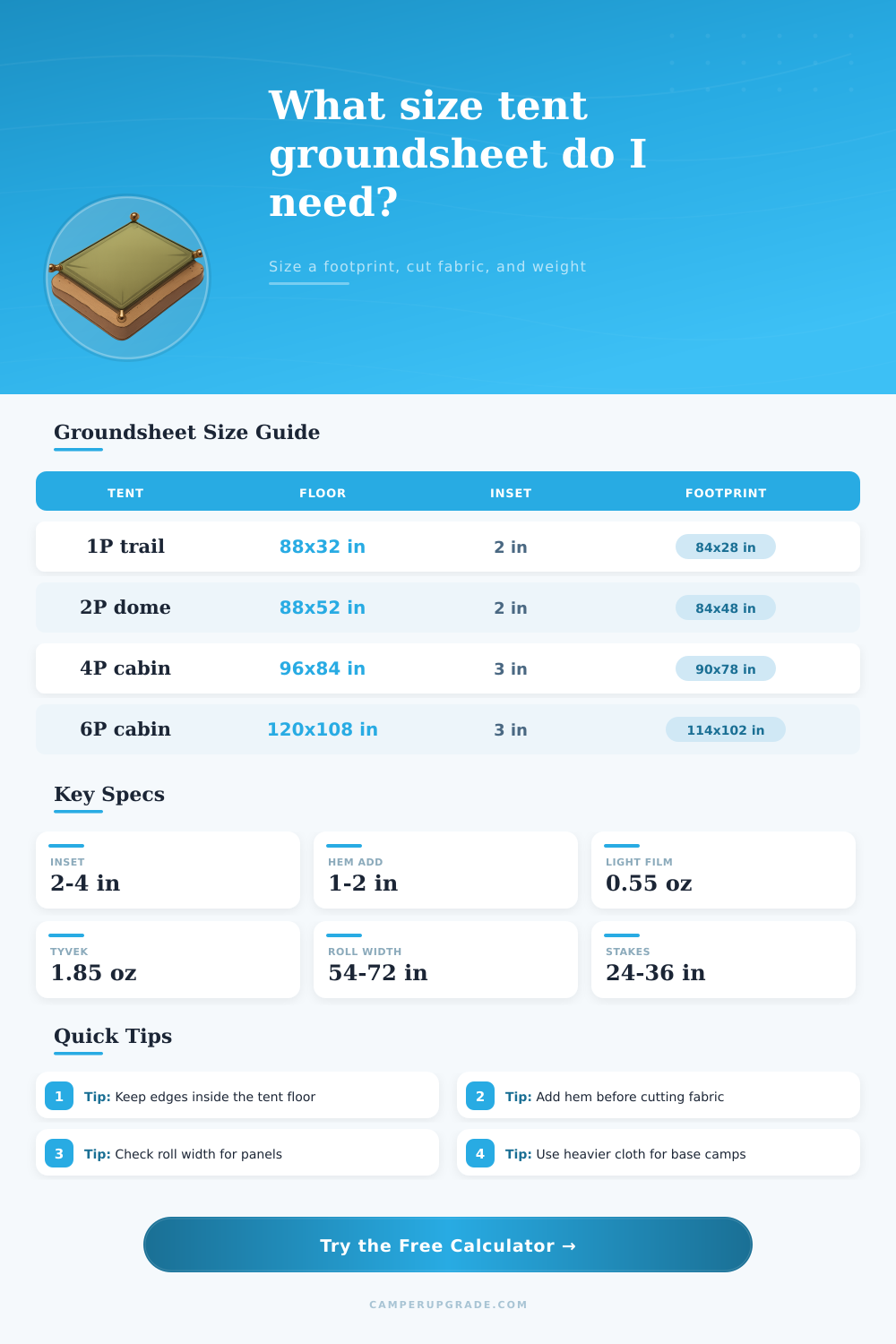
| 1P trail tent | 88 x 32 in | 84 x 28 in with 2 in inset | Polycro or Dyneema |
| 2P backpacking tent | 88 x 52 in | 84 x 48 in with 2 in inset | Silnylon or Tyvek |
| 3P dome tent | 90 x 72 in | 85 x 67 in with 2.5 in inset | PU polyester |
| 4P cabin tent | 96 x 84 in | 90 x 78 in with 3 in inset | Oxford polyester |
| 6P family cabin | 120 x 108 in | 114 x 102 in with 3 in inset | Oxford polyester |
| 13 ft bell tent | 156 in round | 148 in round with 4 in inset | Canvas or heavy polyester |
A groundsheet is a piece of fabric that sits underneath a tent. The groundsheet should be smaller than the tent’s floor area to prevent water from entering the tent. When it rain, water flows from the tent flysheet down the tent walls and lands on the ground.
For this reason, you must tuck the groundsheet into the tent walls so that the water flow away from the tent. If a groundsheet is too large relative to the tent floor area, the water will fall onto the groundsheet and flow into the tent. The calculator help you determine the size of the finished groundsheet footprint so that it remains inside the tent and dont allow water to enter the tent.
How to use the groundsheet calculator
Additionally, the calculator include the hem allowance in the calculation of the size of the groundsheet. You dont have to calculate the hem allowance of the groundsheet yourself. The inset allow you to set the distance between the groundsheet and the tent walls.
For backpacking tents, many people use a two inch inset. This provides a good amount of space for the groundsheet to be tucked into the tent walls. For large family cabin tents, the inset may be three or four inches.
These tents often have walls that are farther apart from one another. Additionally, the tent may allow for rain to pool between the tent walls. The hem allowance is the amount of fabric that is folded under the groundsheet to prevent the edge of the groundsheet from fraying.
This do not impact the finished size of the groundsheet. However, it does impact the way in which the fabric is sewn together or otherwise taped to the groundsheet. If the groundsheet is wider than the width of the fabric roll on which the groundsheet will be purchased, the groundsheet will require multiple panel of fabric.
Many fabric rolls is 60 inches in width. A two person tent can be covered with a single 60-inch wide panel of fabric. However, a large cabin tent may require two or three panels.
The calculator accounts for the width of the seam overlap between the panels of groundsheet fabric. Every seam in the groundsheet requires the overlap of the edges of the panels of fabric. The type of fabric of which the groundsheet is made impacts the weight of the groundsheet.
Additionally, the seams add to the weight of the groundsheet. Light films of groundsheet fabric may weigh less than half an ounce per square yard. Heavier fabrics that contain coating will weigh more then half an ounce per square yard.
The number of panels of fabric that are used for the groundsheet will add to the weight of the groundsheet. Stake loops are small metal pieces that are used to secure the groundsheet. The setting for the stake loop spacing in the calculator allow a person to determine where the person will place the stake loops around the perimeter of the groundsheet.
If the tent that will be using the groundsheet is a simple rectangular tent, the stake loops can be placed only at the corners of the groundsheet. For round or hexagonal tents, stake loops should be even around the entire perimeter of the groundsheet. The calculator will output the perimeter of the groundsheet and the estimated number of stake loops that will be required for the groundsheet.
These two values will allow a person to make a decision about whether the groundsheet will remain in place when the tent is tensioned. The buying margin is the amount of groundsheet that will be purchased in addition to the amount that the calculator calculates. An eight percent buying margin provides enough extra fabric to allow for errors in cutting the groundsheet.
If the tent that will be using the groundsheet has a shaped floor or if the person is creating the groundsheet for the first time, more fabric may be purchased than eight percent of the amount that the calculator calculates. A shaped groundsheet will produce offcuts of fabric that will not be able to be used for any other part of the groundsheet project. A higher buying margin will provide extra fabric for this scenario.
The person that is making the groundsheet includes the buying margin in the total length of the roll of fabric that will be purchased. Thus, the person will not have to calculate this value when he or she is at the fabric store. A groundsheet project is successful if the person makes the correct decision regarding the inset, the hem allowance, and the seam overlap.
These three values will impact the way that the tent drains water, how flat the groundsheet will lie when set on the ground, and the weight of the groundsheet. By utilizing the calculator to make the decisions for the project, the person will have a straightforward project in creating the groundsheet. Additionally, the person will complete the project so that there will be no need to make corrections to the project while utilizing the tent along the trail.