Tent Footprint To Tent Ratio Calculator
Compare your groundsheet or tent footprint to the actual tent floor, rainfly drip line, tuck margin, shape taper, material weight, and wet-weather runoff risk.
This calculator is a planning aid. Always check the tent maker's footprint notes when the fly, poles, or vestibules depend on a specific corner geometry.
Your footprint fit result
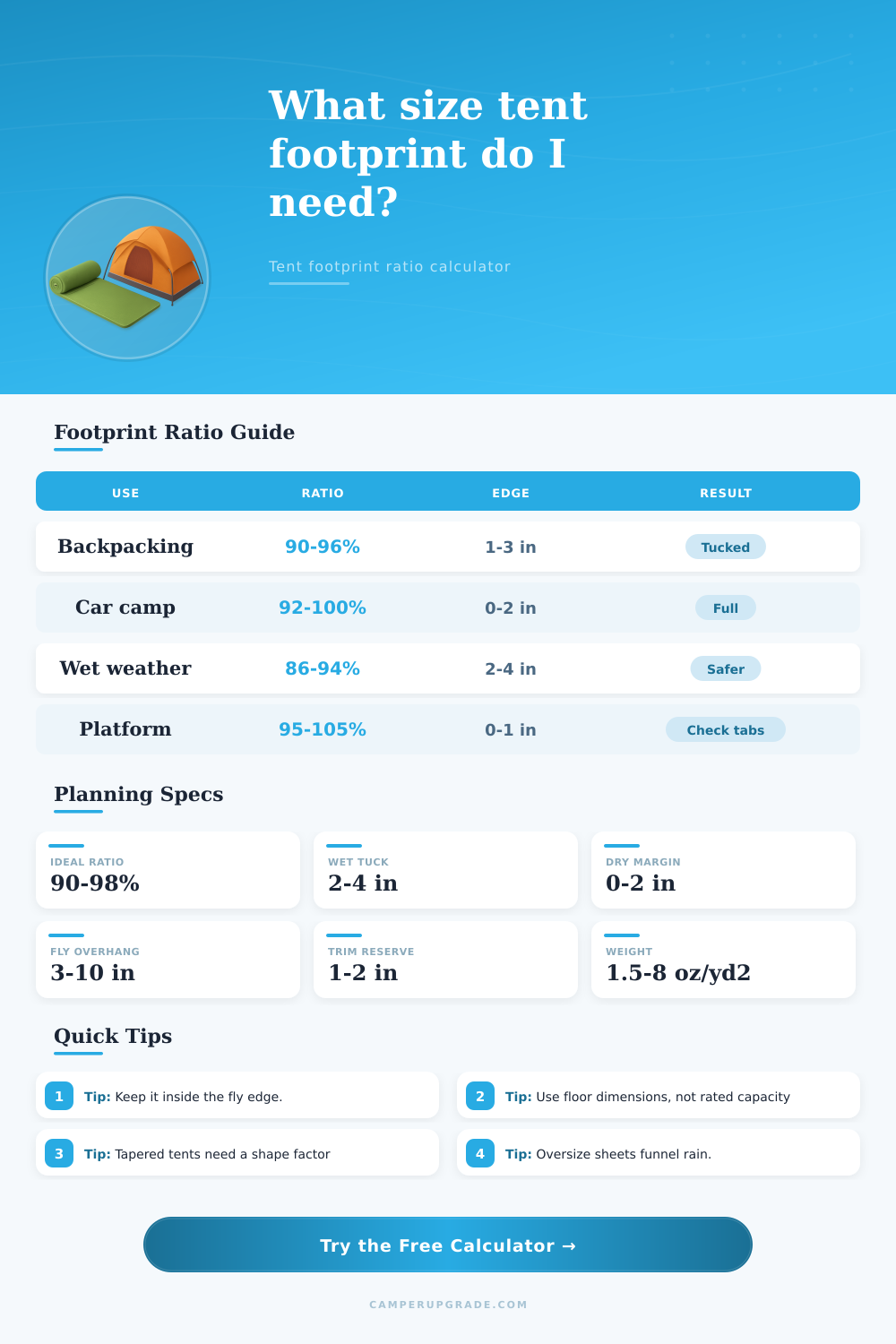
| Footprint result | Approximate ratio | Typical edge position | Best use | Watch for |
|---|---|---|---|---|
| Minimal underbody sheet | 70-84% | 4+ inches inside | Ultralight trips, dry camps, floor abrasion at key zones | Uncovered corners, muddy vestibule kneeling spots |
| Wet-weather safe tuck | 85-94% | 2-4 inches inside | Rainy forecasts, bathtub floors, splashy campsites | Too much exposed floor on rocky ground |
| Balanced footprint | 90-98% | 1-3 inches inside | Most three-season tents and OEM-style footprints | Different taper between tent and sheet |
| Full floor coverage | 99-105% | Flush to slightly proud | Dry car camping, platforms, shaped OEM clips | Rainwater wicking if edges are exposed |
| Oversized groundsheet | 106%+ | Sticks outside floor | Vestibule mat, porch tarp, snow base when folded back | Funneling runoff under the tent floor |
In bad weather, footprint selection will determine your comfort level on a trip. You want the footprint to be big enough so that sheet isn’t rubbing against the tent body (abrasion). But you don’t want the footprint too big either or water collects on edges and runs under the tent. The balance between those two problems is what the ratio actualy measures.
The balance is what they call the Ratio. To keep it off of drip line, a footprint that sit a couple of inches inside the tent floor on every side helps keep material out of reach. That’s important because the material itself protect where you kneel and sleep. Any plastic that extend past the fly becomes a gutter-like surface when it rains hard. Then all that water runs directly to seam edges.
Why Footprint Size Matters
So, just input your floor dimensions, the shape factor that accounts for taper, and the desired amount of sheet tucking inward and the calculator do the rest, telling you if you have enough margin or are creating an exposed edge. You also need to consider other factors, because campsites aren’t usually flat and real tent aren’t perfect rectangles. They has tub floors that rise up around the edges. You want to give a bit more of an undercut on footprint to ensure that it doesn’t ride up against the sides. Backpacking tents taper, shedding area at one end (the foot), so that a rectangular tarp with identical length and width will cover less usable space then those dimensions indicate. The tool adjust for these things without requiring you to do geometry yourself.
And then there’s what material to choose, which feeds back into that decision. Puncture resistant fabric (like this) will be heavier. It will hold up better on gravel and stay in place in the wind. However, it will be harder to transport and harder to trim down if it’s too big for your needs. On the other hand, lighter-weight sheeting (like this) is simpler to manage and also simpler to trim down if needed. But it won’t last as long on rock or offer as much protection from sharp objects found on gravel.
The calculator also let you pick the material of your groundsheet. It calculates an estimated weight immediately so you can weigh the pros and cons before cutting.
If you go camping in the rain for the first time and get wet, many people learns this lesson the hard way. A lot of them pitch a low quality blue tarp that’s as large as the tent itself and stake it out flat. They then find themselves waking up to puddles under any part of the tarp where the tent fly overlaps the plastic. In most cases, the fix is rarely a bigger sheet. It is usually a smaller one, centered properly and allowed to sit slightly inside floor edge so water runs past rather than pooling against the tent. It should of been properly centered and just barely inside the floor edge so water runs off instead of pooling up against the tent.
Same goes for snow and platforms: A close-to-straight line between the tent corners is rewarded by fixed anchor points on a deck. Similarly, a winter groundsheet help a lot if it lies almost flat, as it allows the tent floor to sit completely on the insulating layer. The ratio will tell you if current size fits your intended use or not.
After you know what the ratio refers to in real life terms, it isn’t a guessing game anymore. Measure your floor one time, factor in the shape of your space and how much you want to tuck, and it’s downhill from there. Essentially, try to keep the sleeping surface off the ground and protected while not making any other way for water to get to it. That seems pretty straightforward.