⛺ Tent Ballast Calculator
Calculate the exact anchor weight needed to secure your tent or canopy against wind. Enter your tent dimensions, expected wind speed, and surface type for instant safety results.
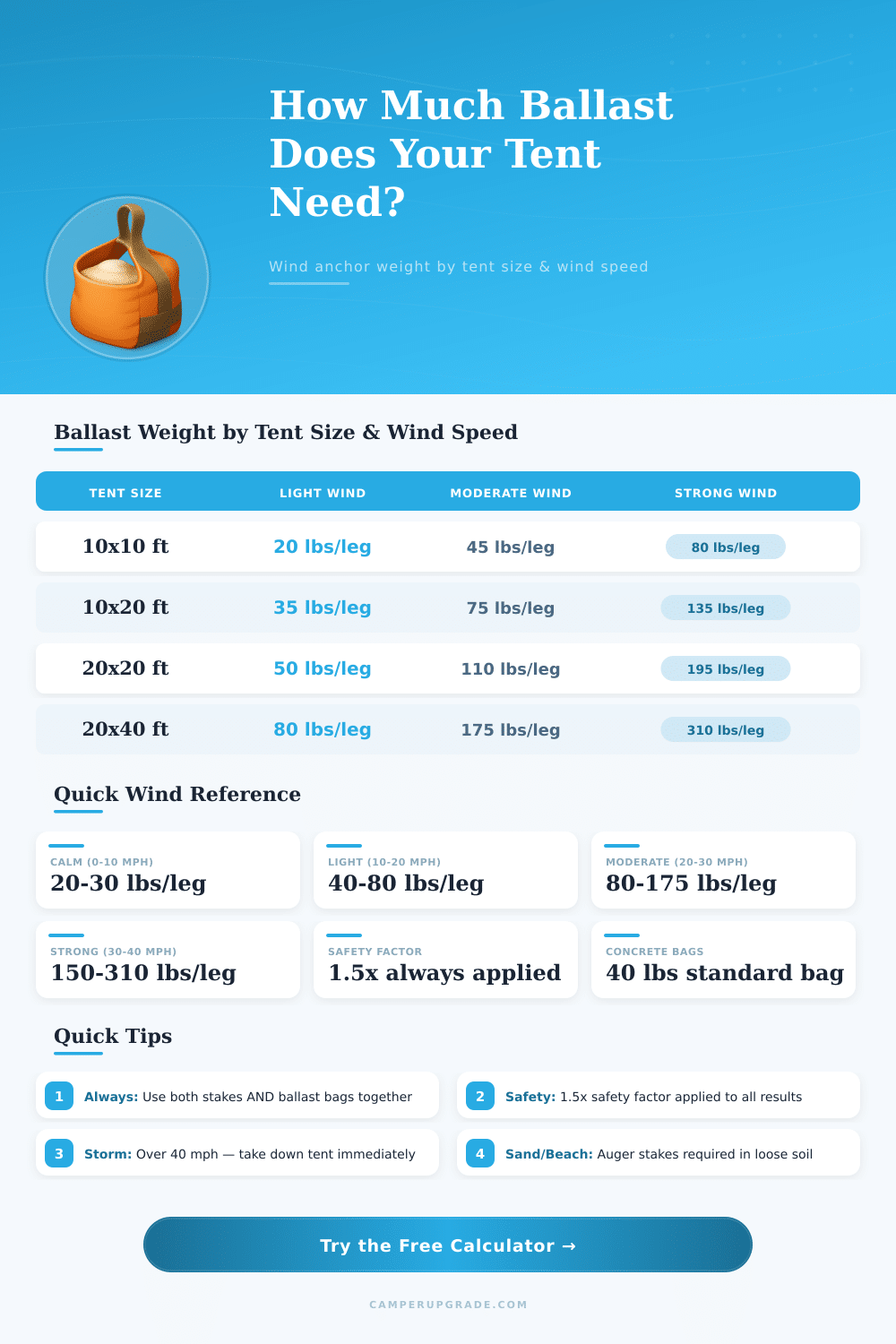
| Tent Size | Calm (5 mph) | Light (15 mph) | Moderate (25 mph) | Strong (35 mph) |
|---|---|---|---|---|
| 10x10 ft | 10 lbs/leg | 35 lbs/leg | 65 lbs/leg | 130 lbs/leg |
| 10x20 ft | 18 lbs/leg | 60 lbs/leg | 115 lbs/leg | 225 lbs/leg |
| 20x20 ft | 25 lbs/leg | 85 lbs/leg | 160 lbs/leg | 320 lbs/leg |
| 20x40 ft | 40 lbs/leg | 140 lbs/leg | 265 lbs/leg | 530 lbs/leg |
| 40x60 ft | 90 lbs/leg | 310 lbs/leg | 590 lbs/leg | 1180 lbs/leg |
| Surface | Primary Anchor | Backup Anchor | Notes |
|---|---|---|---|
| Concrete | Concrete ballast bags | Water weight barrels | No stakes possible — 100% ballast |
| Asphalt | Ballast bags + auger | Water weight | Avoid heavy stakes; use weighted bases |
| Grass | Ground stakes (18-24 in) | Ballast bags | Best penetration; combine both methods |
| Dirt / Compacted | Ground stakes (24-36 in) | Ballast bags | Drive stakes at 45-degree angle |
| Sand / Loose | Auger screw stakes | Ballast bags (heavy) | Needs 3-4 ft auger; add 50% more ballast |
Tent ballast is basically the solution for keeping a tent in place when you can not put stakes in the ground. Instead of trust in traditional anchoring, one binds heavy objects around the edge of the tent to press it down. Those weights can be concrete blocks or other strong materials that do the task.
It sounds quite simple but actually exist many nuances about that
How to Keep a Tent in Place Without Stakes
Concrete blocks are probably the most common choice for ballast. They have various weights depending on what you want to anchor. In the lighter part, you will find blocks of around 350 pounds; those work best for hard surfaces when you anchor tent.
Next are the heavier: blocks of 500 pounds are designed specifically for frame tents that must be pressed down. Moreover, custom concrete blocks can weigh between 500 and 5,000 pounds. Here is the clever part; special plates allow you to stack four to eight blocks together in one massive unit, reaching about 5,200 pounds total, and you can move it without neeeding heavy machinery.
Water barrels are another common choice for tent ballast. Filling one barrel gives you around 660 pounds. Laying one at each of the four corners, you get more than enough weight for anchor canopy properly and resist the wind.
For frame tents especially, having a good ballasting system is not a choice (it is a knead).
Cast steel stabilizing weights offer another way. They sit directly on the feet of the tent and are a solid solution to keep the structure without using any stakes. In many cities, companies that rent ballast install those for events on concrete or roofs where putting stakes is not possible.
Those rental systems give reliable support for event structures and stop the tents from moving or falling when the wind picks up.
Actually, staking directly in the ground stays the safest method. That is made of hammering iron spikes deep in the soil. When staking is not possible, water barrels or concrete blocks become your back-up plan.
You can even buy special ballasting plates with footplates that match the weight of a filled water barrel.
The right choice of ballast depends on several factors. Consider the nearby buildings, the size of your tent and the kind of surface you work on. The positions at the corners are important, ballasts should sit at all four corners, although extra anchor spots are entirely reasonable if the conditions require that.
Online calculators can help determine the proper resistance and the details for your setup. These tools consider the friction between different surfaces, dry asphalt, wet asphalt, smooth or rough concrete, grass, dirt and stones. Having thesedetails right, you will keep everyone at your event safe.