Temperature to Clo Calculator
Estimate outdoor clothing insulation from temperature, wind, moisture, shelter, sun, activity level, exposure time, and safety margin for camping and trail use.
🌡Real Outdoor Presets
⚙Conditions and Activity
🧥Material and Layer Comparison
📊Reference Tables
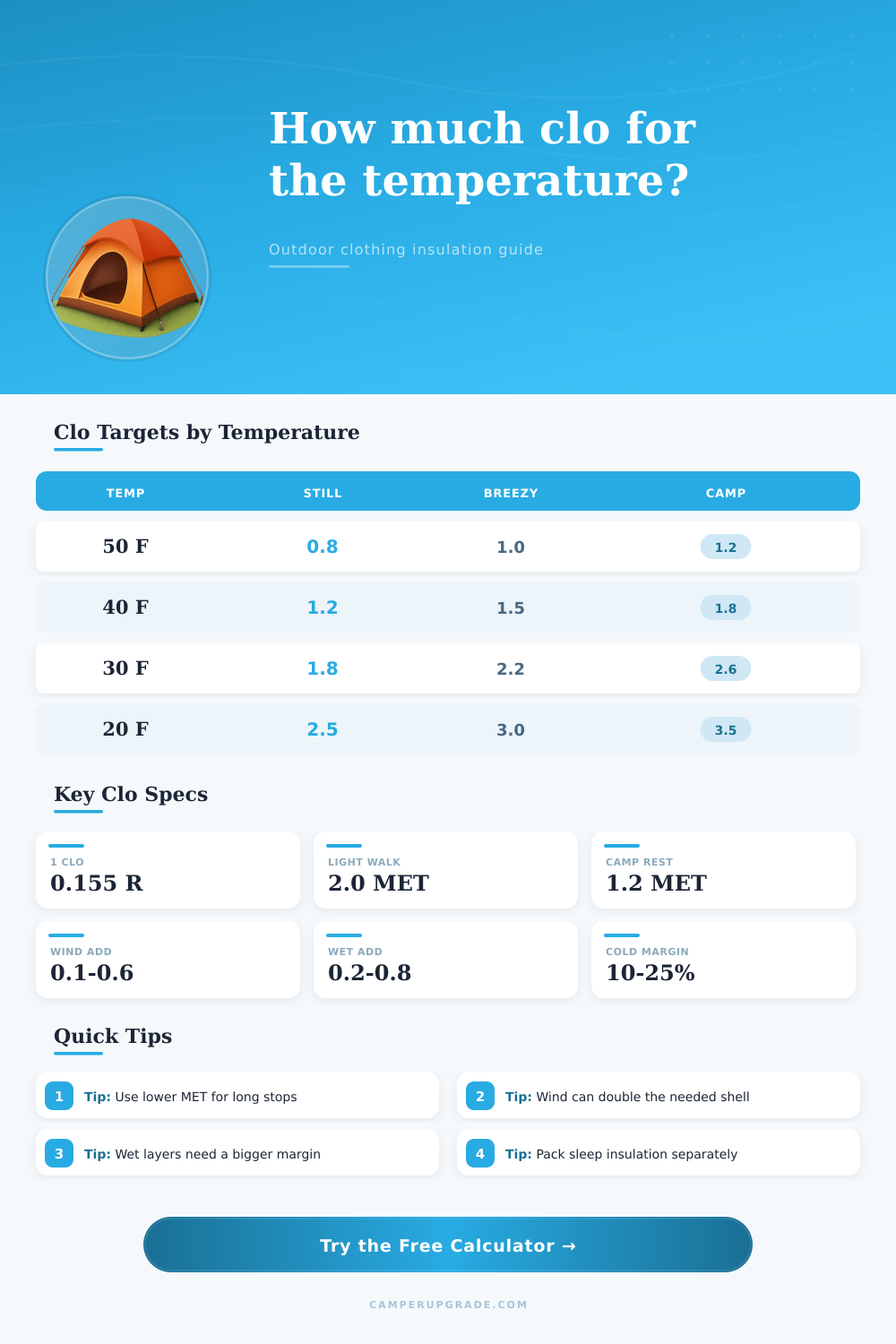
| Air Temperature | Easy Hiking | Standing Camp Chores | Mostly Still Rest |
|---|---|---|---|
| 50°F / 10°C | 0.4–0.7 clo | 0.8–1.1 clo | 1.1–1.4 clo |
| 40°F / 4°C | 0.7–1.1 clo | 1.2–1.7 clo | 1.7–2.2 clo |
| 30°F / -1°C | 1.0–1.5 clo | 1.8–2.4 clo | 2.4–3.1 clo |
| 20°F / -7°C | 1.4–2.0 clo | 2.5–3.2 clo | 3.3–4.1 clo |
| 10°F / -12°C | 1.9–2.6 clo | 3.2–4.0 clo | 4.2–5.1 clo |
| Garment or Layer | Typical Clo | Best Use | Moisture Note |
|---|---|---|---|
| Light synthetic base layer | 0.06–0.10 | Sweaty movement | Dries quickly |
| Midweight merino top | 0.12–0.20 | Cool camp starts | Warm when damp, slow drying |
| 100 to 200 weight fleece | 0.20–0.40 | Active insulation | Handles moisture well |
| Light synthetic puffy | 0.45–0.70 | Wet shoulder season | Less collapse when damp |
| Down sweater or belay jacket | 0.55–1.20 | Dry cold stops | Protect from rain and sweat |
| Waterproof breathable shell | 0.03–0.08 | Wind and rain blocking | Stops convective loss |
| Wind at 30°F / -1°C | Approx Wind Chill | Added Clo Need | Practical Response |
|---|---|---|---|
| 0 mph / 0 km/h | 30°F / -1°C | 0.0 clo | Normal insulation target |
| 5 mph / 8 km/h | 25°F / -4°C | 0.2–0.3 clo | Add shell or vest |
| 10 mph / 16 km/h | 21°F / -6°C | 0.4–0.6 clo | Shell plus warmer hat |
| 20 mph / 32 km/h | 17°F / -8°C | 0.7–1.0 clo | Full wind block and puffy |
| 30 mph / 48 km/h | 15°F / -9°C | 1.0–1.3 clo | Limit exposure time |
| Camping Scenario | Typical MET | Clo Planning Range | Example Layer Stack |
|---|---|---|---|
| Cooking or coffee outside RV | 1.2 | 1.0–2.0 clo | Base, fleece, shell, hat |
| Long glassing or fishing stop | 0.9 | 2.0–4.5 clo | Base, puffy, insulated pants |
| Easy hiking with daypack | 2.4 | 0.4–1.8 clo | Base, grid fleece, wind shell |
| Snow camp chores | 1.6 | 2.0–3.8 clo | Base, fleece, parka, shell pants |
| Dry desert stargazing | 1.0 | 1.5–3.5 clo | Warm hat, puffy, gloves, dry socks |
💡Calculation Tips
Clothing insulation are measured by a unit called clo. The clo is an measurement of the thermal resistance that clothing provide to prevent heat from you body from escaping into an air. Most individuals understands that when they feel cold, they should wear more layer of clothing, and when they feel warm, they should wear fewer clothing.
However, this process will cause individual to feel either too warm or too cold due to the inability of clothing to generate heat; only the metabolism of the body produce heat. Clothing act as a barrier to retain the heat that the body produces, thus acting as a dam for the bodys heat. The level of activity that an individual perform will impact the amount of clothing insulation that they requires.
How to Dress to Stay Warm
When an individual performs high level of physical activity, such as hiking, the body produces a great deal of heat, and less clothing insulation (clo value) are required. However, when an individual performs little activity, such as while resting at a campsite, the body produce little heat, and a higher clo value of insulation are required. Most individuals makes the mistake of attempting to layer clothing according to the average air temperature throughout the day.
However, clothing should be layer according to the coldest portion of the activity. If an individual layers clothing for high levels of activity, they will feel cold as soon as they cease performing those activity. Environmental factor will impact an individual’s clothing insulation requirements.
For instance, wind will strip away thin layer of air that surrounds the body and will remove heat from the body at a higher rate then still air. Wearing a wind shell does not add much clo value to an individual’s clothing, but it will protect the insulation of the clothing that they is wearing. Additionally, moisture will impact clothing insulation.
If the base layer of clothing become damp from sweat or mist in the air, the air pockets within the clothing will collapses. Water conducts heat away from the body at a higher rate then air does, so the body will lose more heat to damp clothing. To combat this, individuals will have to use more clothing insulation to retain there body heat.
The human body element will impact clothing insulation requirements. Some individuals has lower body temperature than others. Some individuals will feel cold more easy than others, and some will feel warm more easy.
Because of this element of unpredictability, it is essential for individuals to wear a safety margin within their clothing plan. A safety margin will provide extra insulation for ten or twenty percent of clothing insulation compared to the amount that they typical wear. This safety margin will ensure that individuals does not lose too much heat from their bodies if the wind should pick up or if they become still for extended period of time.
It is always better for an individual to wear a jacket that is slightly too warm than to little clothing insulation. Individuals should account for gap in their clothing. Gaps in the clothing allow heat to escape from the extremities of the body.
Wearing a heavy parka does not necessarily prevent heat loss if an individual dont wear a hat or gloves. Proper clothing insulation for the body will ensure that the clothing retain the bodys heat and prevents the body from losing heat to the environment. Finally, individuals can use a clothing insulation calculator to determine their clothing insulation needs.
Clothing insulation calculators will take into account the air temperature, the wind speed, the humidity, and the activity level of the individual that is calculating there clothing insulation needs.