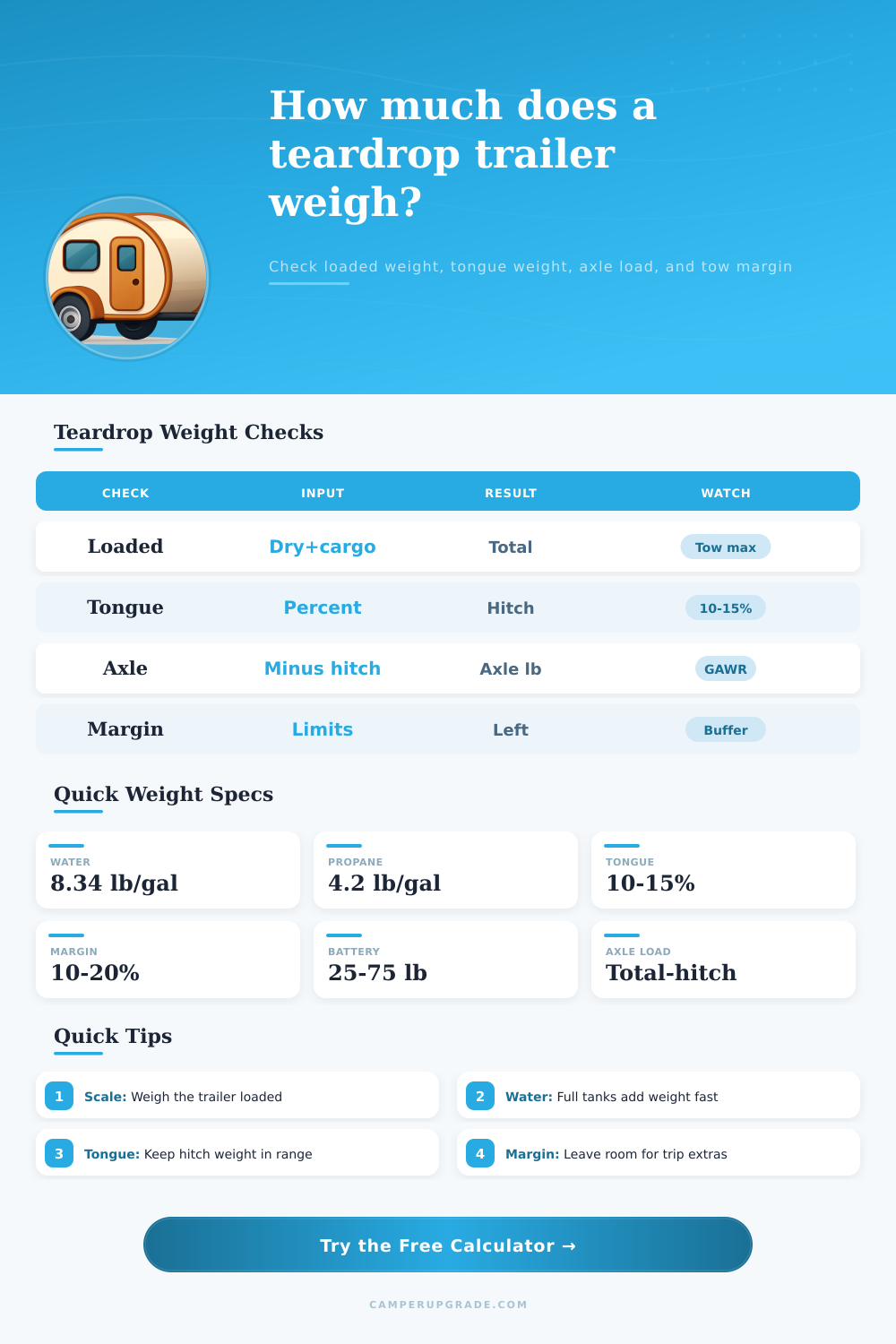
Teardrop Trailer Weight Calculator
Estimate loaded trailer weight, tongue weight, axle load, remaining payload margin, and tow margin from the items most likely to change before a teardrop trip.
| Teardrop style | Typical dry wt | Loaded range | Common axle |
|---|---|---|---|
| Ultralight micro | 500-900 lb | 750-1200 lb | 1200-2000 lb |
| Classic 5 x 8 | 900-1300 lb | 1200-1700 lb | 2000-2200 lb |
| Large 5 x 10 | 1200-1700 lb | 1600-2200 lb | 2200-3500 lb |
| Off-road model | 1500-2200 lb | 2000-3000 lb | 3500 lb |
| Galley-heavy build | 1300-1900 lb | 1800-2600 lb | 2200-3500 lb |
| Item | Typical weight | Where it rides | Effect |
|---|---|---|---|
| Water | 8.34 lb/gal | Tank or jugs | Large trip swing |
| 20 lb propane | About 37 lb full | Tongue rack | Raises hitch load |
| Group 24 AGM | 45-55 lb | Tongue box | Raises hitch load |
| 100 Ah lithium | 24-32 lb | Cabin or tongue | Lower battery load |
| Cooler and pantry | 50-140 lb | Rear galley | Can lower tongue % |
| Tongue percent | Meaning | Tow feel | Check |
|---|---|---|---|
| Under 8% | Light hitch | Sway risk | Move weight forward |
| 10-12% | Normal small trailer | Stable target | Confirm hitch rating |
| 13-15% | Firm hitch load | Often stable | Watch payload |
| Over 15% | Heavy tongue | Rear sag risk | Check vehicle payload |
| Limit check | Formula | Good sign | Warning |
|---|---|---|---|
| Loaded weight | Dry + all load | Below tow limit | Over tow rating |
| Axle load | Total - tongue | Below GAWR | Tire or axle overload |
| Tongue load | Total x percent | 10-15% | Payload squeeze |
| Safety margin | Limit x reserve | Positive margin | No spare capacity |
Actual ratings depend on the trailer certification label, tire load rating, hitch rating, vehicle payload sticker, and tow vehicle manual. Use real scale weights before towing near a limit.
Teardrop trailers is often considered to be light and easy tow. However, the weight of the teardrop trailer may be more than you expect. When you look at a teardrop trailer, you might think that it is very lightly.
However, once you add all of the cargo items to the teardrop trailer, such as water, propane, battery, and cooking supplies, the trailer will be much heavier. The calculator include on this page will help you to calculate the total weight of your teardrop trailer. This calculator incorporates all of the information that you enters into the calculator.
How to Calculate Your Teardrop Trailer Weight and Balance
The dry weight of your trailer is the weight of the teardrop trailer when it is empty. In addition to this weight, you will also have to enter the weight of the cargo that you plan to include in your trailer. The loaded weight of your trailer is the total of these two differents weights.
This loaded weight can be divided into two different category: tongue weight and axle load. Tongue weight is the amount of weight of the trailer that is resting on the hitch of your tow vehicle. This weight is important to understand, as different amount of tongue weight can cause different driving experiences with your trailer.
For instance, if the tongue weight is too low, your trailer may begin to sway behind your towing vehicle. Additionally, if the tongue weight is too high, it may push the front tire of your tow vehicle closer to the ground with less contact with the road. Builders of trailers typically recommend that the tongue weight is between 10% and 15% of the loaded weight of your trailer.
This calculator will help you to understand whether or not the tongue weight of your trailer will fall into this recommended range. Axle load is the amount of weight that the axles of your trailer will have to support. Axle load can be determined by subtracting tongue weight from the loaded weight of the trailer.
Axle load will have to remain within the gross axle weight rating of the trailer. The calculator will automatically calculate the axle load of the trailer by subtracting tongue weight from the loaded weight of the trailer. It is important to leave a safety margin for axle load, as you may encounter additional cargo that you did not account for when you calculate the trailer weight.
Water is one of the heaviest forms of cargo that you can include within your trailer. One gallon of water weighs 8 1/3 pounds, so if you include many gallon of water into your trailer, the total weight will add up to a significant number of pounds. This calculator will calculate the total weight of the water that you plan to include by multiplying the number of gallons of water by 8 1/3.
Propane is another form of cargo that can add to the weight of your trailer. The propane that is included in your trailer when it is filled will weigh more than if the trailer do not have propane within it. This weight will be closer to the tongue weight of the trailer.
Batteries can have a significant effect on the total weight of the trailer as well as its balance. If you use a traditional AGM battery, it will be heavy and placed within the tongue box of the trailer. In contrast, the lithium batteries are much lighter and can be placed further into the trailer.
By placing the battery towards the back of the trailer, the tongue weight will decrease, even if the total weight of the trailer remains the same. The calculator can help you to understand how much the tongue weight will change if you change the location of the battery within the trailer. It is important to incorporate a safety margin into the calculation of your trailer’s weight.
This safety margin will account for the fact that you will subtract a percentage from your tow vehicle’s tow rating and axle load rating. A 10% safety margin is suggested for most trailers. The safety margin can be changed in the calculator to reflect if you want to have a more conservative or less conservative safety margin for the trailer.
Even with the weight calculator, you will want to weigh your trailer on a scale. The information that you enter into the calculator is an estimate of the weight of your trailer. However, a scale will provide the exact weight of your trailer.
Thus, while the trailer weight calculator may make it easier for you to determine the weight of your trailer, the scale will remain the only way to be certain as to the actual weight of the trailer. Many individuals will make mistakes when they calculate the trailer weight. One of the most common mistake is to forget items such as spare tires, sewer hoses, or leveling blocks are considered cargo.
Another of the most common mistake is to assume the dry weight of the trailer includes the battery and propane. The dry weight does not include the battery and propane. Finally, many individuals will assume that the tow rating for their tow vehicle is the only load that they must consider.
However, they must also consider the payload and tire weight limits for the tow vehicle. These mistakes will result in a negative safety margin when calculating the trailer weight with the included calculator. The tables that are included on the page will provide context to the information within the calculator.
For instance, the tables will display the total weight of different type of teardrop trailers. Additionally, the tables will display the amount of weight that each type of cargo will add to a teardrop trailer. These tables can provide an understanding of the weight of your trailer and cargo in relation to other with similar trailers.
Trailer weight and balance will impact the driving experience that you have with your trailer. For instance, the trailer may track straight when the water tank is filled. However, when the water tank is half-empty, the trailer may tend to wander.
If you place the battery towards the front of the trailer, the tongue weight will increase, and if it is placed towards the back of the trailer, the tongue weight will decrease. The tongue percentage that is displayed with the trailer weight calculator can help you to understand how to best balance your trailer to obtain the best tracking experience with your trailer. Overall, the trailer weight calculator allows you to prepare for your trip before you even leave from home.
You will need to enter the dry weight of your trailer, the weight of the water that you will have within the trailer, and the weight of the galley and cooking supplies that you will have within your trailer. The calculator will tell you whether or not the total weight of your trailer is within your tow vehicle’s tow limit. Additionally, if the weight is too great for your tow vehicle, you can always make a decision to leave some of the cargo behind.
By understanding the weight of your trailer prior to setting off on your trip, you can avoid stress during your trip with the trailer.