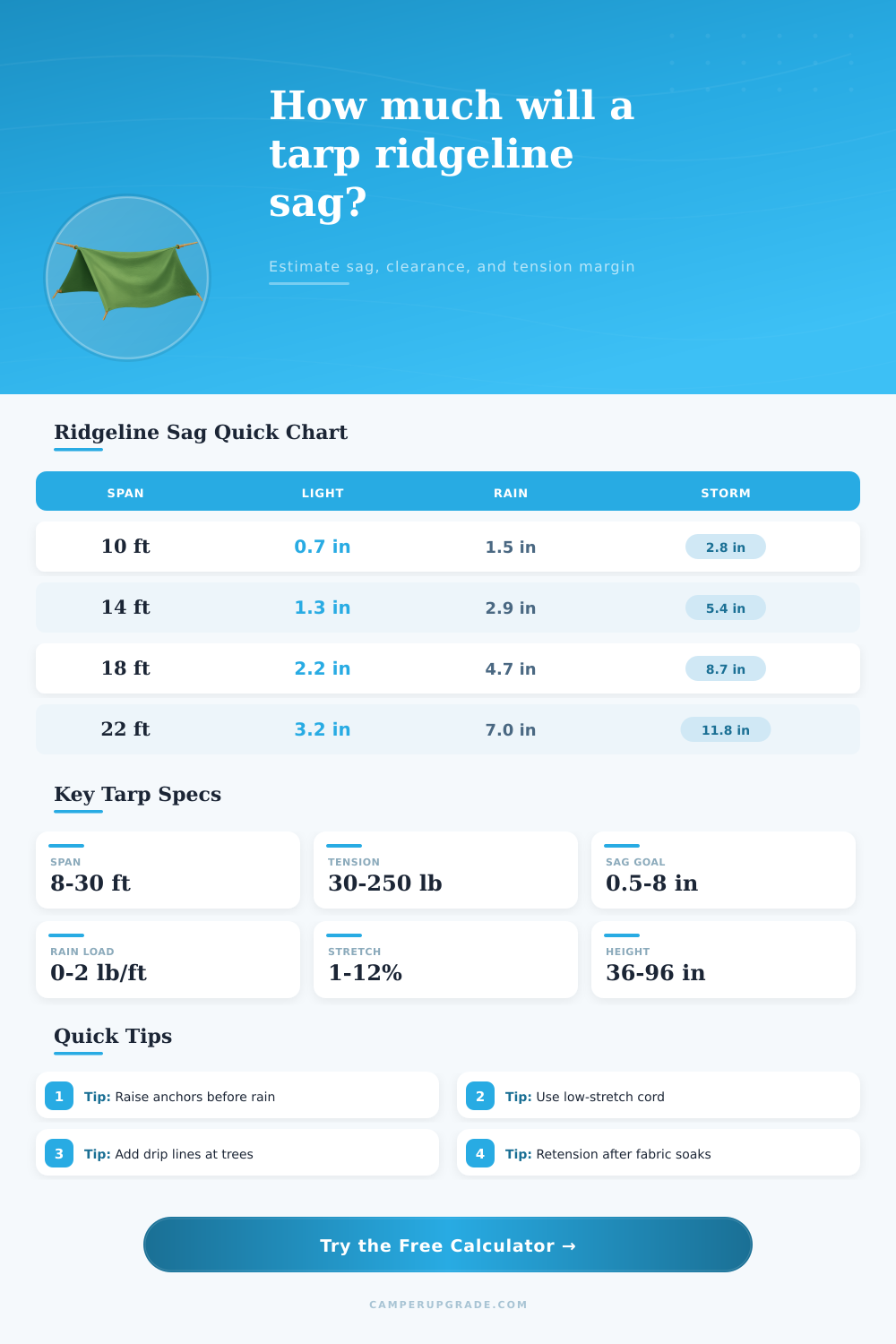
Tarp Ridgeline Sag Calculator
Estimate midpoint sag, rain-load deflection, usable clearance, and line tension margin for tarps, hammock flys, awnings, and camp kitchen pitches.
Ridgeline sag estimate
| Dry line load | 10 ft at 60 lb | 14 ft at 90 lb | 18 ft at 120 lb | 22 ft at 160 lb |
|---|---|---|---|---|
| 0.08 lb/ft ultralight tarp | 0.2 in | 0.3 in | 0.3 in | 0.4 in |
| 0.15 lb/ft silpoly tarp | 0.4 in | 0.5 in | 0.6 in | 0.7 in |
| 0.30 lb/ft wet tarp | 0.8 in | 1.0 in | 1.2 in | 1.4 in |
| 0.60 lb/ft pooled load | 1.5 in | 2.0 in | 2.4 in | 2.7 in |
| Condition | Rain load to enter | Wind load to enter | Planning note |
|---|---|---|---|
| Dry fair weather | 0.00 lb/ft | 0.03 lb/ft | Use for shade checks and calm hammock flys |
| Light steady rain | 0.08 lb/ft | 0.08 lb/ft | Good for a sloped tarp that sheds water |
| Heavy rain or wet fabric | 0.18 lb/ft | 0.12 lb/ft | Use when the tarp wets out or sags between tie-outs |
| Pooling risk | 0.45 lb/ft | 0.16 lb/ft | Raise the ridge, steepen panels, or add panel pull-outs |
| Gusty exposed pitch | 0.12 lb/ft | 0.35 lb/ft | Wind adds side pull and movement even without much rain |
| Setup | Typical span | Good starting tension | Sag target | Line choice |
|---|---|---|---|---|
| Backpacking A-frame | 10-13 ft | 50-90 lb | 1-3 in | Dyneema or polyester |
| Hammock hex tarp | 12-15 ft | 60-100 lb | 2-4 in | Reflective guyline or Dyneema |
| Camp kitchen fly | 16-24 ft | 120-220 lb | 3-6 in | Static cord or webbing |
| Vehicle awning ridge | 8-14 ft | 70-140 lb | 1-3 in | Polyester or webbing |
| Canvas shelter | 14-22 ft | 150-250 lb | 4-8 in | Static cord with strong anchors |
| Attachment height | 2 in sag | 4 in sag | 6 in sag | Best use |
|---|---|---|---|---|
| 48 in | 46 in clear | 44 in clear | 42 in clear | Low storm edge or stealth pitch |
| 60 in | 58 in clear | 56 in clear | 54 in clear | Low porch or hammock storm mode |
| 72 in | 70 in clear | 68 in clear | 66 in clear | Most standing camp tarp ridges |
| 84 in | 82 in clear | 80 in clear | 78 in clear | Kitchen tarp or tall vehicle awning |
| 96 in | 94 in clear | 92 in clear | 90 in clear | Large group fly with headroom |
Sag is an physical phenomenon that occurs when a ridgeline dip downward. Sag is a problem for tarps if the tarp begin to sag toward the ground. Sag affects the shedding of water from the tarp, and it affect the headroom for individuals underneath the tarp.
If individuals does not account for sag, the center of the tarp may hang lower than the objects beneath the tarp. To avoid sag reducing the headroom for individuals underneath the tarp, individuals must understand the variable that cause sag. The span of the ridgeline are one of the primary cause of sag.
Why a Tarp Sags and How to Fix It
The span is the distance between the two points where the ridgeline is anchored at. The longer the span of the ridgeline, the more the ridgeline will sag. The relationship between the span of the ridgeline and the amount of sag are not linear.
If the span of the ridgeline is doubled, the amount of sag do not double. The amount of sag will increase to a much higher amount because the span is squared in the mathematical relationship between the span and the amount of sag. A longer span require more tension to keep the ridgeline from sagging.
However, the longer span of the ridgeline also make it more difficult to control the amount of sag. An additional cause of sag is the tension that is applied to the ridgeline. The more tension that you apply to a ridgeline, the less it will sag.
However, there is a limit to the tension that can be applied to a ridgeline. Every ridgeline have a maximum capacity. If the tension is increased too much, the ridgeline could eventually stretch or the anchors for the ridgeline could become pull out of the ground.
In order to find the appropriate tension for a tarp and ridgeline system, individuals should use a calculator. The calculator will tell individuals how much tension is required to overcome the weight of the tarp and the weight of the weather. The weight of the tarp is another factor that can contribute to the amount of sag for a tarp system.
The heavier the tarp, the more it will sag. The weight of the tarp will increase if the tarp becomes wet. A light tarp will create less sag than a heavy tarp.
The other factor to consider with sag is fabric stretch. Fabric stretch isnt the same as ridgeline stretch. Fabrics such as silnylon will stretch more when they are wet than other types of fabrics.
This stretch of the tarp when it is wet can create sag for the tarp. Fabrics that will stretch less when they are wet include silpoly and DCF. These fabrics will create less sag than silnylon.
Weather load, such as rain and wind, are additional variables that can add to the sag of the tarp. Rain will add to the weight of the tarp. The additional weight of the rain will cause the tarp to sag.
Wind can also create an effect on the tarp. The wind will apply pressure to the tarp, creating vertical force that will make the tarp sag. These loads is unpredictable.
Rain and wind loads must be accounted for when creating a tarp system. If you dont account for these loads, the tarp will sag to a much lower point than the individual creating the tarp system planned. Many people make mistake with tarps when they do not consider the variable of sag.
They dont consider it a system of variable. They should of looked at the whole setup. Its alot more complicted than it looks.