Tarp Lean To Coverage Calculator
Estimate the dry footprint, pitch drop, edge height, and usable shelter capacity from a rectangular tarp pitched as a lean-to.
Full Coverage Breakdown
| Pitch Angle | Ground Depth From 10 ft Slope | Vertical Drop From 10 ft Slope | Best Coverage Use |
|---|---|---|---|
| 25 degrees | 9.1 ft projection | 4.2 ft drop | Wide shade or fair-weather porch |
| 35 degrees | 8.2 ft projection | 5.7 ft drop | Balanced dry floor and headroom |
| 45 degrees | 7.1 ft projection | 7.1 ft drop | Reliable rain shed with compact footprint |
| 55 degrees | 5.7 ft projection | 8.2 ft drop | Storm wall, windward block, narrow dry strip |
| Tarp Size | Raw Ground Projection | With 1 ft Ends And 1.5 ft Drip | Typical Lean-To Role |
|---|---|---|---|
| 7 x 9 ft | 48 sq ft | 32 sq ft dry cover | Bikepacking gear wall |
| 8 x 10 ft | 61 sq ft | 43 sq ft dry cover | Solo bivy and pack |
| 10 x 12 ft | 92 sq ft | 66 sq ft dry cover | Two-pad sleep shelter |
| 12 x 16 ft | 147 sq ft | 112 sq ft dry cover | Group kitchen or patrol tarp |
| 12 x 20 ft | 184 sq ft | 145 sq ft dry cover | Storm wall with group staging |
| Material | Wet Sag Allowance | Edge Stability | Coverage Planning Note |
|---|---|---|---|
| Silpoly | 1% to 2% | High | Good for predictable drip margins. |
| Silnylon | 3% to 5% | Medium | Re-tension after rain begins. |
| Woven poly | 1% to 3% | High | Allow more tie-out load in gusts. |
| Canvas | 2% to 4% | Very high | Needs strong anchors for high ridges. |
| DCF composite | 0% to 1% | Very high | Dimension stays close to the calculation. |
| PU ripstop nylon | 2% to 4% | Medium | Add a little extra drip margin. |
| Use Case | Area Per Zone | Minimum Clear Depth | Why It Matters |
|---|---|---|---|
| Sleeping pad plus small pack | 18 sq ft | 6.5 ft | Enough length to keep bedding behind the drip edge. |
| Cot or wide chair | 30 sq ft | 7.5 ft | Allows leg room without touching the rear wall. |
| Cooking or sitting station | 25 sq ft | 5 ft | Leaves room for movement under a sloped roof. |
| Bike or pack storage | 16 sq ft | 3 ft | Counts compact gear held back from wind-driven rain. |
| Standing rain shade | 14 sq ft | 4 ft | Useful for short breaks where floor dryness is less critical. |
At some point during any backpacking trip, you’re going to look up and find that weather has changed, and you know that your shelter strategy was overly optimistic. It’s a tarp, some rope, and a tree… but how do you make the math work? How do you figure out geometry of being dry?
A lean-to is most straightforward shelter you’ll ever pitch, but it’s also the most easily botched. A change in pitch angle by just five degrees. An overhang of a few inches. And those are things that will keep the water off your head and mean you slept dry, instead of wet. But most people guess at those numbers using gut feel alone, which tends to result in pools of water appearing exactly where their heads ought to be.
How to Use a Tarp Shelter Calculator
After entering the size of your tarp and desired angle, calculator does all the work for you. No more trying to imagine 3D space standing in rain. The magic happens when it converts fabric area into practical useable floor space, taking out the unavoidable losses on the sides. They’re not imaginary. Rain will always fall onto a sloping surface and travel down until it reaches an edge. And if that edge lands on your sleeping pad, you’ll find yourself sleep in a drip zone.
By allowing you to enter a drip margin at the front, the tool takes that into account and makes sure the dry footprint it calculates is one that you can safely sleep (or store) on without wet socks. It is a minor tweak to the input variables, but it keeps you away from the wet sock disaster that derailed so many trip.
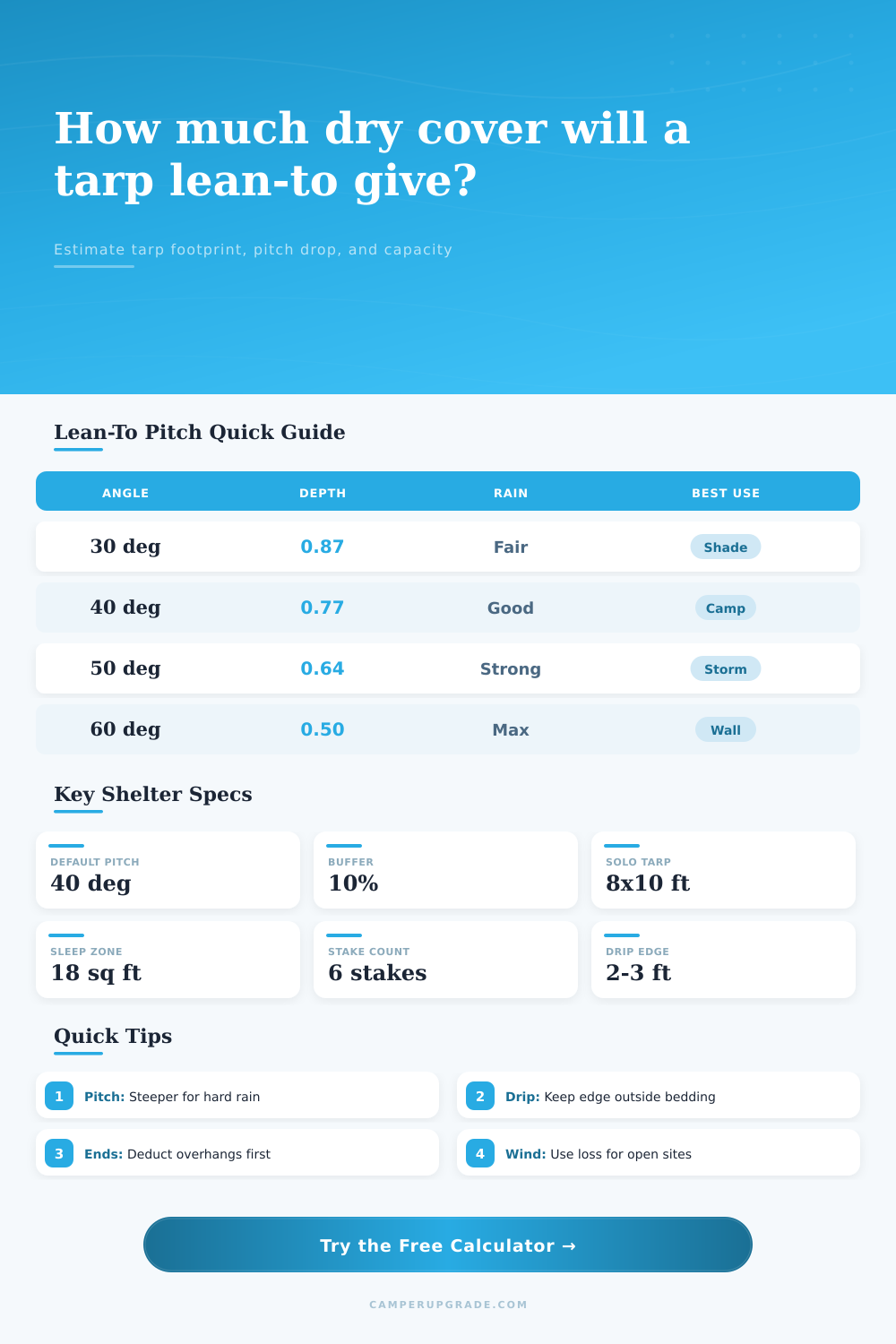
There is one variable, however, which trumps all: pitch angle. Pitch determines the tradeoff between ground coverage and headroom. A shallow pitch of thirty degrees provides a wide porch. It is perfect for shade on a sunny day, and feels spacious too. But if the wind comes up and starts pushing rain in sideways, then there’s not much resistance at that shallow slope. Water pools. Spray kicks back under low edge.
Increase the pitch steepness to fifty degrees or more and it will shed water quickly. It will also provide a better defense against wind-driven rain. The tradeoff is depth. As the pitch gets steeper, the tarp covers less horizontal ground. So you lose square footage for your gear but gain protection from vertical rainfall. Exactly how much? The calculator lets you know. So you can decide whether you’d rather have more shielding from the weather…or more floor space.
The second interesting aspect of plan reality is that material behaves differently. Your silpoly or silnylon tarp will stretch as it soaks up rain water and becomes heavier. What was a nice tight forty-degree pitch at sundown may be a sagging, wet mess at thirty degrees by midnight. This means the drip line shifts and water pools in the middle. The program has options for various materials and takes into account this sagging. For something like a stiff woven poly tarp the shape stays more true. Problem is edge isn’t as forgiving in higher winds. Canvas tends to keep its shape, but requires good strong stakes as the weight of wet canvas is significant. Knowing about how these materials interact prevents you from taking still measurements and expecting them to work in changing conditions.
Intuition also goes awry with side overhangs. Many campers imagine they can stretch out in full width of their tarp. They cannot. At each end, some fabric must be set aside for tie-outs that support the ridge and hold up the sides. Without that side margin, the shelter collapses and the dry area contracts. The calculator allows you to specify these deductions upfront when planning your layout. That way, you get an honest picture of available dry space before you unpack your wet tent bag. Better to realize you’re down to one sleeping pad now, rather than after unpacking.
Capacity depends on planning. You have to think about how much useful space you will have within a zone, not the overall square footage. That 10 by 12 foot tarp sounds great except when you take out all the space for wind exposure, side stakes, and drip lines. It may end up being only enough space for one backpacker plus pack. If you’re really cozy, it could be room for two person. Depending on how you plan to use the space, the app will change the shrunken size to its actual usable space. Whether that’s cooking space, storage space, or sleep space, this lets you understand how much space you actualy have before you hit the trail.
Staying dry is less about the size of your tarp and more about the precision of your pitch. It’s more about how well you pitched it than its dimensions. Geometry that doesn’t account for where the water runs to can result in a big shelter and a soggy bottom. Running the numbers turns guessing into a system. The tarp does its thing covering the sky; the numbers do their thing keeping the rain at bay.