Tankless Water Heater Flow Rate Calculator
Estimate usable hot water flow from inlet temperature, target temperature, BTU/hr rating, burner efficiency, fixture demand, altitude derate, and propane pressure mode.
Measure cold tap temperature when possible. Winter campground water can be much colder than the air.
Many RV showers feel comfortable around 105°F to 112°F at the fixture.
Use the input rating from the tankless water heater data plate or manual.
Non-condensing propane units often land near 78% to 86%; condensing units may be higher.
Use measured bucket-test flow or the aerator/showerhead rating.
Count fixtures that need hot water at the same time.
Altitude reduces available oxygen, which can lower burner output.
A common planning value is about 4% per 1,000 ft above 2,000 ft.
This planning factor estimates how fuel delivery affects real burner output.
Reserve helps prevent temperature sag when pressure or inlet temperature changes.
Tankless Flow Result
Effective BTU/hr is input BTU/hr multiplied by efficiency, altitude factor, and propane pressure factor.
- Input42k BTU
- 55°F rise1.28 GPM
- Best useSink
- Input60k BTU
- 55°F rise1.83 GPM
- Best useShower
- Input80k BTU
- 55°F rise2.44 GPM
- Best useCombo
| Fixture | Low Flow | Typical RV | High Flow |
|---|---|---|---|
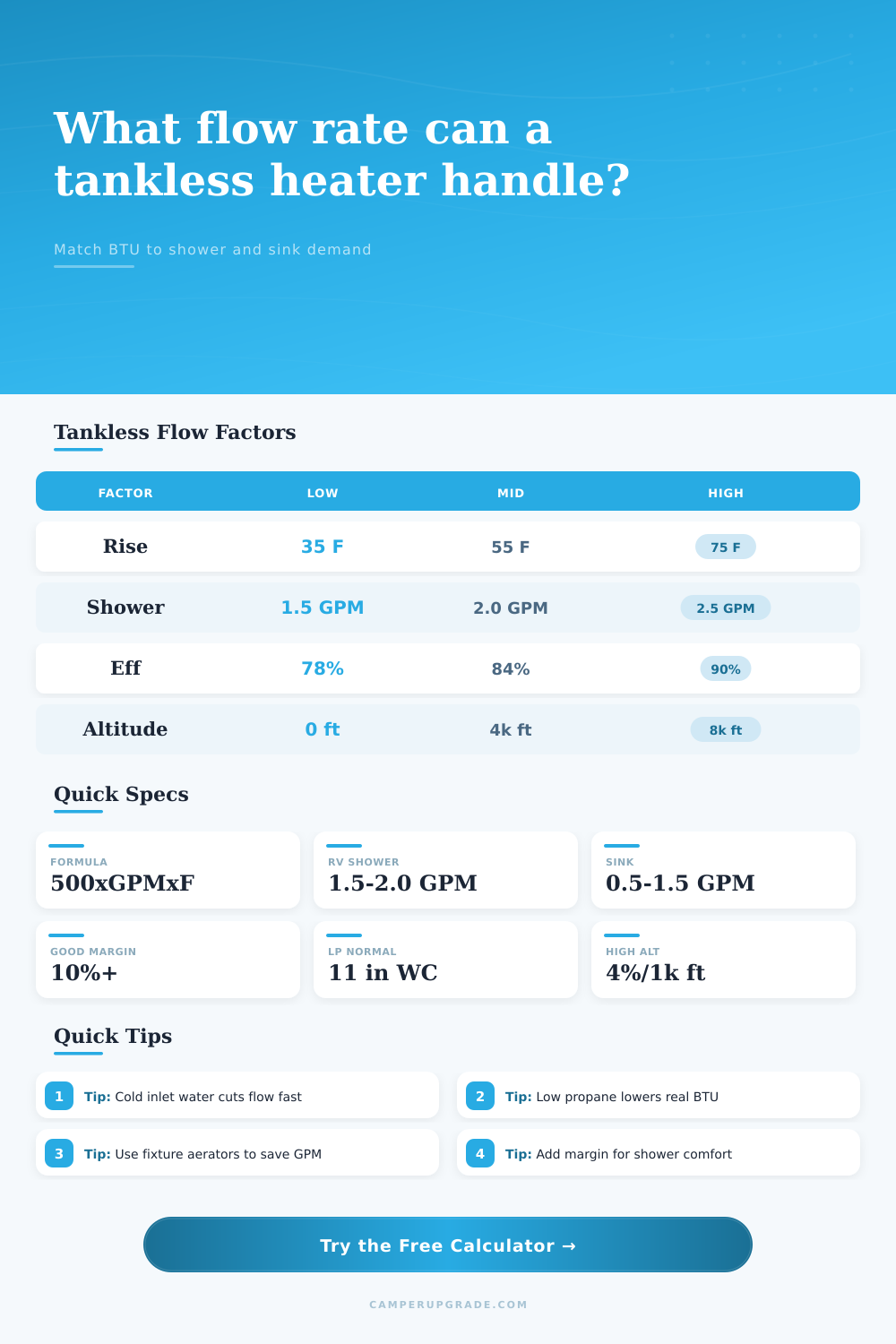
| RV showerhead | 1.2 GPM | 1.5 to 2.0 GPM | 2.5 GPM |
| Bathroom sink | 0.5 GPM | 0.8 to 1.2 GPM | 1.5 GPM |
| Kitchen sink | 0.8 GPM | 1.2 to 1.8 GPM | 2.2 GPM |
| Outdoor rinse hose | 1.0 GPM | 1.5 to 2.0 GPM | 3.0 GPM |
| Heater Input | 35°F Rise | 55°F Rise | 75°F Rise |
|---|---|---|---|
| 42,000 BTU/hr at 84% | 2.02 GPM | 1.28 GPM | 0.94 GPM |
| 60,000 BTU/hr at 84% | 2.88 GPM | 1.83 GPM | 1.34 GPM |
| 80,000 BTU/hr at 84% | 3.84 GPM | 2.44 GPM | 1.79 GPM |
| 100,000 BTU/hr at 84% | 4.80 GPM | 3.05 GPM | 2.24 GPM |
| Condition | Planning Factor | Effect | Calculator Use |
|---|---|---|---|
| 0 to 2,000 ft | 100% | No altitude derate | Standard campsite |
| 5,000 ft, 4% rule | 88% | 12% less burner output | Mountain camping |
| Normal LP pressure | 100% | Full planned output | Regulator steady |
| Cold cylinder sag | 87% | Noticeable flow loss | Winter or low fuel |
| Item | Formula | Use | Example |
|---|---|---|---|
| Temperature rise | Target – incoming | Find heating load | 110 – 55 = 55°F |
| Effective BTU/hr | BTU x efficiency x derates | Real heat to water | 60k x 84% = 50.4k |
| Hot water GPM | Effective BTU / (500 x rise) | Available flow | 50.4k / 27.5k = 1.83 |
| Required input | Demand x 500 x rise / factors | Check heater size | 1.8 GPM needs 58.9k |
When you finally flip on your RV shower after a long day of driving, it’s about to test your expectations. You’re expecting pressure and warmth. Instead, you get a lukewarm dribble that fritzes out mid-scrub.
Most of the time, it isn’t the fault of the heater. Typically, there’s just a gap between physics and what the unit is supposed to do. For example, tankless water heaters is compact engineering marvels. However, they’re limited by strict laws of thermodynamics. They can’t make heat. All they can do is move it. So if you have forty-degree water coming in and need it to be a hundred ten out, the heater is going to have to work overtime. And if it can’t keep up? The flow drops.
How to Get Better Hot Water in Your RV
That’s where this calculator comes in. It strips out marketing speak and tells you exactly how much hot water you’ll get under real conditions.
Let’s begin with the temperature rise. That’s the change of the hot water going out vs. The cool water coming in. If the inlet water is sixty degrees in the middle of summer, a rise of a hundred ten is just a difference of fifty degrees, something the heater can handle just fine. Now drop down to winter camping where the inlet water may well be forty, and the rise is now seventy degrees. You’ve got a larger gap to fill with the same BTU output, so there goes the flow rate. Basic arithmetic, yes, but it still catches folks by surprise. When you plumb in your actual temperatures, the calculator above does all the math for you, so you don’t have to guess what kind of power you really need.
And then there’s efficiency. An 84 percent efficient propane tankless unit means that out of all the fuel energy, most of it reaches water, while some is lost up the flue.
There’s a wrinkle here, however: altitude. As you increase altitude, the air becomes thinner, and because there is less oxygen, the burner can’t burn as hot. A general guideline is to derate the output roughly four percent per each one thousand feet over two-thousand feet. That loss applies if you’re camping in the mountains, your heater isn’t broken, it’s just suffocating. This tool accounts for that, and allows you to input altitude, adjusting the effective BTU accordingly.
Another quiet killer is propane pressure. A weak flame happens when either your regulator sags or your tank is too low. You’ll burn 10-15 percent less than you think (but have no idea why). Include pressure conditions with calculator and get a better feel for how it’s really performing.
What’s on the data plate? That is the best possible situation, and it never happens in real life. The rubber hits the road with fixture demand. Low-flow aerators at your sink may draw under one gallon per minute, whereas a normal RV shower head could be drawing two. Add them together and now you’re talking about a lot of water, all running into that same shower drain. And unless your heater can keep up with total load, the temperature will drop like a rock.
You don’t need a big heater for this problem; most times you just need to make sure your fixtures is matched to the heater. Switching from a normal shower head to a low-flow model can give you the ability to run another faucet. It is a little change that brings a giant improvement in comfort.
The next thing is to check out the reference tables on that page. They display performance of each size heater at different temperature rise levels. An 80k BTU heater has more headroom but consumes more fuel. A 42k BTU heater may be straining in winter but humming along nicely in summer. There’s no such thing as a free lunch. You pay in terms of fuel costs for greater flow capacity. Know your worst case, plan for the coldest water you’re likely to encounter, and if the numbers pencil out there, they’ll pencil out anywhere.
You can also measure your actual flow. Time how long it takes a full one-gallon bucket under your showerhead to fill up. Divide sixty by that number of seconds for your real GPM. Now compare with what the calculator shows you.
What if your demand is more than the adjusted capacity? You’re in luck! You have choices. Upgrade the heater, but make sure you know the constraints first. Turn down the target temperature. Lower the flow at the fixture.
So what’s the comfort level? There must be some wiggle room for the flow capacity. I say a 10-20% reserve will let the system breathe. It will prevent the system from getting too hot or cold with changes in pressure, giving it some room. If you don’t leave some cushion, a rise in demand or a drop in propane pressure will give you a cold shock. Most folks overlook that part because they just size for max output, not the stability of that output.
So how does that translate? The GPM is real, the BTU is potential. Temperature rise is the bridge between the two of them.
So what happens when you get your results? Look at the margin. If it’s positive, you’re good. If it’s negative, you’ll be waiting on hot water. It’s not a dream, it’s a planning tool. It turns vague hopes into concrete numbers. These numbers tells you if you’re ready for that trip.
And next time you’re standing in the shower, keep those bits of physics in mind: Where does all that water go? And where do you think the heat comes from? It’s a balancing act. Get it right, and you’ve got hot water. Get it wrong, and you learn.
Use the Free Calculator to find out if your setup measures up. Adjust accordingly. Test some more. The water will let you know the truth.