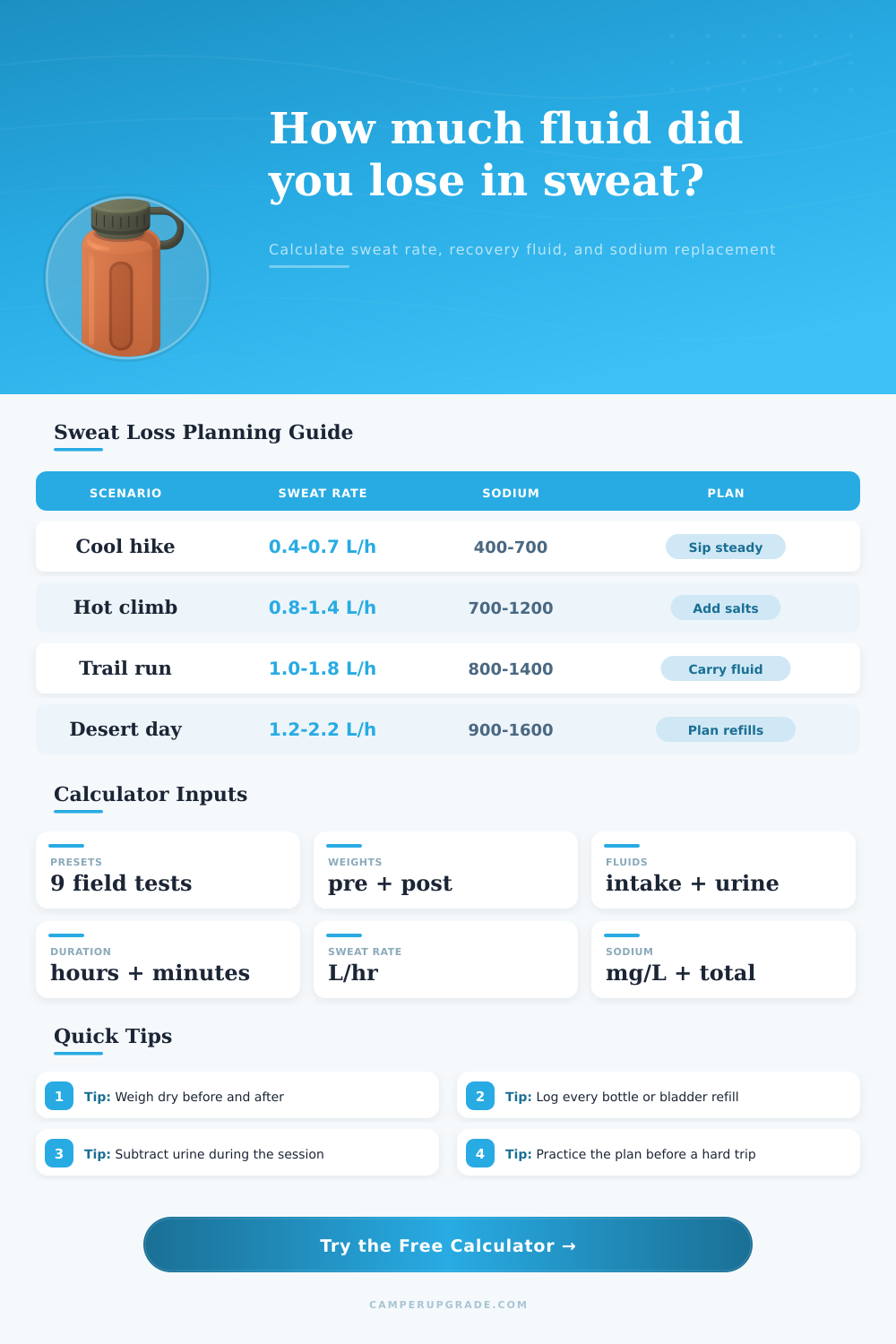
Sweat Loss Replacement Calculator
Estimate sweat loss, sweat rate, fluid replacement, urine-adjusted deficit, sodium loss, and electrolyte targets from a simple before-and-after weigh-in.
1.Field Test Presets
2.Inputs
This planning tool assumes 1 liter of water is about 1 kilogram, and 1 pound of body mass change is about 15.34 fluid ounces of water. It is not medical advice.
3.Breakdown
4.Spec Grid
5.Reference Tables
| Sweat Rate | Interpretation | Field Note |
|---|---|---|
| Under 0.5 L/hr | Low | Cool weather, easy pace, or short work blocks |
| 0.5-1.0 L/hr | Moderate | Common hiking and camp-work range |
| 1.0-1.5 L/hr | High | Heat, humidity, climbing, running, or heavy packs |
| 1.5-2.0 L/hr | Very high | Plan refills, shade breaks, and sodium carefully |
| Over 2.0 L/hr | Extreme | Retest conditions and avoid forcing fluid beyond comfort |
| Sweat Sodium | Typical Range | Replacement Cue |
|---|---|---|
| Light salt loss | 300-600 mg/L | Water plus normal salty food may cover many sessions |
| Average salt loss | 600-1000 mg/L | Use electrolyte drink or salty snacks on longer days |
| Salty sweater | 1000-1400 mg/L | Visible salt marks or cramps may justify a higher plan |
| Very salty | 1400+ mg/L | Use tested products and avoid guessing on big heat days |
| Input | Formula Role | Accuracy Tip |
|---|---|---|
| Pre weight | Starting body mass | Use dry clothes or no clothes, same scale |
| Post weight | Ending body mass | Wipe sweat and remove soaked layers first |
| Fluid intake | Adds back fluid consumed | Measure bottles before and after |
| Urine output | Subtracts non-sweat fluid loss | Estimate only during the measured session |
| Duration | Converts loss to hourly rate | Use elapsed active time, not all-day camp time |
| Preset | Use Case | Default Sodium |
|---|---|---|
| Cool day hike | Mild conditions and moderate effort | 600 mg/L |
| Hot climb | Sun, grade, and steady exertion | 950 mg/L |
| Trail run | Higher hourly sweat rate | 1000 mg/L |
| Desert pack | Dry heat with refill planning | 1200 mg/L |
| Winter layers | Sweat hidden under insulation | 750 mg/L |
6.Hydration Tips
Many individual do not recognize the amount of fluid that they have lost from their bodies until they feel unwell following a period ofactivity. A person may feel tired or unwell from activity due to either fluid loss or fluid replacement issues. A more accurate determination of fluid loss can be made through the use of a scale to determine one’s weight prior to and following the activity.
This method is more accurate then guessing at fluid loss based off thirst or the number of bottles of water that were consumed during that activity. An individual’s body weight should be considered a changing number. Weighing oneself prior to and after activity will reveal the loss of fluid from the body.
Measure Sweat Loss and Replace Fluids
In order to calculate an individual’s actual sweat rate, the amount of fluid that was consumed during the activity should be deducted from the change in body weight, as should the amount of fluid lost through urine during that activity. The calculator that is included in this project can perform each of these calculation. The calculator will provide information regarding an individual’s sweat rate, total fluid loss, and the amount of sodium that are lost as a result of that fluid loss.
Sweat rate isnt a fixed number for an individual. An individual may lose fluid at different rates based upon environmental factor. For instance, an individual may lose a significant amount of fluid during the middle of the day when compared to the early morning hour when the individual may be relatively inactive.
An understanding of an individual’s sweat rate is essential for understanding how quick that individual should refill their water bottles. Additionally, an individual can use that information to determine if they should drink plain water or water with salts is added to replace the sodium that are lost through sweating. Adding salts to water is important for individuals to prevent the feeling of heaviness of the legs or the “fuzzy” feeling in the head that can result from low levels of sodium in the body.
While many individuals understand the importance of replacing lost fluid, the target that they set for themselves is not always met. Individuals may drink fluids during activity, yet they may not have enough fluid to sustain them throughout the activity. The body continues to lose fluids through metabolism and urine after activity.
In order to account for this fluid loss, the calculator allows individuals to determine a target for fluid replacement after activity. The target should be calculated as a percentage of the fluid deficit prior to activity, multiplied by 125 or 150 percent. Using this percentage to determine a target after activity prevents an individual from experiencing fluid deficits prior to the next activity scheduled for that day.
Sodium is a variable that many individuals dont consider in the rehydration process. However, low levels of sodium can lead to muscle cramp. The amount of sodium in an individual’s sweat is variable, as is the rate at which the body becomes acclimated to the climate.
If an individual’s sweat contains high levels of sodium, white ring will form on their clothing following activity. The sodium input in the calculator can be adjusted to account for these differences in sodium levels in individual’s sweat. The information collected during one activity can be used to plan future activity.
For instance, if an individual can calculate the sweat rate for themselves in liter per hour, they can calculate the number of water bottles or packets of electrolyte supplements that they should carry during activity. Additionally, they can determine the conditions that lead to high rates of fluid loss and prepare accordingly. Thus, the use of these calculations help to eliminate the errors that may arise in the attempt to determine the amount of fluid that has left the body.
In order for this calculation to be effective, an individual should weigh themselves with the same scale and in the same clothing each time. The body should be weighed prior to and after activity in two or three different weather climates. Through the process of testing, adjusting, and testing again, individuals can transform the measurement of fluid loss into planning information that will allow them to ensure that the amount of fluid that is replaced from activity is equal to the amount that is lost.