Surfboard Volume By Weight Calculator
Estimate recommended surfboard volume from surfer weight, skill, wave power, paddling fitness, board intent, and compare an existing board from known liters or dimensions.
🏄Surfboard Volume Presets
Recommended Surfboard Volume Snapshot
⚙Surfer And Conditions
📏Current Or Target Board Check
📊Volume Planning Details
📘Reference Tables
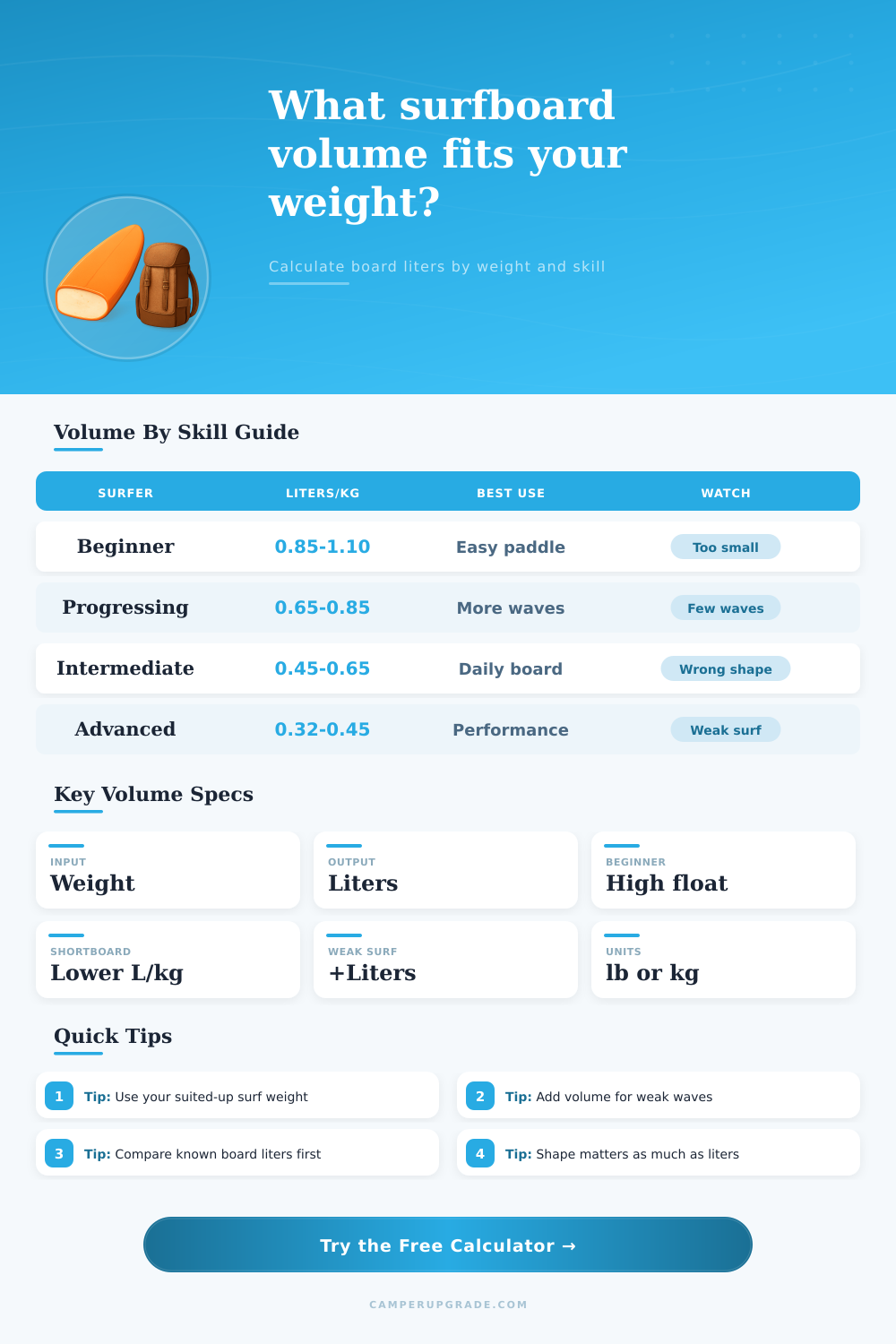
| Surfer profile | Common liters per kg | What it feels like | When to go higher |
|---|---|---|---|
| Learning or first hard board | 0.85 to 1.10+ | Easy paddling, stable takeoffs, slower turning | Older surfer, low fitness, soft waves, cold suit |
| Beginner trimming across the face | 0.72 to 0.90 | High wave count with enough control to turn | Beach break with weak shoulders or infrequent sessions |
| Progressing intermediate | 0.55 to 0.75 | Good paddle help without feeling huge | Moving from a foam board to a midlength or fish |
| Intermediate daily shortboarder | 0.42 to 0.60 | Balanced paddling and maneuverability | Small-wave board or crowded lineup |
| Advanced performance surfer | 0.30 to 0.45 | Loose and sensitive with less forgiveness | Weak surf, thicker rubber, or a step-down board |
| Board type | Volume tendency | Shape note | Best use |
|---|---|---|---|
| Foam board or soft top | High | Thick rails, stable deck, forgiving outline | Learning, family quiver, weak waves |
| Longboard or mini-mal | High to moderate | Length and glide matter as much as liters | Small waves, trimming, early entry |
| Fish or hybrid | Moderate plus | Wide tail and flatter rocker plane early | Everyday surf, weak to average waves |
| Groveler | Moderate plus | Short length but extra width and foam under chest | Knee to shoulder-high small waves |
| Performance shortboard | Lower | Narrower outline, more rocker, thinner rails | Steeper waves and skilled surfers |
| Step-up | Moderate | More length and hold, not always much more foam | Powerful surf where control matters |
| Wave condition | Volume move | Shape help | Watch-out |
|---|---|---|---|
| Soft knee-high surf | Add 8-15% | Flatter rocker, wider tail | Too little foam kills wave count |
| Average beach break | Base range | Balanced outline | Match rocker to local waves |
| Hollow, steep waves | Base or lower | More rocker and hold | Too much foam can bounce |
| Cold water suit | Add 3-8% | Extra paddling help | Use suited-up body weight |
| Travel quiver | Add margin | Versatile mid-volume shape | Avoid one perfect-only board |
✅How To Use The Result
In surf shops, they says that volume is king… They make it sound simple. You just has to know how many liters you need to float your bodyweight, and everything else will follow. This is true, sort of. It’s not realy as simple as it seems. Volume also have a lot to do with the following factors: wetsuit thickness, skill level, and local waves. In other words, if you don’t get the volume-to-weight ratio right, you could be missing all the sets or catching only one wave after spending an hour paddling out.
So how do we account for all this? The calculator (above) take care of it for you. It begins with your base weight but then factors in the drag of your gear as well. Many surfers miss out on opportunity here because a thick cold water suit add three or four kilos of dead weight to their bodies. The thing about all that rubber is that it pulls you down and creates more drag, so unless you think about your suited up reality when calculating volume you’re probably going to opt for board that feels unresponsive and sluggish.
Why Volume Is More Than Just Weight
It all depends on skill level, which determine how much assistance the shape provides. Less experienced surfers needs more float to stay up to speed through flats and to stay upright as they learn to catch their balance. Experienced surfers can gets away with losing foam since their rhythm and body positioning creates forward momentum that newbies simply can’t match. This means that a heavier novice may actualy want the same volume as a lightweight expert who rips the liviv shit out of steep reefs every weekend. Sounds like a counterintuitive tradeoff, but this is what makes the volume charts so contradictory until experience enters the equation.
Not all swells are created equal, so we’d also be wrong if we didn’t spend some time talking about wave power. Beach breaks requires additional buoyancy because they’re often weak and mushy; there isn’t much energy available in that whitewater. Reef breaks, on the other hand, provides plenty of speed and drive. If you’re hunting hollow barrels, too much volume will result in a floaty-feeling board that’s difficult to turn sharply. The tool takes this into account, bumping your target range up (or down) depending on whether you’re after soft spits or punchy reef breaks.
It’s one thing to catch a wave but another to control it when you’re up. The other big factor in translating volume into performance come from board shape as well. A shortboard with the same capacity as a 35 liter fish will paddle much further because it is shorter. Additionally, the wide tail and full rails on a hybrid shape spreads out the buoyancy better so it planes out easier. However, a performance shortboard tapers that foam down to a narrow outline, concentrating the lift beneath your feet and making it feel much faster and smaller underfoot. So when looking at numbers between different board types keep in mind where the volume is laid out on the deck as that can skew your comparison of numbers alone.
A lot of folks underestimate importance of fitness. If you’re not in shape or haven’t been surfing in a while, your arms will burns fast out there. That extra bit of flotation provided by a bigger board are a crutch. It keeps you ahead of the wave while your endurance catches up. And there’s nothing wrong with prioritizing volume to catch more waves. You’ll develop muscle memory at a much quicker pace when you catch more waves. This is better than struggling on a board that’s too small for your current fitness level.
When upsizing or downsizing, it’s best practice to take baby steps. If you drop fifteen liters all of the sudden, I’m willing to bet that’ll throw your system off course and end your day. By making gradual adjustments, you’re able to train your skill set to fit new experience. While the reference tables on this page offers some good starting points, always let your body be the ultimate decider. At the end of the day, surfing is supposed to feel good in the water, not reach a certain number. You should of let the numbers be your guide, but listen to your body when it’s on the face.