SUP Paddle Length By Height Calculator
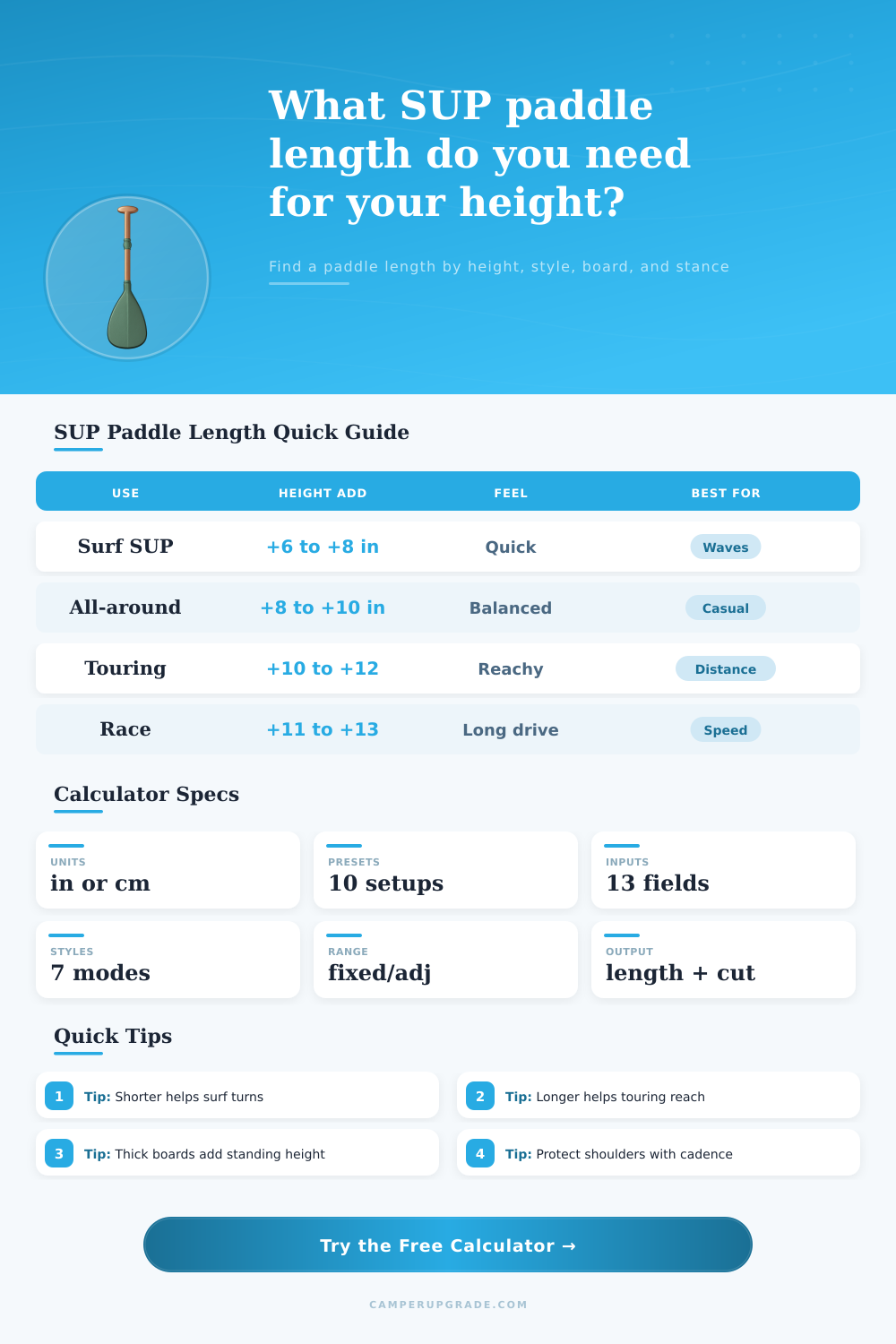
Estimate a stand up paddle length from rider height, board thickness, paddling discipline, stance, cadence, blade style, and shoulder comfort before you set an adjustable paddle or cut a fixed shaft.
🛶SUP Paddle Presets
⚙Height, Board, and Paddling Inputs
Your SUP Paddle Fit
📏Quick Reference Ranges
📋SUP Paddle Length Tables
| Rider Height | All-around Start | Touring Start | Surf Start |
|---|---|---|---|
| 5 ft 0 in / 152 cm | 68-70 in / 173-178 cm | 70-72 in / 178-183 cm | 66-68 in / 168-173 cm |
| 5 ft 4 in / 163 cm | 72-74 in / 183-188 cm | 74-76 in / 188-193 cm | 70-72 in / 178-183 cm |
| 5 ft 8 in / 173 cm | 76-78 in / 193-198 cm | 78-80 in / 198-203 cm | 74-76 in / 188-193 cm |
| 6 ft 0 in / 183 cm | 80-82 in / 203-208 cm | 82-84 in / 208-213 cm | 78-80 in / 198-203 cm |
| 6 ft 4 in / 193 cm | 84-86 in / 213-218 cm | 86-88 in / 218-224 cm | 82-84 in / 208-213 cm |
| Adjustment | Change | Why It Matters | First Test |
|---|---|---|---|
| Thick inflatable | Add 0.5-1.0 in | Feet sit higher above water | Start at neutral plus 1 in |
| Shoulder discomfort | Subtract 1-2 in | Reduces top-hand reach and leverage | Try shorter for one full session |
| Surf stance | Subtract 1-3 in | Knees stay bent and strokes are quick | Test in turns and bracing |
| Touring posture | Add 1-2 in | Improves reach during steady cruising | Check if top shoulder lifts too high |
| Large blade | Subtract 0.5-1 in | Lessens catch load on joints | Watch for smoother cadence |
| Paddle type | Fit priority | Length clue | Setup caution |
|---|---|---|---|
| Fixed carbon | Exact cut | Test before trimming | Measure handle insert depth. |
| Adjustable | Shared range | Keep collar overlap | Do not exceed clamp marks. |
| Travel paddle | Packability | Check ferrule reserve | Joint flex can change feel. |
| Kids paddle | Growth room | Low swing weight | Shorter is safer for cadence. |
| Race shaft | Reach and drive | Longer after testing | Stop if shoulders rise. |
💡Fit Checks Before Cutting
Even if you’re not sure what it was about that paddle that wasn’t quite right, you’ve been there, standing on a paddleboard with a paddle that didn’t feel right. Maybe your shoulder ache after twenty minutes, or maybe you were reaching too far forward and losing your balance. It’s one of those small problems that can spoil an otherwise perfect day on the water. The majority of newbies chalk it up as a matter of either their lack of core strength or poor wind conditions, when the real culprit is oftentimes nothing more than three inches of shaft.
Paddle length isn’t just about physics; it is more about how your body move. You don’t want a paddle so long that it turns your shoulder into a hinge that break down under weight, but you also don’t want one so short that you can’t glide along. According to the old rule of thumb, just add eight to ten inches to your height for an all-around paddle. That’s fine if your normal board is about average in terms of flex and you’re doing typical flat calm water stuff in a lake.
How to Find the Right Paddle Length for You
But when you start adding other variables like stance preference and board thickness it changes things quite a bit, which is where the calculator come in. Plug in details of what exactly you will be using and it will do the work for you. So the length isn’t a certainty anymore but a variable instead. And two paddlers who are the same height may need entirely different sized boards based off whether they plan to tour around a bay or surf some waves.
Another overlooked variable is the thickness of board itself. An inflatable board with a thick deck raises your feet up farther from the water surface, which essentially raises your standing height. Standing taller mean you can extend further down while bending less in your back. This raise the recommended height slightly if you’re using a six-inch deck. And again, it’s not much, but it keeps you from feeling like you’re hacking away at the water with shorter, less efficient strokes. On the other hand, maybe you’re on a hard racing board that’s thinner, so it requires a little shorter paddle to keep pace and stay in a good cadence.
In contrast, surfing requires a completely different geometry. You want less leverage on the shaft (tight turns and quick recovery), so you’re looking at much shorter paddles, often just six inches over your own height according to the calculator, which means you’ll be thinking about stroke rate instead of pure reach. It makes you think more about stroke rate than reaching itself. Try using a long touring paddle on a wave, and you’ll be exhausted before catching another set.
The silent variable on all of this? Shoulder health. Paddlers tend to write off early soreness as simply becoming a stronger paddler. More likely, your stroke length is longer than your body can accommodate at the moment and your top hand are too high. If your shoulders is sensitive, the tool will shorten to help you dial it in for comfort. Don’t mistake this for weakness. It’s about sustainable mechanics. You’ll be able to get a bit higher cadence with a paddle that is a tad shorter. This distributes the load onto additional muscles instead of concentrating the stress into a single joint.
Try out the range before committing to a set shaft length. Being able to adjust the length of a paddle as you work will allow you to dial in the sweet spot over time. How does your back feel at the end of a half hour? Are you rounding your shoulders? Shorten up. Don’t feel like you’re getting good purchase on every stroke? Lengthen a bit. When you get dialed in, cut that fixed shaft confidently. Keep in mind to account for handle depth when measuring, though. Better power transfer starts with a clean cut.
The length should of been based on the rhythm that fits your body and your board. Reaching becomes gliding, awkward to smooth. When it’s no longer you fighting the paddle, but you and the paddle are one, that is when you know. That’s when you no longer think about the gear and begin feeling the water again.
The math provides the baseline; your shoulder tells the truth. Every time, trust comfort over the chart.