☀️ Sunscreen Duration Calculator
Calculate exactly how long your sunscreen lasts & when to reapply during peak outdoor activities
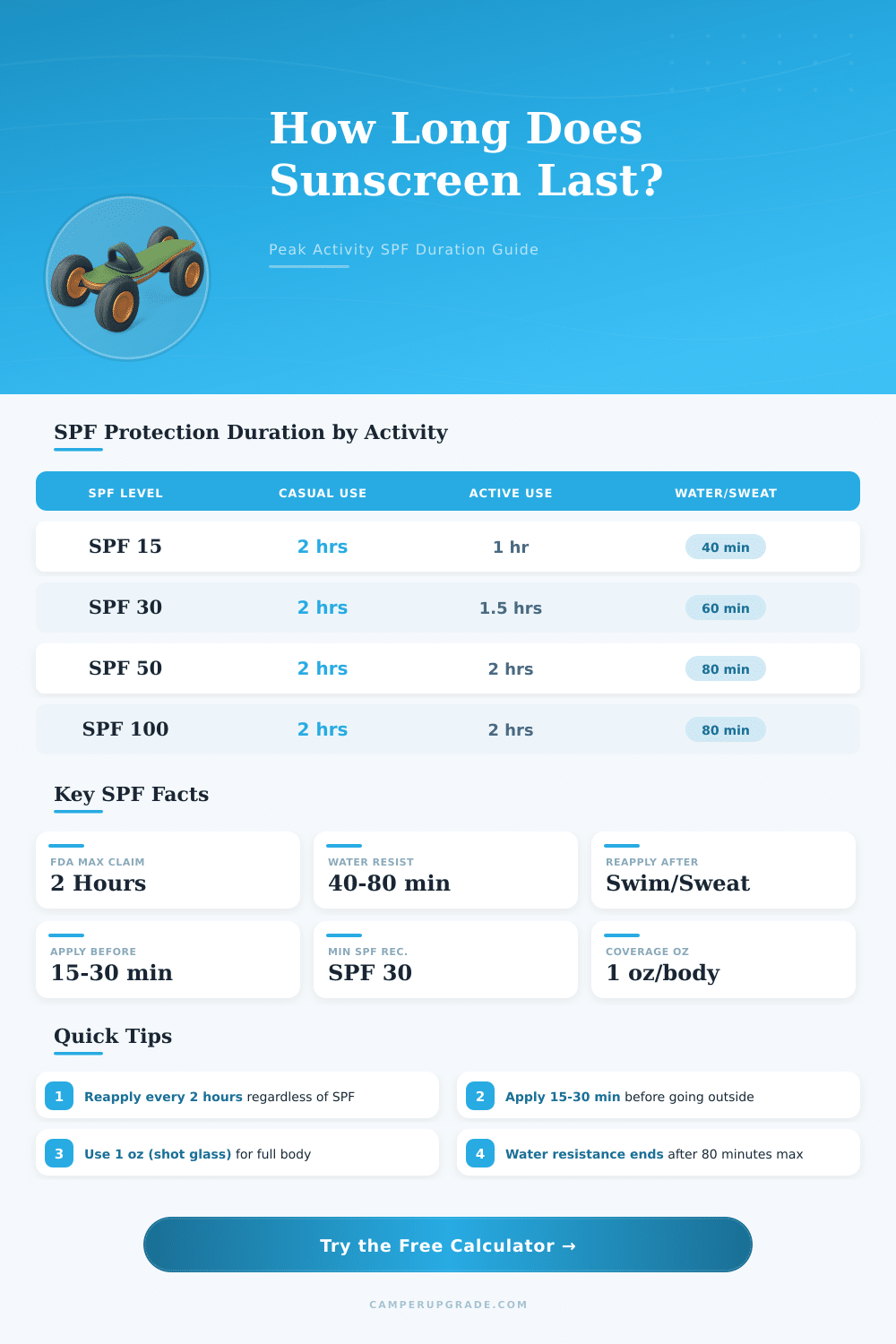
| SPF Level | Casual / Low Activity | Moderate Activity | High Activity / Sweat | Swimming / Water |
|---|---|---|---|---|
| SPF 15 | Up to 2 hrs | 60–90 min | 45–60 min | 40–60 min |
| SPF 30 | Up to 2 hrs | 90–120 min | 60–90 min | 40–80 min |
| SPF 50 | Up to 2 hrs | 90–120 min | 60–90 min | 40–80 min |
| SPF 70 | Up to 2 hrs | 90–120 min | 60–90 min | 40–80 min |
| SPF 100 | Up to 2 hrs | 90–120 min | 60–90 min | 40–80 min |
Note: The FDA caps effectiveness claims at 2 hours regardless of SPF. Higher SPF blocks more UV but does not last longer. Reapplication frequency is driven by activity, not SPF number.
| Formula Type | Water Resistance | Sweat Resistance | Notes |
|---|---|---|---|
| Regular Lotion/Cream | None | Low | Best for everyday use, reapply promptly after sweating |
| Water-Resistant (40 min) | 40 min | Moderate | Reapply after 40 min of swimming/sweating |
| Water-Resistant (80 min) | 80 min | High | Best for water sports; reapply after 80 min |
| Spray Sunscreen | Varies | Low–Moderate | Apply generously; often under-applied, reducing protection |
| Sunscreen Stick | Moderate | Moderate | Great for face & targeted areas; harder to apply evenly to body |
| Mineral/Physical (Zinc/Titanium) | Moderate | Low | Sits on skin surface; effective immediately; can rub off easier |
| UV Index | Risk Level | Reapply Every | Recommended SPF |
|---|---|---|---|
| 1–2 | Low | Every 2 hours | SPF 15+ |
| 3–5 | Moderate | Every 2 hours | SPF 30+ |
| 6–7 | High | Every 90 min | SPF 30–50+ |
| 8–10 | Very High | Every 60–80 min | SPF 50+ |
| 11+ | Extreme | Every 60 min | SPF 50+ (limit exposure) |
| Body Zone | Approx. Amount | % of 1 oz | Reapplication Priority |
|---|---|---|---|
| Face & Neck | 1/4 tsp (1.25ml) | ~8% | High — most exposed |
| Arms (both) | 1 tsp (5ml) | ~17% | High — frequently exposed |
| Chest & Abdomen | 1 tsp (5ml) | ~17% | Medium |
| Back & Shoulders | 1 tsp (5ml) | ~17% | High — often missed |
| Legs (both) | 2 tsp (10ml) | ~33% | Medium |
| Feet & Tops | 1/2 tsp (2.5ml) | ~8% | Medium — often missed |
sunscreen is a product that one applies on the skin to defend it against sunburns and to help escape skin cancer. It has several names, for instance sunblock, sun lotion or sun cream. This product comes in various kinds, as creams, sprays gels and foams.
Applying sunscreen forms a key part of a whole plan to protect the skin against sun damage.
How to Use Sunscreen and Stay Safe
SPF means the Solar Protective Factor. It estimates how much more time one can stay under the sun before getting the same level of UVB radiation damage compared with without some protection. Like this, if one uses SPF 10, it takes ten times more time to reach that same impact.
Recommended is broad spectrum sunscreen, that blocks both UVA and UVB rays, with SPF at least 30. Some favour SPF 50 or more, because many folks lay too ltitle of sunscreen compared with the amount in test attempts. Correctly used, SPF 30 ensures around 95 percent protection against sun rays.
Reapplying sunscreen is really important. One should reapply it every two hours. After swimming or sweating it requires to be replaced immediately.
Waterproof sunscreen is not entirely waterproof, so recall that. Setting alarms on the phone is useful, because under the sky easily one looses the feeling of time.
Many folks use too little sunscreen. One ounce is enough to cover the whole body. Zones commonly forgotten are the tops of ears, the nape, the tops of feet and parts around clothing and sunglasses.
The right sunscreen depends also on the skin type. Lightweight gel sunscreens work well for oily or mixed skin. For dry skin creams or rich mixes are more useful, and choosing hydrating, gentle ingredients always matters.
Some sunscreens are based on minerals, that use physical UV blockers like zinc oxide. These commonly look white and hardly rub in, even so some new versions spread easily with a bit of white trace. Zinc oxide is considered a bit more effective for sun protection than titanium oxide.
There are safety points that matter to know. Spray sunscreens can store flammable chemicals. There were cases when folks applied spray sunscreen and later came near to a grill, lit cigarette or candle, because of that their skin caught fire, causing heavy burns that needed treatment.
Some sprays were recalled because of that risk. Reef safe sunscreens avoid dangerous chemicals like oxybenzone and octinoxate. From more than 2 200 sunscreen products, checked in one guide, only one from four met standards for good sun protection while also avoiding ingredients tied to healthproblems.
Limit the time under the sun, especially in the midday hours, to add another layer of protection beyond only sunscreen.