Sunscreen Amount by Body Area Calculator
Estimate a full-dose sunscreen plan from body surface area, exposed zones, product form, outdoor hours, and reapplication timing.
🧭Real Outdoor Presets
📏Body, Product, and Trip Inputs
🧍Exposed Body Area Map
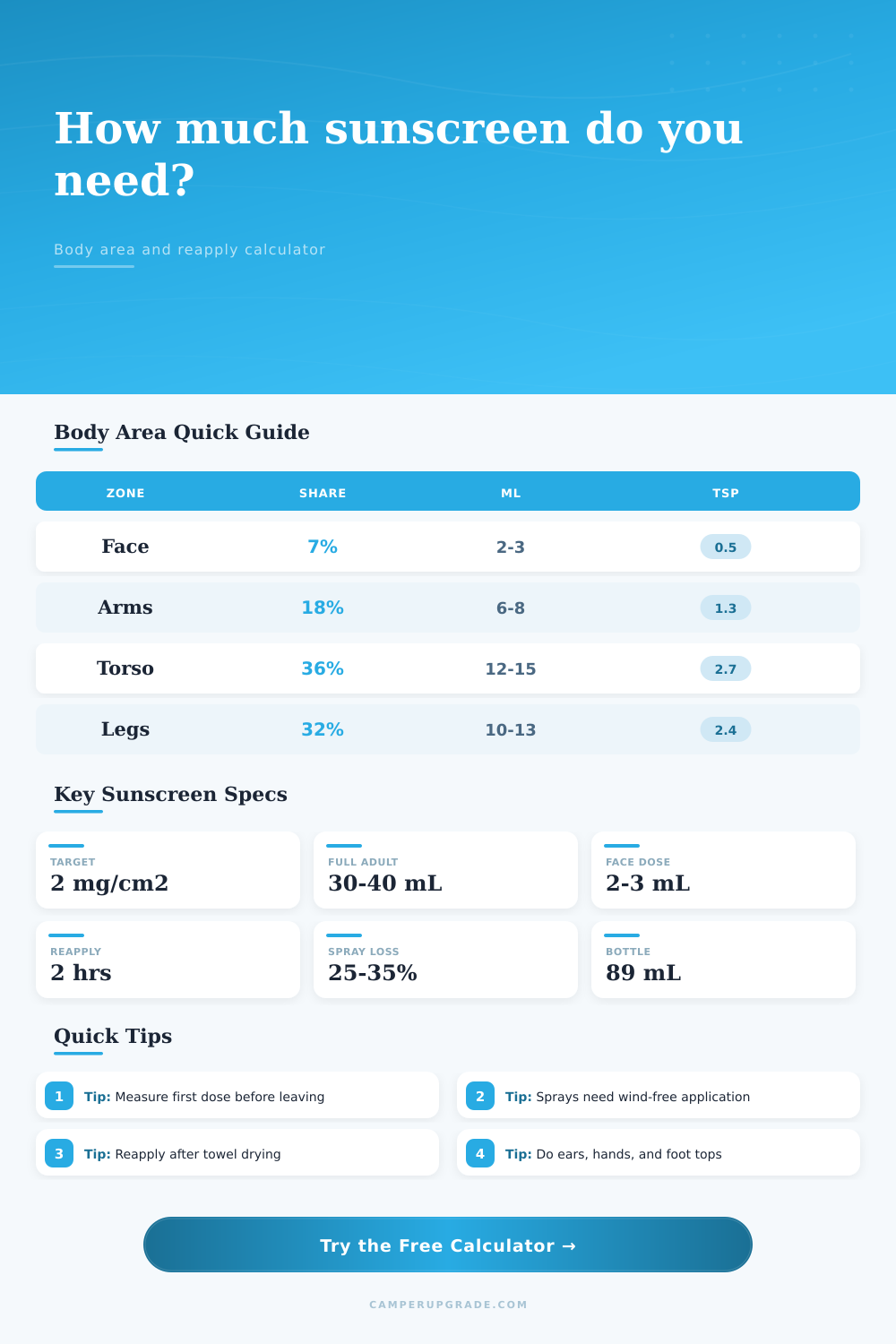
The zone percentages are an adult body-surface map for sunscreen planning: face and neck 7%, scalp and ears 2%, arms 18%, hands 5%, front torso 18%, back and shoulders 18%, legs and feet 32%.
Full Calculation Breakdown
🧴Product Form Spec Grid
📚Reference Tables
| Body Zone | Planning Share | Full Adult Dose at 2 mg/cm² | Common Misses |
|---|---|---|---|
| Face and neck | 7% of BSA | About 2 to 3 mL | Nose sides, jawline, neck fold |
| Scalp, ears, lips | 2% of BSA | About 0.7 mL | Ear rims, part line, lip edge |
| Both arms | 18% of BSA | About 6 to 8 mL | Upper-arm backs, elbow creases |
| Hands and wrists | 5% of BSA | About 1.7 to 2.2 mL | Finger webs, watch line, thumb side |
| Front torso | 18% of BSA | About 6 to 8 mL | Collarbone, swimsuit edge |
| Back and shoulders | 18% of BSA | About 6 to 8 mL | Shoulder caps, mid-back strip |
| Legs and feet | 32% of BSA | About 10 to 13 mL | Foot tops, ankle bones, knee backs |
| Application Target | Formula Use | Amount on 10,000 cm² | Best Use Case |
|---|---|---|---|
| 1.0 mg/cm² | Light touch-up | 10 mL before loss | Short refill on already coated skin |
| 1.5 mg/cm² | Careful everyday | 15 mL before loss | Covered clothing with limited exposure |
| 2.0 mg/cm² | Label test dose | 20 mL before loss | Beach, water, snow, long open sun |
| 2.2 mg/cm² | High-miss margin | 22 mL before loss | Wind, sand, spray, or hard-to-reach zones |
| Container or Measure | Metric Volume | Approx Teaspoons | What It Covers |
|---|---|---|---|
| Half teaspoon | 2.5 mL | 0.5 tsp | Face and neck for many adults |
| One teaspoon | 4.93 mL | 1 tsp | One large zone or two small zones |
| Travel tube | 89 mL | 18 tsp | Two to three full adult applications |
| Family bottle | 237 mL | 48 tsp | Six to eight full adult applications |
| Named Preset | Typical Clothing | Starting Exposure | Reapply Pressure |
|---|---|---|---|
| Beach Day Adult | Swimsuit or trunks | High | Water plus towel drying |
| RV Awning Afternoon | T-shirt and shorts | Moderate | Shade breaks lower total volume |
| Boat Deck Crew | Long sleeves, face open | Moderate | Reflection and spray raise misses |
| Snowfield Reflection | Cold layers, face open | Low area | High reflected UV on face |
💡Calculation Tips
If you put on sunscreen an hour before getting out of the car, you’re thinking: “Good enough, I’m covered.” But that is not true. Most grown-ups uses roughly one-quarter of amount they should be using. Why? It’s not laziness; it’s abstraction. Who knows what a “teaspoon” feels like when trying to rub it all over their back?
Enter the calculator. After plugging in body stats (height/weight), along with clothing intentions, the calculator do the math for you, taking the guess-work out of prepping your kit. The point is surface area. The sunscreen should be applied at a thickness of about two milligrams per square centimeter to provide the advertised protection. Less than this and the sunscreen will drop in its SPF protection dramaticly. So if you’re stingy applying it, an SPF 50 sunscreen may act more like an SPF 10 one.
Why You Need a Sunscreen Calculator
The calculator use standard metrics for weight and height, your body surface area, and plots the areas that are really exposed to the sun. You may believe you have half your body covered by your t-shirt but it doesn’t account for parts of your neck, legs and arms that is left bare. And here’s why: UV exposure isn’t equally distributed.
How the product is applied also affects the logistics: lotion is effective but clunky; sprays are easy to use but hard to master. A major reason that sprays score so low here (with an allowance built into the calculator for wind plus overspray) is that if you’re aiming for a certain amount of substance per unit area, you have to put many times as much lotion onto your skin different than with a cream to get the same effect. That’s important if your plan involves heading to the beach after all. The page has a reference table to show this point. The issue is not the ingredient list, but rather that only a portion of what you apply will stay on your skin instead of blowing into the air.
But that’s where most plans come off the rails: Reapplying. Top up; no, you don’t need a complete new coating with each one. But you will want something to replenish what was washed away by sweat, water or towel. Intensity levels and reapplication intervals can be set in the calculator. Swimming? Water washes it away. Hiking in the heat? Sweat break it down.
How much should you apply next time? The calculator figures that out for you: how many teaspoons or milliliters. And that tells you: Will this little travel tube work? Or do I really need to bring a bigger bottle (aka family size)? Using up all your sunscreen on the third hour of a four-hour outing is not a product failure; it’s a plan failure.
We also tend to skip over little spots. We burn the backs of our necks. We burn the tops of our feet. We burn the ears. You can account for this in the calculator by using a buffer percent. Don’t think of it as paranoid, but instead think of it as realizing we’re not perfect when applying it ourselves. We’ll forget the hairline. We’ll miss some on the jaw line. We’ll skip over an area here or there. When you build a margin for error into your estimate, it means that even if you apply it imperfectly, you will still have enough product to get protected.
Less is More, Reducing your pack weight alleviates anxiety. There’s no need to go digging around in your bag because you packed a tube that won’t cut it. No more half-bottles because you overestimated how much you needed. Aim to carry just enough so you can effectively maintain a continuous barrier during whatever you’re doing. Whether it’s a day at the park or a weekend festival, the formula applies.
Use what you think you’ll need, factor in any loss, and consider your level of exposure. Instead of wondering if you’re good-to-go, you can simply use the calculator to convert all those variables into a nice neat volume number so you can concentrate on enjoying yourself. Prepping meets reality. And you know exactly how well protected you are from the strength of the sun.