Summit Turnaround Time Calculator
Estimate your summit ETA, latest safe turnaround, descent ETA, and remaining buffer from route distance, elevation gain, pace, weather margin, group delay, daylight, and a hard cutoff.
Route Mountain Route Presets
Inputs Timing Inputs
Summit Timing Results
Specs Route And Pace Grid
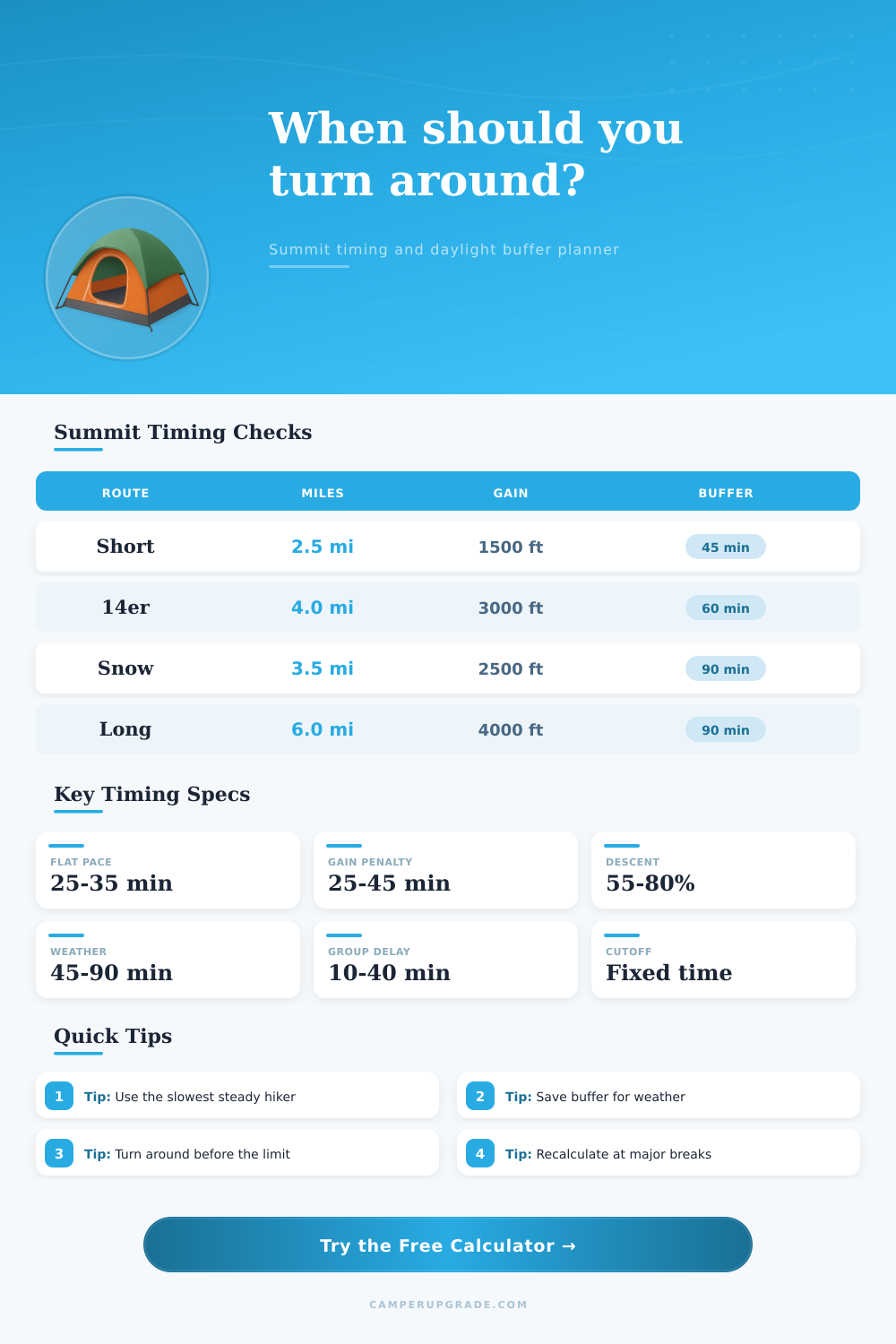
Table Route Preset Reference
| Preset | One-way distance | Elevation gain | Planning use |
|---|---|---|---|
| Easy Ridge | 2.4 mi | 1400 ft | Short summit with clean trail and moderate grade |
| Short Alpine | 3.1 mi | 2200 ft | Above-treeline day hike with moderate exposure |
| 14er Standard | 4.0 mi | 3000 ft | High-elevation standard route with early start |
| Snowfield Climb | 3.6 mi | 2600 ft | Firm morning snow, slower descent, bigger buffer |
| Class 3 Scramble | 3.8 mi | 2800 ft | Hands-on terrain and careful downclimbing |
| Long Approach | 6.2 mi | 3300 ft | Longer trail miles with moderate technical demand |
| Volcano Camp | 4.8 mi | 4200 ft | Big vertical day from high camp or trailhead |
| Winter Peak | 4.2 mi | 2700 ft | Snow travel, short daylight, and slow group movement |
Table Ascent Penalty Guide
| Condition | Penalty per 1000 ft | When to use it | Notes |
|---|---|---|---|
| Fit, light pack | 20-28 min | Good trail and acclimated hikers | Use only if the group usually climbs quickly |
| Average hiking group | 30-38 min | Most mountain day hikes | Good default for mixed ability groups |
| High altitude or heat | 40-50 min | Thin air, hot sun, heavy pack, or loose footing | Pair with a larger weather buffer |
| Snow, scree, or fatigue | 50-70 min | Slow steps, route checks, and repeated breaks | Conservative choice for uncertain terrain |
Table Descent Factor Guide
| Descent terrain | Factor | Example | Planning note |
|---|---|---|---|
| Smooth trail | 55-65% | Dry switchbacks or packed dirt | Fast groups may descend well under ascent pace |
| Normal mountain trail | 65-80% | Rock steps, roots, and moderate grade | Balanced default for most summit hikes |
| Loose or steep | 80-95% | Scree, talus, steep snow, or tired knees | Use a higher factor when slips are likely |
| Technical downclimb | 95-120% | Scrambling, rope transitions, or darkness | Descent can be slower than uphill movement |
Table Buffer And Cutoff Reference
| Route risk | Weather buffer | Group delay | Cutoff approach |
|---|---|---|---|
| Stable short hike | 30-45 min | 5-15 min | Daylight limit may be enough |
| Afternoon storm risk | 60-90 min | 10-25 min | Set hard cutoff before peak storm window |
| Snow or route finding | 90-120 min | 20-40 min | Use a strict summit turnaround time |
| Winter daylight | 60-120 min | 20-45 min | Let the earlier of daylight and hard cutoff rule |
Tips Practical Timing Tips
Besides the summit that a hiker aim to reach on the day of hiking, many hikers must make one of most important decisions. This decision is regarding the turnaround time for the hike. The factors that influence the turnaround time include the distance of the hike, the amount of elevations that will be gained, the pace at which a person can hike the trail, the weather, and how late the daylight will end for that specific hike.
Many hikers tend to make mistakes in planning their turnaround time because they are too focused on the hikes goal and are too optimistic about how long it will take to complete the hike once they begin. The turnaround time calculator will help prepare a hike by making the mathematical calculations after inputting the hiking route details, start time, and daylight limits. The calculator will help determine the estimated time to reach the summit, the latest time to turn around, the descent time, and the weather buffer.
How to Choose a Turnaround Time for Your Hike
The weather buffer will show the amount of time that remains after accounting for the time allotted for potentially bad weather. If the hike include a positive weather buffer, it means that there is time to account for weather changes or fatigue. However, if the hike features a negative weather buffer, it means that the time to account for bad weather has already been used during the hike.
Hikers can input the flat hiking pace that they can maintain for three hour while on the trail with a pack at an alpine elevation on potentially wet or loose ground. However, if the trail feature a significant elevation, an ascent penalty will be required. The hiking party will be given this extra time according to the thousand feet of elevation gained.
This additional time may be given due to thin air at high elevations, the fitness of the individual hikers, or the difficulty of the trail. The amount of time calculated by multiplying the flat hiking pace and the ascent penalty and adding the group delay will allow the hiking party to plan for the ascent to the mountains summit. The descent factor will take into account how long the hiking party will take to descend the mountain.
Due to fatigue, a hiker may take longer to descend the mountain than they will hike up. The descent factor will allow for input of how much of the hikes flat pace the hiking party will maintain on the descent. A low percentage will allow for good trail conditions and fresh legs.
A higher percentage will allow for trails with snow or scree that are more challenging to descend. However, the distance planned for the descent will be the same different than the distance accounted for ascending the mountain. The daylight limit and cutoff times will determine the latest time to turn around.
After determining the latest time to turn around, the descent time and weather buffer will be deducted from that latest time for the hiking party to turn around. The weather buffer will not account for time to spend on the mountains summit. The hiking party will be allotted the time in the weather buffer to contend with potentially bad weather while en route to the summit.
The time after the descent should of a positive number of minutes. If the time after the descent is close to zero, the hiking party may have to plan to begin the hike earlier or lower the objective. Many hiking parties will not plan their hiking trip around the calculated turnaround time.
Instead, they will rely on how they feel when they reach the summit to determine whether or not they want to continue hiking. This is a matter of comfort for short hikes. However, on longer hikes with potentially bad weather, there will be guesswork in determining if the hiking party can make it to the summit.
By using the turnaround time calculator, hiking parties can make up their minds before they set out on the trail. The tables referenced on the page will provide typical time factors for hiking pace, ascent, and descent for hiking parties to use as estimates. The turnaround time calculator may complicate the plans created by the group factor.
Many hiking parties will plan the hike according to the strongest climber in the group rather than the pace of the entire group. However, the plans should account for the pacing and the delays for each individual in the group to provide a later turnaround time to account for any struggles of any individual member. Weather is the most crucial important variable to account for when planning a hike.
Thunderstorms and rapidly dropping temperatures in the afternoon may happen faster than the weather report suggest. The time in the weather buffer will account for such instances in which the hiking party may not want to spend time on the summit but instead would like to spend time lower on the mountain. Experienced hiking parties may plan the hike according to this weather buffer first before deciding on any other aspect of the hike.
The decision to turn around may be difficult for some because of the emotions associated with the decision. For some individuals, turning around may suggest a failure of the hike because they have spent so much time and elevation to reach this point. However, the turnaround time calculator will make the emotional weight of the decision lighter for the hiking party because the time calculations will show the consequences of the decision.
If the latest time to turn around has passed by the time that the hiking party reaches the summit, then the decision to turn around is due to a schedule conflict that the hiking party created for themself. The same logic applies to the descent. Hiking parties may plan the descent according to the hike estimates but may find it difficult to adhere to such plans due to fatigue and the fading of the hiking light.
Thus, the hiking party should check the weather buffer at any major break in the hike. Although it may seem unlikely that the hiking party will fail to adhere to the descent estimates, it is crucial to know that such a plan could fail. Finally, the turnaround time calculator allows the hiking party to see the invisible costs of the hike, such as how much time will be lost to the pace of the party or to the descent difficulties of the trail.
While the goal of any hike is to reach the summit, the turnaround time allows hiking parties to enjoy the summit that they have worked so hard to reach.