Stuff Sack Volume Calculator
Estimate the right sack size for sleeping bags, tents, clothes, cook kits, and compressible camping gear using volume, shape, closure, fabric, and packability allowances.
🏕Quick Gear Presets
📏Sack And Gear Inputs
Inside diameter after seams, not flat fabric width.
Used with height for oval dry bags and tent sacks.
For roll-top bags, enter height below the folded closure.
Use this when the gear maker lists packed volume.
Calculation Breakdown
🧵Material And Spec Comparison
📊Common Gear Packed Volumes
| Gear item | Typical volume | Compression behavior | Suggested sack range |
|---|---|---|---|
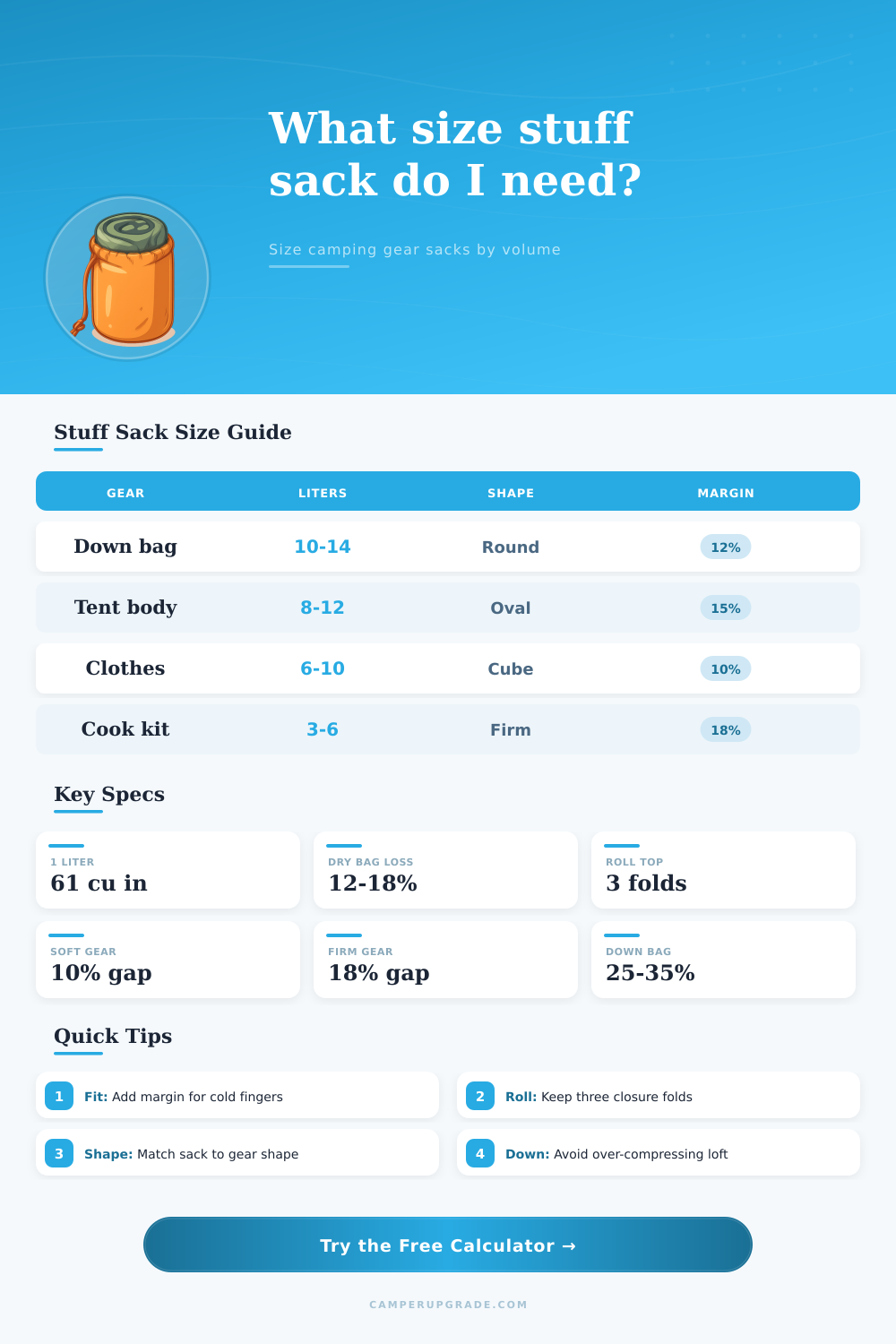
| 20F down mummy bag | 11 to 14 L | Compressible, protect loft | 12 to 16 L |
| 30F synthetic quilt | 14 to 18 L | Bulky spring-back | 16 to 22 L |
| Two-person tent body | 8 to 12 L | Medium, pole-free | 10 to 15 L |
| Sil tarp shelter | 4 to 7 L | Slippery fabric | 5 to 8 L |
| Weekend clothing set | 6 to 10 L | Soft but uneven | 8 to 12 L |
| Nested cook kit | 3 to 5 L | Firm, dead air gaps | 4 to 7 L |
| Inflatable sleeping pad | 2 to 5 L | Firm roll | 3 to 6 L |
📐Cylinder Size Reference
| Round sack size | Raw volume | With 12% loss | Best use |
|---|---|---|---|
| 5 in x 10 in | 3.2 L | 2.8 L | Stove, first-aid, pad |
| 6 in x 12 in | 5.6 L | 4.9 L | Rain gear, tarp |
| 7 in x 14 in | 8.8 L | 7.7 L | Clothes, tent body |
| 8 in x 16 in | 13.2 L | 11.6 L | Down bag, hammock |
| 9 in x 18 in | 18.8 L | 16.5 L | Synthetic quilt |
| 10 in x 20 in | 25.7 L | 22.6 L | Bulky winter gear |
🧮Closure And Fabric Factors
| Sack type | Usable factor | Closure note | Best fit style |
|---|---|---|---|
| Drawcord nylon | 95% | Top gathers into corners | Soft sleeping gear |
| DCF ultralight | 97% | Low stretch, crisp seams | Known-size kits |
| Roll-top dry bag | 88% | Three folds need air space | Wet or splash gear |
| Compression sack | 82% | Straps deform cylinder | Sleeping bag only |
| Mesh sack | 92% | Stretch leaks shape | Cook kit or wet items |
| Packing cube | 90% | Zipper corners flatten | Clothing layers |
📦Standard Sack Size Conversion
| Nominal size | Cubic inches | Typical round dimensions | Camping use |
|---|---|---|---|
| 3 L | 183 cu in | 5 x 9 in | Small ditty kit |
| 5 L | 305 cu in | 6 x 11 in | Rain shell or stove |
| 8 L | 488 cu in | 7 x 13 in | Clothes or tarp |
| 10 L | 610 cu in | 7.5 x 14 in | Tent body |
| 13 L | 793 cu in | 8 x 16 in | Down bag |
| 20 L | 1220 cu in | 9.5 x 19 in | Bulky synthetic bag |
| 30 L | 1831 cu in | 11 x 22 in | Winter layers |
⚡Field Sizing Notes
At some point, we’ve all crammed our sleeping bag into a too-small pack trying to squeeze it into a bag that, on paper, was big enough. Reality doesn’t give a rip what the volume rating is; the fabric want to stretch out, and your cold fingers wants to let go. That’s the lesson of doing this: Gear storage isn’t as simple as “this bag holds X amount of air.” It’s also about how much real world space it takes up to close the lid after filling it.
Flat dimensions simply don’t take these things into consideration, which is where the calculator above come in. It factors all this in for you. Most manufacturers quote the raw interior volume (i.e., the total surface area of their fabric). But of course the usable volume is less than that number due to seam allowances, zippers, and roll-top closures that consumes vertical inches with each fold. Before you stuff your quilt in there, factor in the loss of height from such things as a dry bag with a three-fold collar. The tool adjusts final recommendation so you’re not left wondering if adding an extra inch of space will make or break your packing strategy.
Why Bags Are Harder to Fill Than They Look
Volume is only part of the equation; form is equally important. A round cylinder stuff sack has lots of wasted air at the corners, so it holds fewer cubic inches than a rectangular packing cube. However, a packing cube use all available space but isn’t flexible for things like tent bodies that has odd shapes. Once you pick out the form factor that matches your equipment, then it becomes a question of whether the object fill the container well.
Soft stuff fits against the sides and creates no wasted dead air space. However, a hard-sided sleeping pad or cook kit will create air pockets between itself and the side and increase total volume. Knowing this avoids the annoyance of getting a bag that’s technically big enough but can never be closed because something hard is plugging up the zipper.
Another example: I have learned from experience that my gut instinct about how much to compress down insulation is dead wrong. To save pack space, you’ll think it’s smart to try to wring all of the air out of your sleeping pad insulation… But doing that too much will cause it to loose its loft and insulating power over time. The calculator models multiple levels of compression and shows you the impact on both the volume and health of your gear. In this case, you might find you can save two liters of packed volume with a modest squeeze, but at the cost of ruining a $1,000 sleeping bag. Using the calculator to see how much pressure affects your gear helps you decide: Do you need to get it that compact for this trip? Or are you just vanity packing?
In small ways, weight of the fabric matters for usability. Heavy-duty ripstop fabrics is stiff, so they do not stretch or fit well, which reduces their usable volume. Conversely, thinner ultralight nylon conforms to your body and stretches, so it effectively increases the usable volume. So two sacks with the same labeled capacity may not work equally well in the real world due to these different structures. The reference tables on the page break this down, explaining how a material’s stiffness impacts the resulting usable factor. It could of that the bigger sack made of soft fabric is actualy more efficient than the smaller sack made of hardy plastic since it lets your gear settle into every nook and cranny.
The other side of things is the cold. When we’re cold, dexterity decreases and fine motor skills goes out the window. Tightly cinching something is really hard when our fingers are numbing off. That’s why you want to factor in the human element and add a little wiggle room to what you’re thinking. Not only do we need a container large enough to hold everything, but also one that allows us to interact easily with its contents in adverse conditions. While in the summer a 10% buffer may seem wasteful on the trail, it could be the difference between being able to get camp packed up before dark or having to shiver while doing so. The correct-sized bag isn’t necessarily the tiniest available; it’s simply the most convenient. For instance, you need something that can be opened quickly and closed reliably without needing Superman muscles.
If you consider how materials behave, what shapes fit best, and how much you lose when you close things (think closure loss), then you start making plans rather than guesses. And you’ll thank yourself the next time you’re standing in the rain attempting to close your bag while at home you made an extra inch of space because it was sunny out.