String Light Span Calculator
Estimate cord length, sag allowance, support clips, bulb count, and outdoor power load for RV awnings, campsite patios, shade shelters, and portable posts.
⚡Fast Camping Presets
🔧Span Inputs
📊String Type Spec Grid
📐Sag And Support Reference
| Anchor-to-anchor span | 6% sag | 8% sag | 10% sag | Best use |
|---|---|---|---|---|
| 8 ft | 6 in | 8 in | 10 in | Short awning edge |
| 12 ft | 9 in | 12 in | 14 in | RV patio side |
| 16 ft | 12 in | 15 in | 19 in | Small campsite span |
| 20 ft | 14 in | 19 in | 24 in | Post to tree run |
| 24 ft | 17 in | 23 in | 29 in | Use guide cable |
💡Bulb Spacing And Load Table
| Bulb spacing | Bulbs per 25 ft | LED load at 1.5 W | Incandescent load at 11 W | Typical look |
|---|---|---|---|---|
| 12 in | 26 bulbs | 39 W | 286 W | Dense cafe edge |
| 18 in | 18 bulbs | 27 W | 198 W | Compact patio run |
| 24 in | 14 bulbs | 21 W | 154 W | Classic campsite glow |
| 36 in | 10 bulbs | 15 W | 110 W | Open bistro spacing |
🔗Mounting Hardware Reference
| Run condition | Clip interval | Anchor choice | Support cable | Notes |
|---|---|---|---|---|
| Awning rail | 2 to 3 ft | Awning hooks | Usually no | Keep below fabric seam |
| Fence or deck rail | 3 to 4 ft | Screw hooks | No for short runs | Add soft ties near corners |
| Post to post | 4 to 5 ft | Eye lag bolts | Yes over 15 ft | Preload cable, not bulbs |
| Tree to RV | 3 to 4 ft | Tree strap plus hook | Yes over 12 ft | Avoid tight bark contact |
| Canopy frame | 2 to 3 ft | Frame clips | No | Leave zipper path clear |
🏕Common Camper Layouts At 8% Sag
| Layout | Measured path | Cord with sag | Bulbs at 24 in | Suggested supports |
|---|---|---|---|---|
| 16 ft RV awning | 16 ft | 18 ft | 10 bulbs | 4 supports |
| 10 x 10 canopy perimeter | 40 ft | 45 ft | 23 bulbs | 8 supports |
| 8 x 18 patio L | 26 ft | 29 ft | 15 bulbs | 6 supports |
| 12 x 16 picnic rectangle | 56 ft | 63 ft | 32 bulbs | 10 supports |
| 20 ft post-to-tree run | 20 ft | 22 ft | 12 bulbs | 4 supports plus cable |
✅Calculation Tips
The string light installation is treated structuraly, not decoratively.
Wrapping them around the awning and plugging them in resulted in a chaotic drooping mess; instead, you need to consider geometry. The lights act as a temporary bridge across span and must be held up and pulled tight. If you don’t think about this span, you gets a chaotic mess. Get the span right, and you’ve got yourself a cozy patio.
How to Install String Lights
Sag is the primary problem. Because there’s weight to the wire, physics says it will sag between anchor point. Clamping the wire too hard doesn’t get rid of the sag. Pulling it to hard makes the wire stretch or causes bulbs to pop out. Leave it slack and lights sag. That’s where this calculator comes in.
It does the math for you. It takes what you want the finished product to look like and turns those desires into specific measurements (of both support spacing and cord length). It allows you to buy just enough wire, taking guessing game out of it.
First determine what you want to outline. Account for the corners if you are framing a canopy. Run down both sides. Add them together. That’s the total length of the run. Or, measure from end to end if it’s a straight run. If it’s an L shaped patio, add those two ends.
When running lights up a fence line most folks don’t account for return trip. When outlining a canopy they neglect the corners. Enter all that into tool and let it do the math.
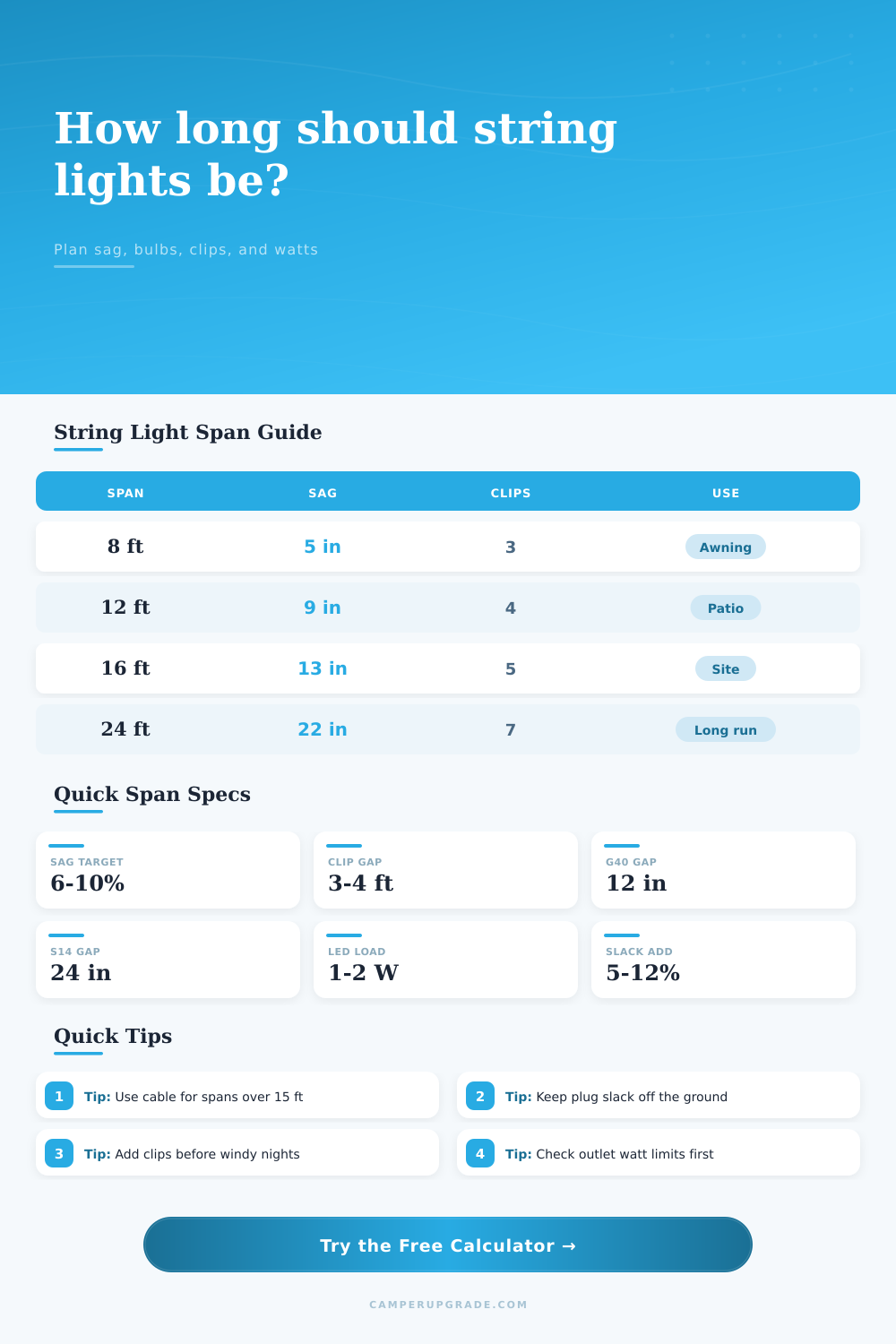
Next decide how much sag you desire. Six percent is tight. Ten percent gives you a nice soft curve. A twenty foot span with a ten percent dip means a 2′ dip. Most folks look for a six to ten percent sag. You’ll find your sweet spot somewhere in there.
Another important variable is how far apart those supports are spaced. No, they can’t be the ends and then hope for the best. They’ll need intermediate help because weight of the bulbs has to get pulled up by something. G40 globes is heavy, lots of weight per foot of length. Enter the support calculator, which will estimate how many clips you would of needed if you went with your max unsupported distance. With all that weight, you want to keep them every three to four feet so string doesn’t sag under load.
If you go further than fifteen feet between trees, you adds a separate guide wire. Run it tight, let the lights hang off it. The lights’ only job is to provide the glow; the cable carries the structural stress.
The last limitation is power. Most RV outlets are limited to about six hundred watts per circuit. If you daisy-chain several strand together, you must understand the combined load. Here’s where LEDs help because each bulb pulls one to two watts. That means you can string dozens of them and never trip the breaker. By contrast, an incandescent bulb draw ten watts or more. That’s enough to trip a breaker with just ten bulbs on a single outlet.
With the calculator, it monitors your load (in watts) compared to limit of your outlet. If you’re pushing too hard, it warns you. You don’t leave until you know. Dimming out the microwave? No way.
Then you tack on slack. For RVs, eight percent is a good rule of thumb. That’s the amount needed to neatly follow rails with the wiring. It’s enough for a nice turn around post and at plug end.
A clean run looks professional. Tangling and loose ends look like they was rushed.
Once you get your figures, order a bit more wire. It’s better to cut back a line of lights than try to splice one together in the breeze.
And you think about the geometry and take into account weight. You calculate the watts. Then when the sun sets, you appreciate the light.