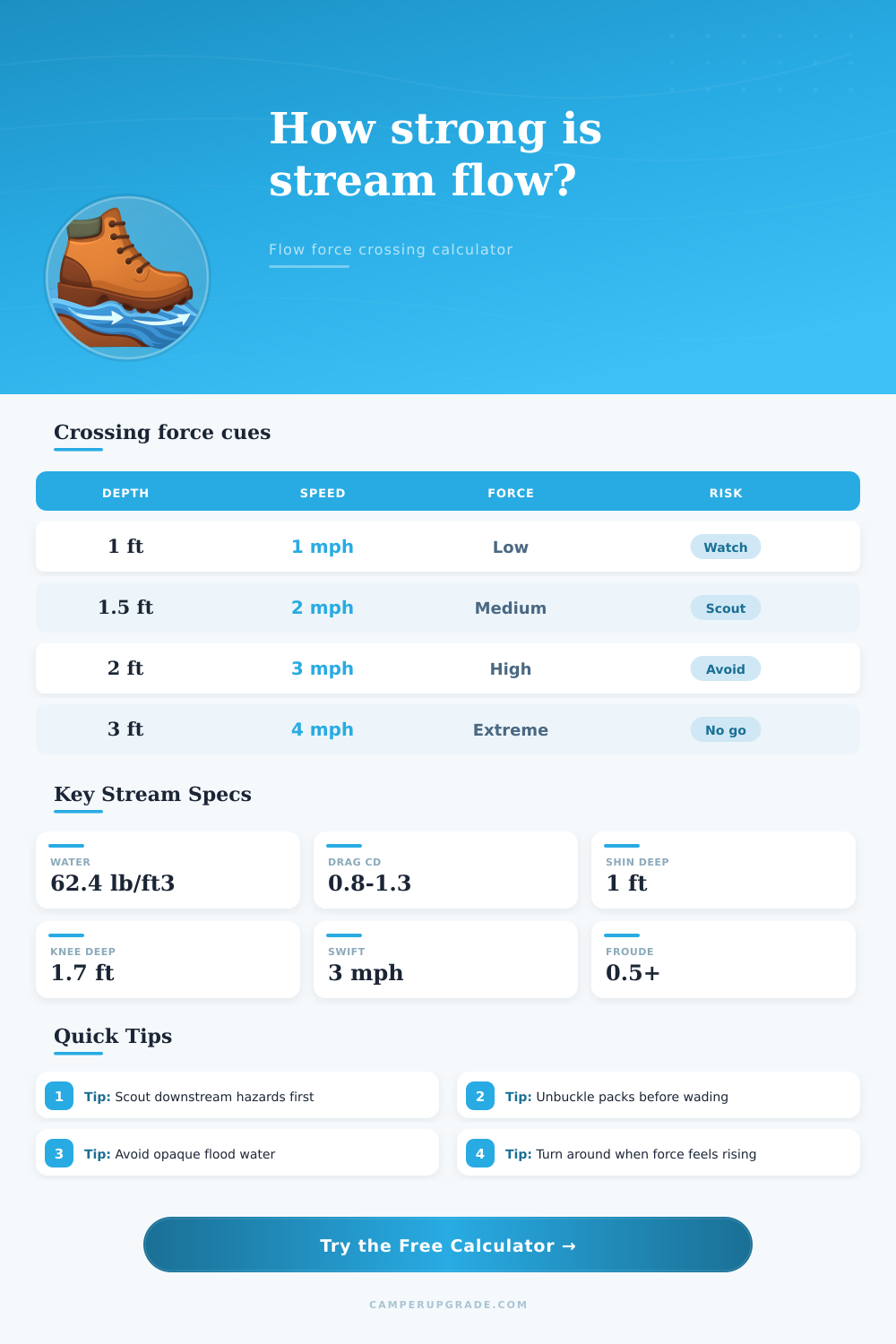
Stream Crossing Flow Force Calculator
Estimate water push, footing demand, traction margin, and crossing risk from stream depth, current speed, exposed body or vehicle area, surface grip, and safety buffer.
🌊Real crossing presets
📏Crossing inputs
This calculator estimates horizontal drag force with F = 0.5 x rho x Cd x area x velocity squared. It is planning math, not a rescue or flood-water clearance.
Crossing force result
🧮Hydraulic reference cards
🥾Footing and tire grip comparison
Slick algae rock
Low practical friction around 0.25. Treat modest depth and speed as unstable, especially with a pack.
Rounded cobble
Moderate grip around 0.35, but rolling stones reduce stance confidence and raise trip consequence.
Coarse gravel
Better bracing around 0.45. It still weakens fast when depth approaches knee or hub height.
Tires on mud
Vehicle traction may fall near 0.30. Buoyancy, hidden holes, and stalled engines are separate risks.
📊Depth and current force table
| Condition | Depth | Current | Planning read |
|---|---|---|---|
| Ankle wade | 0.5 ft / 0.15 m | 1 mph / 0.45 m/s | Low force, still probe for holes and slick rock. |
| Shin wade | 1.0 ft / 0.30 m | 2 mph / 0.89 m/s | Noticeable push; poles or a wide stance help. |
| Knee wade | 1.7 ft / 0.52 m | 2.5 mph / 1.12 m/s | High exposure for hikers with packs or cold water. |
| Thigh wade | 2.3 ft / 0.70 m | 3 mph / 1.34 m/s | Often a turn-around condition for foot travel. |
| Vehicle hub depth | 2.0 ft / 0.61 m | 3 mph / 1.34 m/s | Check intake, diff breathers, entry angle, and bed firmness. |
⚙Drag coefficient reference
| Object in flow | Typical Cd | Exposed area cue | Use when |
|---|---|---|---|
| Angled legs, narrow stance | 0.70-0.85 | Depth x leg width | Facing partly upstream with controlled foot placement. |
| Upright hiker and pack | 0.95-1.15 | Depth x body width | Normal hiking ford with pack, boots, and loose clothing. |
| Bike or pannier load | 1.00-1.30 | Depth x bike length | Bike is broadside or pushed through cross-current. |
| Flat raft, door, or boxy cargo | 1.30-1.45 | Depth x panel width | Large flat surfaces catch pulses and eddies. |
| SUV or camper side | 1.15-1.35 | Waterline x vehicle width | Vehicles face drag and buoyancy before they float. |
🚦Risk thresholds table
| Result cue | Traction margin | Froude number | Crossing decision |
|---|---|---|---|
| Green | 300% or more | Below 0.30 | Usually manageable if the bed is visible and escape is simple. |
| Yellow | 180-300% | 0.30-0.45 | Scout for a slower, wider, shallower line before committing. |
| Orange | 110-180% | 0.45-0.60 | High caution; packs, bikes, and cold water can flip the call. |
| Red | Under 110% | Above 0.60 | Avoid, wait, detour, or find a bridge or controlled ford. |
🧭Common crossing examples
| Scenario | Typical setup | Main force driver | Better choice |
|---|---|---|---|
| Clear ankle ford | 0.5 ft, 1 mph, gravel | Footing more than drag | Cross at the broad, shallow riffle. |
| Cold knee crossing | 1.6 ft, 2.4 mph, cobble | Depth and pack weight | Unbuckle pack and use poles. |
| Bike push | 1.2 ft, 2 mph, panniers | Broadside bike area | Angle upstream and remove heavy bags. |
| UTV creek | 1.7 ft, 2.8 mph, rock | Tire grip and pulses | Walk line first if safe and legal. |
| SUV flood wash | 2.2 ft, 4 mph, opaque | Buoyancy and hydraulics | Do not enter moving flood water. |
The thing about most river crossings is it’s not the force pushing you sideways that gets you, but the moment your foot slips on a hidden stone while that force is already pulling you off balance. No matter how deep water looks or how fast a leaf floats past, you won’t know if you can stay upright until you understand how much drag your vehicle or pack adds. The traction margin number give you an answer.
It is math based off your specific situation, so you do not have to guess how much drag you add or how close you are to falling over when you step out there. But the power of it comes from a simple fact, water has mass, and because mass moves there’s momentum which gets transferred to whatever lies ahead. That means when you’re standing on river, the water exert a force against your front side as wide as you are, depending on how fast it’s flowing.
How To Cross Rivers Safely
Which is where stance becomes key. Because if you put yourself in the water broadside, you catch all those pounds. But if you angle your body just a bit up-current, now you cut down that exposed surface area a lot. You’re not going to fall over as easy as a guy who’s standing fully upright with a big old backpack on his back.
And guess what? The tool model that with drag coefficients. This allow you to model how much less likely the upright guy would fall compared to someone angling their body into current. A slight shift in body position make a huge change in force equation.
Finally, there’s an element that seems like common sense but which many novices undervalue: depth matter. Fast current in a creek doesn’t always mean the same than fast current in a river. A swift run through a shallow section may be slow as molasses compared to a deeper section, where slower velocity offsets drag along the river floor. Danger lurks when depth interact with velocity, when a ford’s Froude number indicate supercritical flow conditions where waves form and hydraulics become chaotic.
That’s way beyond most recreational forders comfort zone. Seeing clear water up to their knees, they think nothing of crossing, failing to realize that when your feet come off the solid ground, buoyancy kicks in and carries you away. Friction gives way to hydrostatic lift, making traction irrelevant. The table on page spells out the danger areas for easy visual reference so you’ll know when a ford go from doable to deadly.
The second half of the fight is surface grip which can’t be fully calculated with raw force alone. You may have the force inside the envelope of your strength, but you’ll fail in a heartbeat against slick algae and rounded cobblestone. The calculator account for these surfaces, differentiating between muddy bottom where traction is near zero and coarse gravel where there’s some good bite.
This is also important for vehicle operators. While the vehicle could of possibly cope with the hydrodynamic force without stalling out, spinning the tires on polished rock or mud shuts down forward momentum and water fill the intake. It takes enough friction to fight both current drag and the vehicle weight.
Scouting the crossing point pays off big. Before putting your weight on anything, look upstream for evidence of potential debris jams that may surge down. Rather than a vertical wall, check opposite bank for an easy exit. Is the water dirty? Assume the bottom isn’t smooth and the current is faster than it looks. Your eyes must verify ground.
Assume the bottom isn’t smooth and the current is stronger then it looks, so move faster. Your eyes must verify the ground. Numbers help you do the planning, but they are not a substitute for seeing the terrain. Listen to the math when it say there’s high risk.
It’s best to take a detour ten miles rather than learning about hydraulic pinning in the bottom of a creek. Respect the flow because water always wins, even if your boots gets wet along the way.