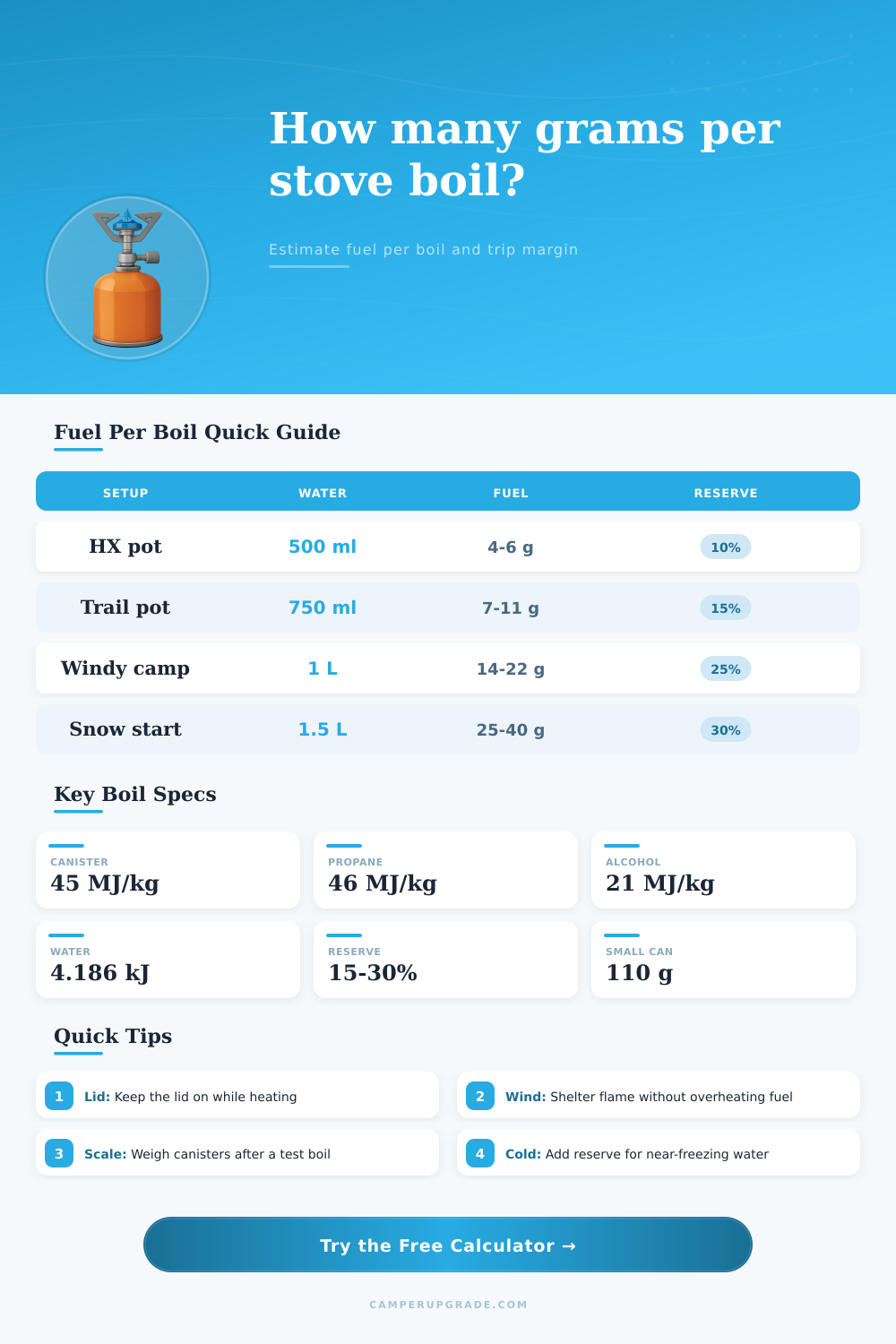
Stove Fuel Grams Per Boil Calculator
Estimate grams of stove fuel for one boil, total fuel for repeated boils, canister boils available, and reserve margin using water volume, start temperature, altitude, fuel blend, stove efficiency, wind, lid use, pot fit, and ignition loss.
🏕Real Camp Boil Presets
⚙Water, Fuel, Stove, and Weather Inputs
The calculator uses water heat capacity, altitude-adjusted boiling point, fuel energy density, stove efficiency, wind loss, lid behavior, pot fit, cold fuel pressure, ignition loss, and boil hold time.
📊Stove Fuel Spec Grid
⛽Fuel Energy Reference
| Fuel type | Energy used by calculator | Typical container | Planning note |
|---|---|---|---|
| Isobutane canister blend | 45 MJ/kg | 110 g, 230 g, 450 g canisters | Strong three-season backpacking baseline; cold can reduce delivered output. |
| Propane camp fuel | 46.4 MJ/kg | 1 lb cylinder or refillable bottle | Stable for car camping, group kettles, and cool weather cooking. |
| White gas stove fuel | 44 MJ/kg | 11 to 30 fl oz fuel bottle | Reliable in winter when primed and operated correctly. |
| Butane cartridge | 45.7 MJ/kg | 220 g cassette can | Convenient for mild camp kitchens and picnic burners. |
| Alcohol stove fuel | 21 MJ/kg | 4 to 12 fl oz bottle | Quiet and simple, but grams per boil are usually much higher. |
| Solid fuel tablet | 28 MJ/kg | 14 g tablet | Best treated as fixed portions with careful wind shielding. |
🔥Typical Grams Per Boil Reference
| Boil scenario | Water volume | Efficient sheltered use | Windy or cold use |
|---|---|---|---|
| Small coffee mug | 300 ml / 10 fl oz | 3 to 5 g canister fuel | 5 to 8 g if exposed or very cold |
| Oatmeal and drink | 500 ml / 17 fl oz | 5 to 8 g canister fuel | 8 to 13 g in wind or cold water |
| Freeze-dried pouch | 650 ml / 22 fl oz | 6 to 10 g canister fuel | 10 to 16 g with poor shelter |
| Two-person dinner pot | 1.2 L / 41 fl oz | 11 to 18 g canister fuel | 18 to 30 g if windy or uncovered |
| Group kettle | 2.0 L / 68 fl oz | 18 to 30 g canister fuel | 30 to 50 g with large losses |
| Snowmelt starter water | 1.5 L / 51 fl oz | 25 to 38 g depending setup | 40 g or more in exposed winter use |
| Altitude | Approx boil point | Fuel effect | Cooking note |
|---|---|---|---|
| 0 ft / 0 m | 212°F / 100°C | Highest heat rise | Sea-level stove tests use this baseline. |
| 3,000 ft / 914 m | 206°F / 97°C | Slightly less heat to boil | Food still cooks nearly normally. |
| 6,000 ft / 1,829 m | 201°F / 94°C | Lower final target | Hydration can take longer. |
| 9,000 ft / 2,743 m | 195°F / 91°C | Less energy to boil water | Wind often offsets the savings. |
| 12,000 ft / 3,658 m | 190°F / 88°C | Much cooler boiling point | Use longer soak or simmer time. |
| Fuel available | At 5 g/boil | At 10 g/boil | At 20 g/boil |
|---|---|---|---|
| 100 g partial canister | 20 boils | 10 boils | 5 boils |
| 110 g small canister | 22 boils | 11 boils | 5 boils |
| 230 g medium canister | 46 boils | 23 boils | 11 boils |
| 450 g large canister | 90 boils | 45 boils | 22 boils |
| 465 g propane fuel | 93 boils | 46 boils | 23 boils |
💡Fuel Planning Tips
Calculating the amount of fuels needed for camping requires an understanding of how fuel consumption change based on many different environmental factor. People often guess at the amount of fuel that will be needed for there camping trip. However, guessing at the fuel needs of a camping trip will lead to either carrying too much fuel or too little fuel for the trip.
If the amount of fuel that is carried on a camping trip are too little, then the camper will run out of fuel, forcing them to eat cold meal. Thus, people must understand how various factors impacts fuel consumption by camping stove. One of the main factor that impacts fuel consumption is the water temperature from which the water will be heated.
How Much Fuel Do You Need for Camping
Heating water from a starting temperature of 35 degrees will require more fuel to heat the water than from a starting temperature of 60 degrees, thus the starting temperature of the water to be heated will impact the amount of fuel that the camping stove consume. The second main factor is the altitude at which the camping trip will occur. The boiling point of water decrease at higher altitudes.
Because the boiling point of the water is lower at high altitudes, it will require less energy to boil the water. However, the impact of the wind and cold temperature at these altitudes can negate this saving in energy required to boil the water at high altitudes. The third main factor impacting fuel consumption is the type of camping stove and the type of pot used on the camping stove.
A camping stove with a basic burner with a thin pot and no lid can only heat the water with thirty percent of the fuel that the stove burns. In contrast, a heat exchanger system stove can heat the water with sixty-five percent of the fuel that the stove burns. Thus, fuel consumption is less for a heat exchanger stove than for a basic camping stove.
Wind can also impact fuel consumption by a camping stove, as the wind can remove heat from the pot before it can heat the water. Thus, a light breeze can increase fuel consumption by fifteen percent or more by the camping stove. Beyond these factor, other factors that can impact fuel consumption are the temperature and the pressure of the fuel that the camping stove use.
The fuel pressure within canister stove will decrease as the temperature of the fuel drop. When fuel pressure decreases, the fuel consumption time of the canister will decrease, but the fuel will also lose heat to the air around the stove. In these case, the decrease in fuel pressure will lead to increased fuel consumption by the stove.
In addition to fuel consumption caused by decreasing fuel pressure, fuel consumption occur when lighting the stove (ignition loss) and when boiling the water for thirty seconds to keep the water in a rolling boil (boil hold time). Thus, an additional amount of fuel must be account for these process. A reserve percentage of the calculated fuel consumption is also necessary for camping trip.
A ten percent fuel reserve percentage may be sufficient for camping trips that are short in length and occur in good weather condition. A twenty-five or thirty-five percent fuel reserve percentage, however, may be better suited for long camping trip with uncertain weather condition. Using a higher percentage of fuel than is calculated for the trip can ensure that a camper has enough fuel to fulfill the need of that trip.
In order to calculate fuel consumption for camping trips, it is recommended to weigh the fuel canister before and after adding fuel for a test boil. By weighing the fuel canister before and after boiling water, it is possible to determine the weight of fuel consume by the stove to heat the water. Using this weight measurement, it is possible to establish a baseline fuel consumption rate for the camping stove and pot that is use for camping trips.
With the establishment of a baseline consumption rate, it is possible to calculate the amount of fuel that will be needed for the remainder of the camping trip. Thus, by considering camping fuel consumption as a variable that change according to environmental factor, it is possible to determine the correct amount of fuel that should be transported for a camping trip.