Speedometer Error Calculator
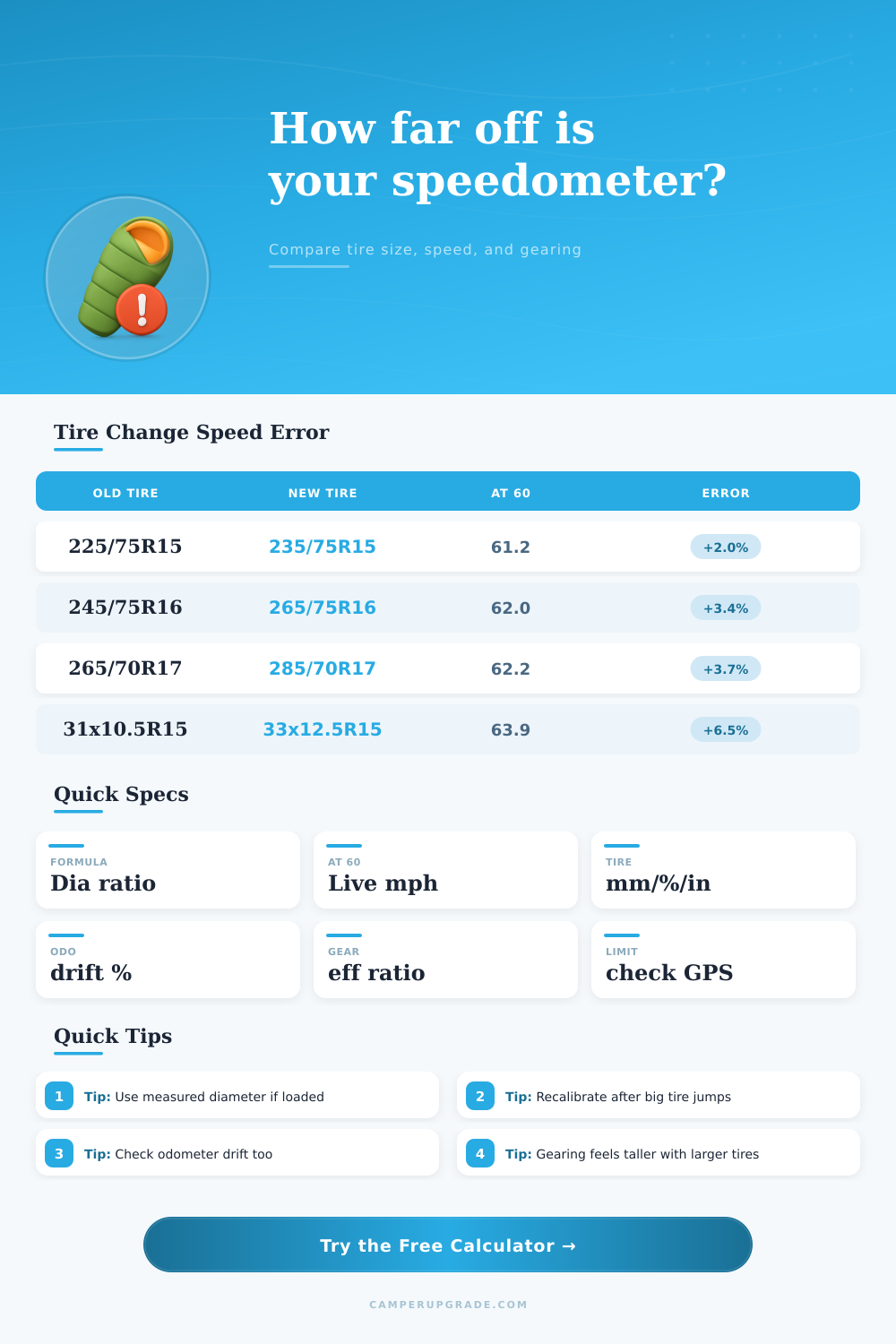
Compare old and new tire sizes to estimate actual road speed, speedometer error, odometer drift, and effective axle gearing after changing tire diameter.
| Calculated Item | Old Tire | New Tire | Change |
|---|---|---|---|
| Diameter | 30.47 in | 31.65 in | +3.9% |
| Circumference | 95.72 in | 99.43 in | +3.9% |
| At 60 mph shown | 60.0 mph | 62.3 mph | +2.3 mph |
| Odometer per 100 mi | 100.0 mi | 103.9 mi | +3.9 mi |
| Tire Size | Diameter | Circumference | Revs Per Mile |
|---|---|---|---|
| 225/75R15 | 28.29 in | 88.86 in | 713 |
| 235/75R15 | 28.88 in | 90.73 in | 698 |
| 245/75R16 | 30.47 in | 95.72 in | 662 |
| 265/75R16 | 31.65 in | 99.43 in | 637 |
| 265/70R17 | 31.61 in | 99.30 in | 638 |
| 285/70R17 | 32.71 in | 102.77 in | 617 |
| 275/65R18 | 32.07 in | 100.76 in | 629 |
| 285/65R18 | 32.59 in | 102.38 in | 619 |
| Indicated Speed | Actual Speed | Speed Difference | Speedometer Reads |
|---|---|---|---|
| 45 mph | 46.8 mph | +1.8 mph | Slow |
| 55 mph | 57.1 mph | +2.1 mph | Slow |
| 65 mph | 67.5 mph | +2.5 mph | Slow |
| 75 mph | 77.9 mph | +2.9 mph | Slow |
| Axle Ratio | Tire Change | Effective Ratio | Road Feel |
|---|---|---|---|
| 3.73 | +3.9% | 3.59 | Taller gearing |
| 4.10 | +3.9% | 3.95 | Taller gearing |
| 4.56 | +3.9% | 4.39 | Taller gearing |
| 3.42 | +3.9% | 3.29 | Taller gearing |
| Odometer Shows | Actual Distance | Difference | Meaning |
|---|---|---|---|
| 50 mi | 51.9 mi | +1.9 mi | Odometer low |
| 100 mi | 103.9 mi | +3.9 mi | Odometer low |
| 250 mi | 259.7 mi | +9.7 mi | Odometer low |
| 500 mi | 519.4 mi | +19.4 mi | Odometer low |
Tire brand, tread depth, load, inflation, and wheel speed sensor calibration can change real-world readings. Use GPS or a measured mile to verify the final correction.
Changing the size of the tires on an RV or tow vehicle can impact the accuracy of the speedometer. If you install tires with a larger diameter, the vehicle will travel further with each revolution of the tires. Thus, the speedometer will report a speed that is lower then the actual speed of the vehicle.
The calculator on this page will allow you to enter the sizes of the tires that you currently have installed and the sizes of the tires that you would like to install, and it will calculate the speed at which the vehicle would be traveling and the correction that would need to be make to the odometer reading. The diameter of the tire is the most important measurement of the tire. The width of the tire, the aspect ratio of the tire, and the size of rim that it is installed upon affect the diameter of the tire.
How Tire Size Affects Speed and Odometer
Two tires with the same measurements may have different diameters, and different diameters will result in the speedometer measuring the speed of the vehicle incorrectly. The speedometer is calibrated to the diameter of the original tires; thus, if the diameter of the tires change, the speedometer will report a speed that is lower than the actual speed of the vehicle. In order to use the calculator, you must enter the diameter of each type of tire.
You can read the section width and aspect ratio of the tire directly from the sidewall of the tire, and you can find the rim size stamped onto the wheel upon which the tire is mounted. However, some individuals may prefer to use a measurement of the diameter of the tire. You can measure the diameter of the tire by allowing the vehicle to sit upon its drive axles and allowing it to compress the tire against the ground; the tire will be even more compressed if the vehicle’s tanks are filled with the necessary fuel.
Using the loaded diameter of the tire will provide a correction to the speedometer that is even closer to the actual speed of the vehicle. Once you have each of the tire diameter measurements, you can use the calculator to determine the ratio of each type of tire. If you divide the diameter of the new tires by the diameter of the old tires, and you multiply that ratio by the speed that is indicated on the speedometer, you can calculate the actual speed at which the vehicle is traveling.
Using that same ratio, the calculator can also calculate the correction for the odometer reading and the axle ratio of the RV. Tables on the calculator will display common tire size combinations to make it easier for you to enter each of the measurements without having to refer to the tires each time. Many individuals will first notice the issue caused by altering the diameter of the tires of an RV.
The speed error that is created with different tire diameters can cause the odometer to drift; the odometer will read fewer miles than the RV has actualy traveled. Thus, other measurements of the RV can also drift; fuel economy will reflect a fuel economy that is higher than that which is actually experienced by the RV owner. While these errors are not inherently dangerous to the RV or to the individuals who ride within it, those errors will accumulate with each mile that the RV travels.
In addition to the speedometer and the odometer readings of the RV, changing the diameter of the tires will also change the way that the RV’s gears feel to the driver. With larger tires, the engine will reach more revolutions per minute (RPM) with each gear shift. As a result, the engine may feel like it does not have the same pulling power when climbing hills.
However, it will have less RPM within the same gears while traveling on flat areas, which may improve the fuel economy of the RV. The axle ratio of the RV will change with each change in tire diameter; the calculator will show you what the new axle ratio will be for the RV. Although the calculator is an accurate tool for determining the speed and the correction to the odometer reading created by each change in tire size, there are some variables in the real world that will counteract the calculations of the calculator.
For instance, the air pressure within the tires will change the diameter of the tires. Similarly, the depth of the tires’ tread may also change with the diameter of the tire. Additionally, different brands of tires can have slight differences in the diameter of those tires.
Each of these variables will ensure that the calculator is not a tool that will be perfect in each instance, but it will provide a good general estimation of the true speed of the vehicle. The best method to determine the actual speed of the vehicle is to use a GPS signal to those tires, or to travel a mile with the RV’s tires mounted and at there correct operating air pressure. In order to make a calibration decision for the tire sizes, you will want to determine the size of the speed error that will be created by the change in tire size.
If the speed error is within 2% of the actual speed of the vehicle, most individuals will simply note the change and continue driving the RV. However, if the error is beyond 3 or 4% in either direction, the speed error will be noticeable, and the odometer will exhibit a significant error in the displayed miles. At this point, the owner can either choose to ignore the speed error, or they can visit a service shop to reprogram the speed sensor that is responsible for the displayed speed of the RV.
The same logical decision processes can be used if you choose to install tires that are smaller than the original tire sizes that were manufactured for the RV. If you use smaller tires, the speedometer will display a speed that is higher than the actual speed of the vehicle. Additionally, the odometer will display a faster reading of the distance that the RV has traveled.
Additionally, smaller tires will provide a shorter gearing ratio of the vehicle. Using smaller tires can improve the acceleration of the vehicle. However, the engine will reach higher RPM when cruising at a set speed, leading to a deterioration of the fuel economy of the RV.
Thus, the calculator can be used in both instances, whether you are installing larger or smaller tires. In addition to the changes in the size of the tires of the RV, the axle ratio of the RV can also change. The axle ratio is the ratio of the transmission of the RV to its wheels.
If the diameter of the tires changes, the effective axle ratio changes, which alters how the RV feels when it is towing heavy loads with its fifth-wheel. Additionally, if the fifth-wheel that is being towed also has larger tires, the transmission will downshift later, allowing the engine of the RV to remain in a lower RPM while it is traveling. In order to decide what changes to make to the RV, you dont have to avoid changing the tires altogether.
Moddern tires are created with the intention of providing additional load capacity and fuel economy to the vehicles in which they are installed. The goal is to determine the cost of those gains in relation to the accuracy of the speedometer. Thus, entering each of the tire sizes and performing the indicated calculations with the calculator will allow you to make an informed decision about changing the tires.
The numbers provided by the calculator will ensure that the speedometer remains accurate after changing the tire sizes.