Specific Humidity Calculator
Estimate air moisture load from temperature, pressure, humidity, and altitude with a full humidity breakdown.
📋Scenario Presets
⚙Moisture Inputs
📊Formula Spec Grid
📘Reference Tables
| Temp | Sat vapor p | 50% RH q | 80% RH q |
|---|---|---|---|
| 0 C | 6.1 hPa | 1.9 g/kg | 3.0 g/kg |
| 10 C | 12.3 hPa | 3.8 g/kg | 6.1 g/kg |
| 20 C | 23.4 hPa | 7.2 g/kg | 11.5 g/kg |
| 30 C | 42.4 hPa | 13.4 g/kg | 21.4 g/kg |
| Altitude | Pressure | Drop vs sea | Use case |
|---|---|---|---|
| 0 m | 1013 hPa | 0% | Sea level |
| 500 m | 954 hPa | 6% | Low hill |
| 1500 m | 845 hPa | 17% | Mountain site |
| 3000 m | 701 hPa | 31% | High camp |
| RH | Temp | q at 1013 hPa | Mixing ratio |
|---|---|---|---|
| 30% | 15 C | 3.2 g/kg | 3.2 g/kg |
| 50% | 20 C | 7.2 g/kg | 7.3 g/kg |
| 70% | 25 C | 13.8 g/kg | 14.0 g/kg |
| 90% | 30 C | 24.0 g/kg | 24.4 g/kg |
| e (hPa) | w (g/kg) | q (g/kg) | Comment |
|---|---|---|---|
| 5 | 3.1 | 3.1 | Very dry air |
| 10 | 6.2 | 6.1 | Dry room air |
| 20 | 12.6 | 12.4 | Comfortable summer air |
| 30 | 19.0 | 18.7 | Humid tropical air |
Specific humidity is a measurement of the amount of water vapor that is contain within a specific mass of air. Many individual use relative humidity to convey information to teh public regarding the amount of moisture that is contained within an air. However, relative humidity will change with changes in the temperature of the air.
Specific humidity will not change with changes in the temperature of the air, as specific humidity measure the actual amount of water vapor that is contained in a kilogram of air. Thus, if the temperature of the air increase, the relative humidity will decrease, but the specific humidity will remain the same (assuming no water evaporate into or condenses out of the air). Specific humidity is a useful measurement of many different tasks.
What is specific humidity and why it is useful
For instance, specific humidity is of interest to meteorologists in that it can allow them to measure the moisture load of the atmosphere. The moisture load of the atmospheres is one of the variables that determines the fuel for storms. Additionally, the moisture load of the atmosphere is the parameter that determine the dryness of an area of the planet for wildfires.
Thus, specific humidity can be used in the attempt to dry crops, manage greenhouses, and understand why some basements may remain damp within a structure. Specific humidity will reveal to an individual the actual amount of water that is contained in the air, as opposed to the relative humidity measurement that indicates the amount of moisture contained in the air relative to the amount of moisture that the air can hold within that specific temperature. The difference between the relative humidity and specific humidity measurements can be seen in various environment.
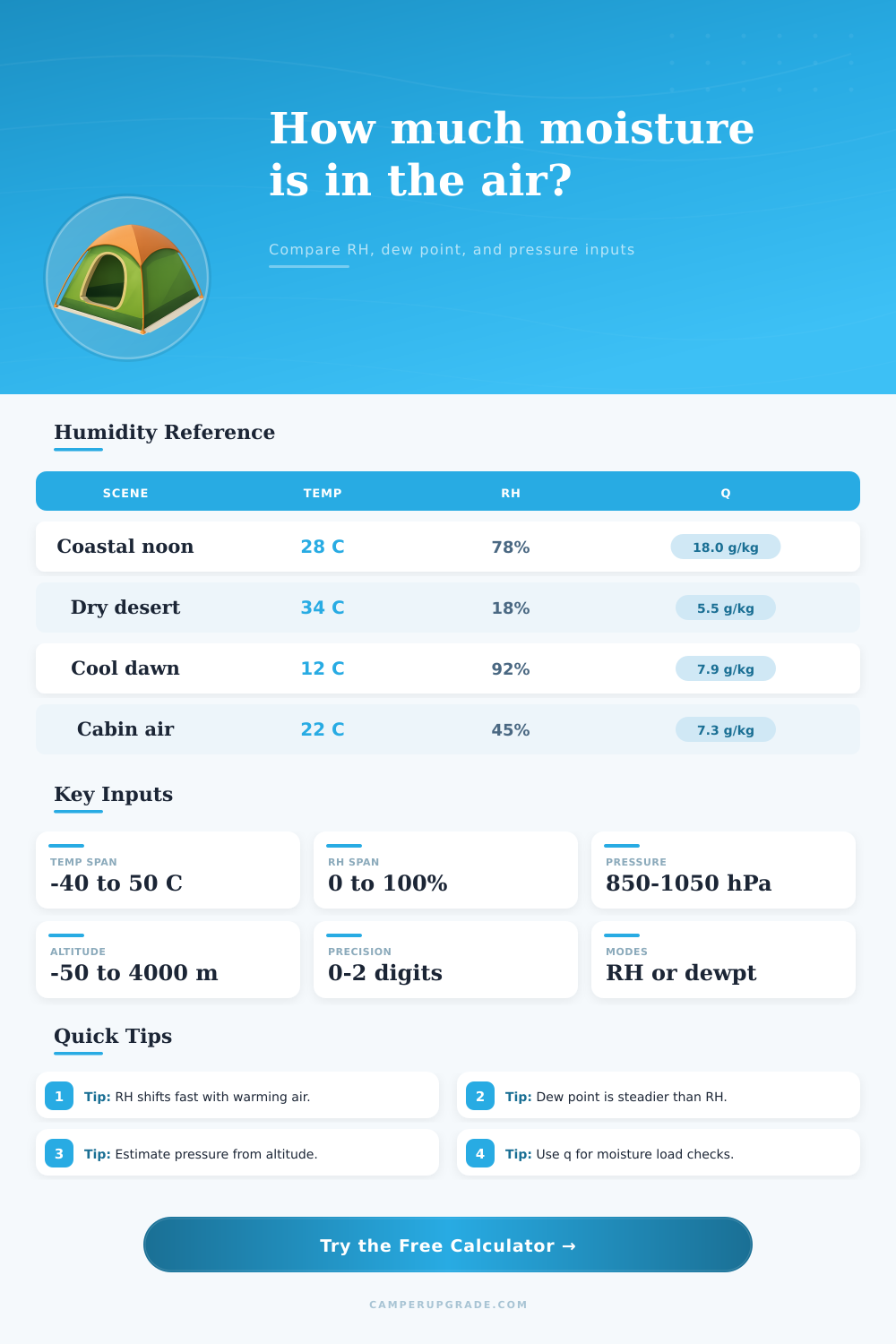
For instance, coastal air may have a temperature of 28 degrees Celsius with a relative humidity of 78%, indicating it contains 18 grams of water per kilogram of air. In contrast, desert air may have a temperature of 34 degrees Celsius with a relative humidity of only 18%, indicating that it contain only 5.5 grams of water per kilogram of air. Thus, despite the hotter temperatures within the desert, there is less water contained within the air molecules of the desert than within the coastal air.
Additionally, air pressure can impact the specific humidity measurement. For instance, as the air pressure decrease with increasing altitude, the specific humidity of the air increase for the same amount of water vapor contained within the air. Vapor pressure is one of the component of the equation that determines the specific humidity of the air.
The vapor pressure of the air is the partial pressure that the water vapor that is contained within the air exerts. The saturation vapor pressure over water can be approximated with the Magnus formula, which utilize the temperature of the environment to calculate that value. With the knowledge of the actual vapor pressure of the environment, another mathematical formula can calculate the specific humidity of the air.
The formula for specific humidity is 0.622 times the vapor pressure divided by the total pressure minus 0.378 times the vapor pressure. Specific humidity is similar to the mixing ratio; however, specific humidity is the ratio of the mass of water vapor to the total mass of air, whereas the mixing ratio is the mass of water vapor divided by the mass of dry air only. Another means of measuring the moisture within the air is through the use of the dew point.
While the relative humidity of the air may change if the air temperature change, the dew point will remain the same. Because of this invariance of the dew point, both pilot and farmers find uses for the dew point measurement. By inputting the dew point into a specific calculator, one can determine the relative humidity and specific humidity of the air.
Another measurement of humidity that differ from specific humidity includes the absolute humidity. The absolute humidity of an area’s air indicate the amount of grams of water per cubic meter of air. Additionally, the absolute humidity consider the absolute air temperature within the environment in Kelvin.
Thus, absolute humidity is of use for those that must size ventilation system, or for those that perform spray drying. For instance, if the vapor pressure of an area is 20 hectopascals, the absolute humidity will be 12 grams per cubic meter of air. However, if the vapor pressure within that same area increase to 30 hectopascals of vapor pressure, the absolute humidity will be 19 grams per cubic meter of air.
These humidity measurement can be used in a variety of situation. For instance, in greenhouses, specific humidity must be monitored to prevent issue like fungal blooms or leaf scorch. Additionally, individuals may want to monitor the dew point and the specific humidity within an RV’s cabin to ensure that the air within the RV is not too damp.
Finally, these various humidity measurement can be used to understand phenomena like fog. For instance, a fog bank at 11 degrees Celsius with 98% relative humidity contain 8 gram of water per kilogram of air. Thus, by utilizing the concept of specific humidity, individuals can understand the amount of water that is contained within the air, regardless of the temperature or the relative humidity percentage of that air bank.