Solar vs Generator Payback Calculator
Compare RV solar output against generator fuel and maintenance avoided across the camping days you actually use.
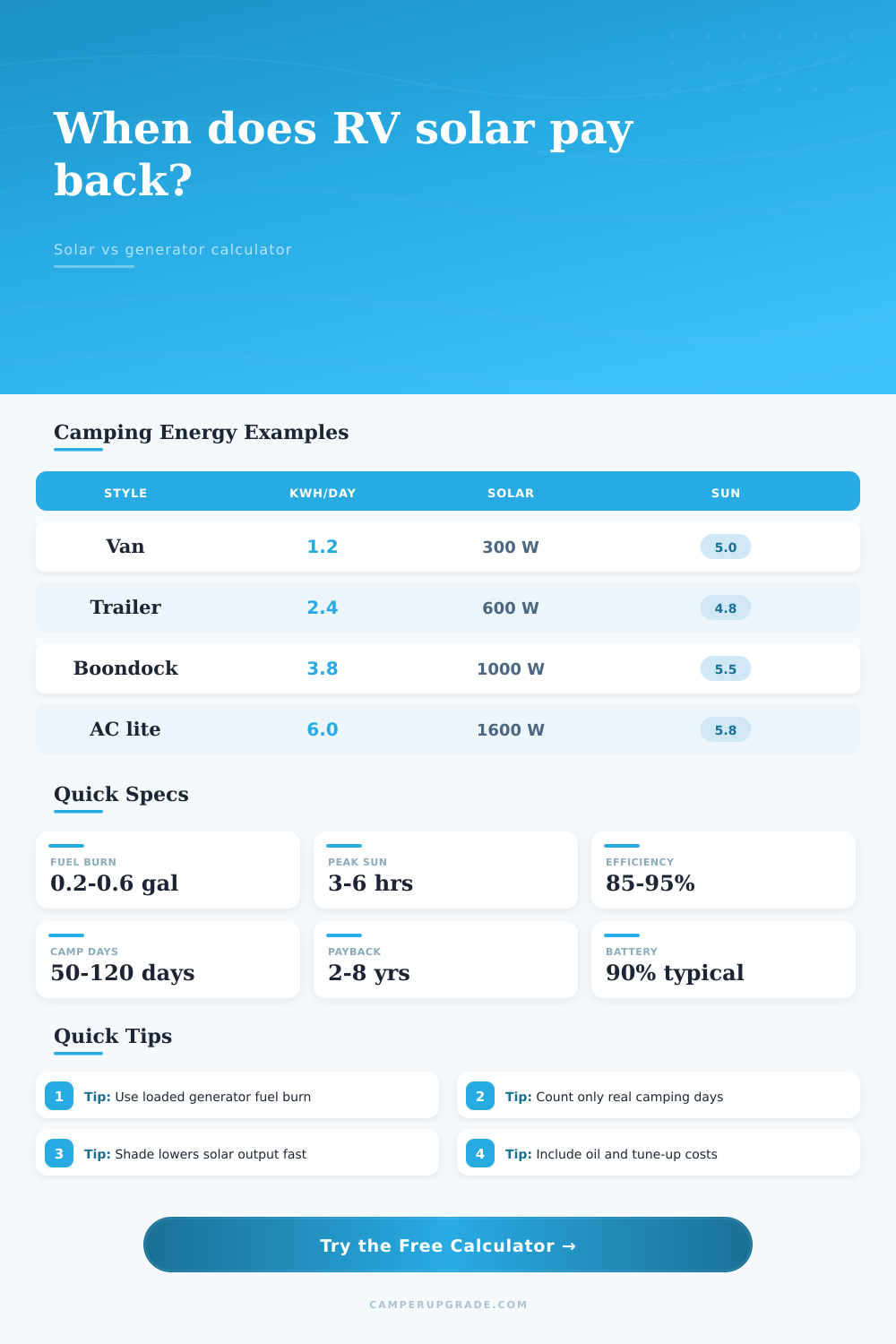
| Camping load style | Typical daily kWh | Likely solar range | Generator offset target |
|---|---|---|---|
| Fridge, lights, fans, device charging | 0.8 to 1.8 kWh | 200 to 400 W | Battery top-off runs |
| Trailer with water pump and furnace blower | 1.8 to 3.0 kWh | 400 to 800 W | Morning and evening charging |
| Remote work with laptop and internet | 2.5 to 4.5 kWh | 700 to 1200 W | Long midday generator blocks |
| Light air conditioner assist | 5.0 to 8.0 kWh | 1200 to 2000 W | Partial daytime support only |
| Solar condition | Peak sun hours | Efficiency setting | Planning note |
|---|---|---|---|
| Open desert or plains in summer | 5.5 to 6.5 | 88% to 94% | Best case for flat RV arrays |
| Mixed trees or shoulder season | 3.5 to 5.0 | 82% to 90% | Use conservative demand coverage |
| Winter sun with low angles | 2.5 to 4.0 | 80% to 88% | Tilting panels may change results |
| Heavy shade or cloudy coastal sites | 1.5 to 3.0 | 75% to 85% | Generator backup remains important |
| Generator size and load | Fuel burn guide | Good runtime input | Maintenance factor |
|---|---|---|---|
| Small inverter at light charge load | 0.12 to 0.25 gal/hr | 1 to 2 hr/day | Lower wear, fewer oil changes |
| Portable inverter at moderate load | 0.25 to 0.45 gal/hr | 2 to 4 hr/day | Common RV battery charging case |
| Built-in RV generator with house loads | 0.40 to 0.75 gal/hr | 2 to 5 hr/day | Use hour-meter service intervals |
| AC-heavy load in hot weather | 0.60 to 1.10 gal/hr | 3 to 8 hr/day | Solar offsets only part of demand |
| Camping days per year | Best use case | Payback sensitivity | Watch point |
|---|---|---|---|
| 15 to 30 days | Short vacation trips | Slow unless fuel burn is high | Comfort may matter more than payback |
| 40 to 80 days | Frequent weekend camping | Moderate and realistic | Use honest shade assumptions |
| 90 to 150 days | Snowbird or seasonal travel | Often strong | Maintenance savings become meaningful |
| 180+ days | Extended boondocking | Very sensitive to uptime | Battery capacity can limit offset |
When you hear that camper’s generator start up at 6 AM, camping doesn’t seem so appealing anymore. It’s loud. It spews exhaust. It costs money (for fuel and maintenance).
That’s not even comparing solar to a generator. That’s comparing solar to saving your money. And your peace of mind.
Is Solar Better Than a Generator?
To make sense out of numbers in the calculator, you need some background on how much electricity you consume. For many folks, there really is no contest. They figure they’ll spend some bucks on solar panels and kick their habit of sucking down gasoline.
What happens in real life? You exchange one problem (upfront cost) for another (ongoing headaches).
Next, get real about how many days per year you’ll be camping. The calculator fits all kinds of crazy usage pattern. Don’t plug in some dream number where you’re out there camping every weekend. If you go camping only thirty days per year, then the solar system have a tough time justifying itself.
And yes, it’s tempting to overestimate sun exposure. But no matter how optimistic you are, physics doesn’t bend. The amount of peak sun hours vary. Do you find yourself in the middle of a big open desert, or do you camp under pine trees? Shade kills solar returns. Half the array covered up by one tree can reduce production more than half. Adjust accordingly!
The calculator will let you make adjustments for sun hours/efficiency. This is important, as sometimes a system that look great on paper fails in a shaded campground.
On the other hand, people discount generator side of the equation. They tally price of fuel, but overlook the wear and tear. Each hour the generator runs add maintenance debt. Spark plugs, oil changes, air filters, and major overhauls accumulate. Each hour costs money to maintain the tool. That’s smart as it reflects actual cost of keeping engine operational.
In a few years, you might see how much the cost of generator has gone up and realize why solar is better. A long solar payback period sounds bad, but it is worth it compared to hassle of maintaining a machine that is hard to start if left sitting idle for weeks at a time. Saving on gas isn’t everything. It’s also about not needing to repair a machine which struggles to start after being idled.
For example, look at typical daily load and see the reference table on the page. It gives you an idea of what to expect in terms of your solar system size. A bigger HVAC means running more AC in a day. It will take longer to pay back your investment.
On the flip side, solar is great at reducing partial loads. When it comes to replacing a genset for full cool-down capacity, that’s a different story. Many folks don’t think about that part. They think solar just takes over from the generator. But it doesn’t. It cuts down on how much it run. It might go from four hours on the genset to one hour of topping off. And that’s where solar saves you money.
Quicker mornings without noise. It uses less fuel. It leads to longer engine life.
It’s a commitment for the long haul. Twenty-five years or longer is the life expectancy of solar panels. Generators have an expiration date. Their demise either comes as a complete meltdown or a very expensiv replacement.
Viewed over a ten or twenty-year time frame, that upfront cost of installing panels appears as a down payment on freedom. It’s less about purchasing power then it is about purchasing peace of mind, the peace of waking up to silence.