Solar Shower Fill Volume Calculator
Estimate solar shower bag fill, gallons per person, bag refills, usable shower minutes, reserve water, and sun heating time from people, flow rate, shower style, and campsite conditions.
🏕Solar Shower Camping Presets
⚙Solar Shower Bag and Use Inputs
The calculator uses 8.34 lb per gallon of water, water specific heat of 1 BTU per lb per °F, bag usable-fill limits, shower flow rate, reserve percentage, and a campsite solar-heating rate adjusted for sun, bag placement, air temperature, wind, and fill depth.
📐Solar Shower Formula Cards
People Demand
people × showers × min × flowBase gallons are multiplied by shower rhythm, then extra rinse water is added.
Reserve Fill
demand ÷ (1 - reserve)Planned fill includes water left for the final rinse, pets, dust, or cleanup.
Usable Bag
bag capacity × fill levelReal hanging volume is lower than rated capacity when air space is kept in the bag.
Solar Heat
ΔT per hr × sun hoursHeating rate changes with sun strength, water volume, wind, air temperature, and bag surface.
🚿Solar Shower Bag Spec Grid
📊Solar Shower Volume and Heating Tables
| Use Case | Flow | Minutes | Water |
|---|---|---|---|
| Foot rinse | 0.35 gpm | 1.0 | 0.4 gal |
| Strict navy rinse | 0.45 gpm | 2.0 | 0.9 gal |
| Careful camp shower | 0.60 gpm | 3.0 | 1.8 gal |
| Hair wash | 0.70 gpm | 5.0 | 3.5 gal |
| Dog or gear rinse | 0.80 gpm | 4.0 | 3.2 gal |
| Bag Size | 85% Fill | At 0.45 gpm | At 0.70 gpm |
|---|---|---|---|
| 2.5 gal | 2.1 gal | 4.7 min | 3.0 min |
| 3 gal | 2.6 gal | 5.7 min | 3.6 min |
| 5 gal | 4.3 gal | 9.4 min | 6.1 min |
| 8 gal | 6.8 gal | 15.1 min | 9.7 min |
| 10 gal | 8.5 gal | 18.9 min | 12.1 min |
| Sun Setup | Gain | Best Fill | Notes |
|---|---|---|---|
| Clear high sun | 7-10F/hr | 3-5 gal | Fast warmup |
| Clear midday | 5-8F/hr | 4-6 gal | Normal camp |
| Hazy sky | 3-5F/hr | 3-5 gal | Start early |
| Partial shade | 2-4F/hr | 2-4 gal | May stay cool |
| Windy beach | 2-5F/hr | 3-5 gal | Shelter bag |
| Start Temp | Target | Temp Rise | Sunny Time |
|---|---|---|---|
| 55F creek | 100F | 45F | 6-8 hr |
| 62F spigot | 100F | 38F | 5-7 hr |
| 70F jug | 100F | 30F | 4-5 hr |
| 78F warm jug | 100F | 22F | 3-4 hr |
| 85F hot camp | 100F | 15F | 2-3 hr |
💡Solar Shower Fill Tips
A solar shower bag use the solar radiation from the sun to heat the water that you use for bathe. Many people use solar shower bags when they are camping in the woods, but many person dont understand how these bag heat the water that is used for bathing. The way in which solar shower bags heat the water depend upon the volume of the water and the strength of the solar radiation from the sun.
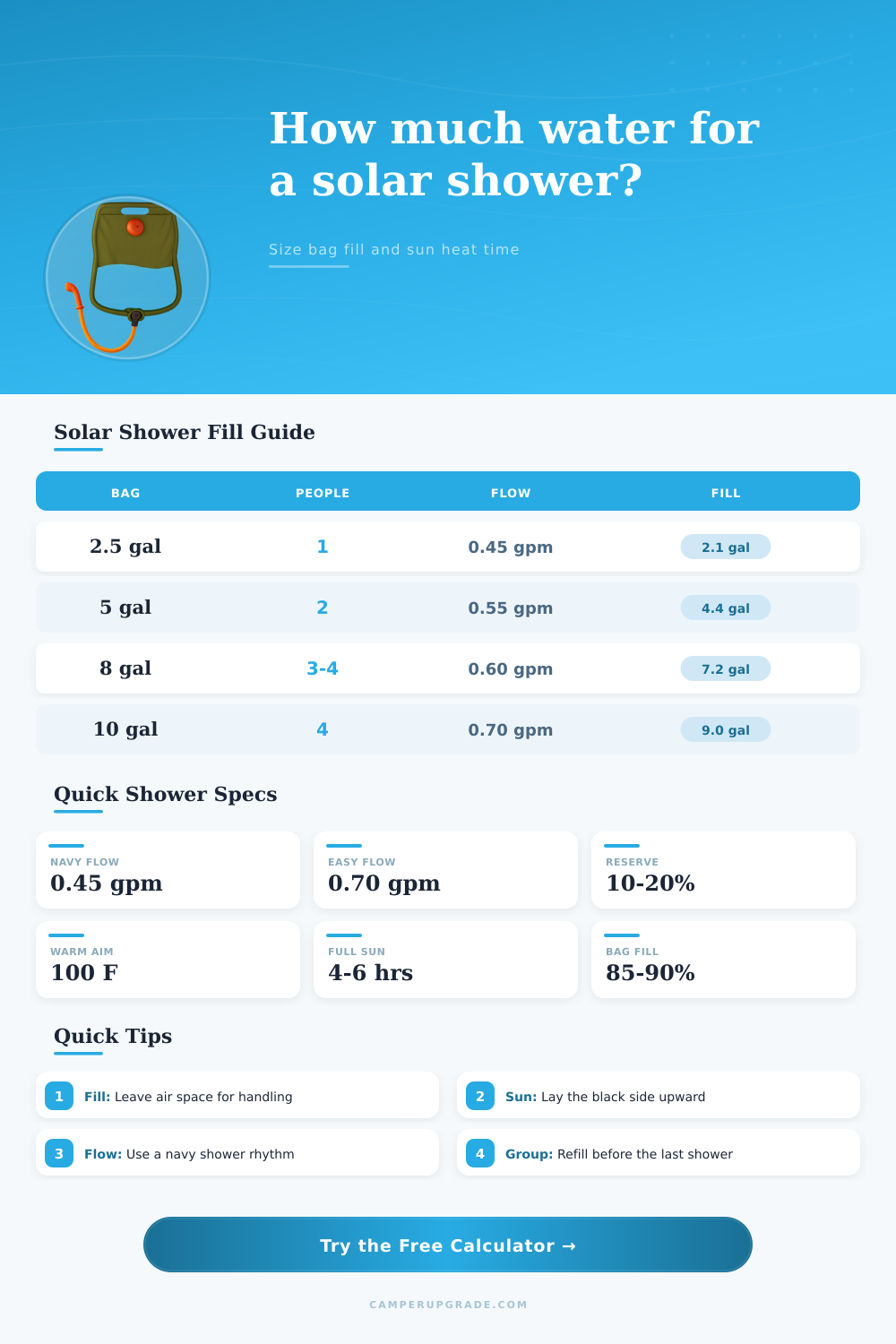
One of the most common mistake that people make when using a solar shower bag is to fill it to it’s maximum capacity. The larger the volume of the water in the solar shower bag, the more longer that it will take for the solar radiation to heat the water to an apropiate temperature for bathing. In order to avoid this issue, you should use the calculator that come with most solar shower bags to calculate the proper amount of water to which you should fill the bag.
How to Get Warm Water from a Solar Shower Bag
The way in which you use the water while in the solar shower bag will also have an impact upon the length of time that the water will last within the solar shower bag. You have two option: you can use the solar shower bag in a manner in which you use a steady stream of water from the nozzle, or you can use the navy shower method. The navy shower method allow you to wet your body with the water from the solar shower bag, turn the water off to allow you to apply the soap to your body, and then turn the water back on to rinse off.
Because the navy shower method use less water than a steady stream method, you can use the navy shower method to ensure that the water will last for a more longer period of time within the solar shower bag. Another factor that will impact the heating of the water is the environment in which you use the solar shower bag. Solar shower bags has a black color to them to absorb as much of the solar radiation from the sun as possible.
However, if the environment in which you are using the solar shower bag also feature strong wind, convection will strip that solar radiation from the solar shower bag. This means that you may find that the water within the solar shower bag is much colder than you would like it to be. To avoid this issue, you can place the solar shower bag on a dark rock or a ground cloth that reflect the sunlight to the solar shower bag.
However, if you hang the solar shower bag from one of your camping site trees, it will be exposed to the wind that may exist in that area. The other factor that will impact the heating of the water within the solar shower bag is the starting temperature of the water. If the starting temperature of the water that you add to the solar shower bag is very cold, it will take the solar shower bag longer to heat the water to a higher temperature.
However, if you heat the water prior to add it to the solar shower bag, the solar shower bag will heat the water to a high temperature in a relatively short span of time. To heat the water to a high temperature quickly, you must use a reduced volume of water within the solar shower bag. The other factor that will impact the length of time that the water will last within the solar shower bag is the nozzle that is use.
Some shower bag have nozzles that have high flow rates, while other shower bags has nozzles that have low flow rates. A high flow rate will cause the water within the solar shower bag to empty quickly. A low flow rate will allow the water within the solar shower bag to last for a longer period of time.
Thus, you should match the flow rate of the nozzle with the volume of the solar shower bag so as to determine how many people can use the solar shower bag. Finally, the time of day that you use the solar shower bag will have an impact upon the heating of the water within the solar shower bag. The sun provide the most solar radiation between the hours of noon and three in the afternoon.
Thus, if you use the solar shower bag during these peak hour of the sun, it will reach a high temperature. In order to use the solar shower bag effective, you should fill it during these peak hours, use a calculator to determine the amount of water, place it on a dark rock to reflect the sunlight onto the solar shower bag, use the navy shower method with a low flow rate nozzle to conserve the water within the solar shower bag, and you will be able to ensure that the solar shower bag provides you with enough warm water for your bathing need.