Solar Panel Tilt by Latitude Calculator
Calculate annual, seasonal, roof-adjusted, and RV-ready solar panel tilt angles from latitude, campsite orientation, mount style, and panel dimensions.
Solar Tilt Results
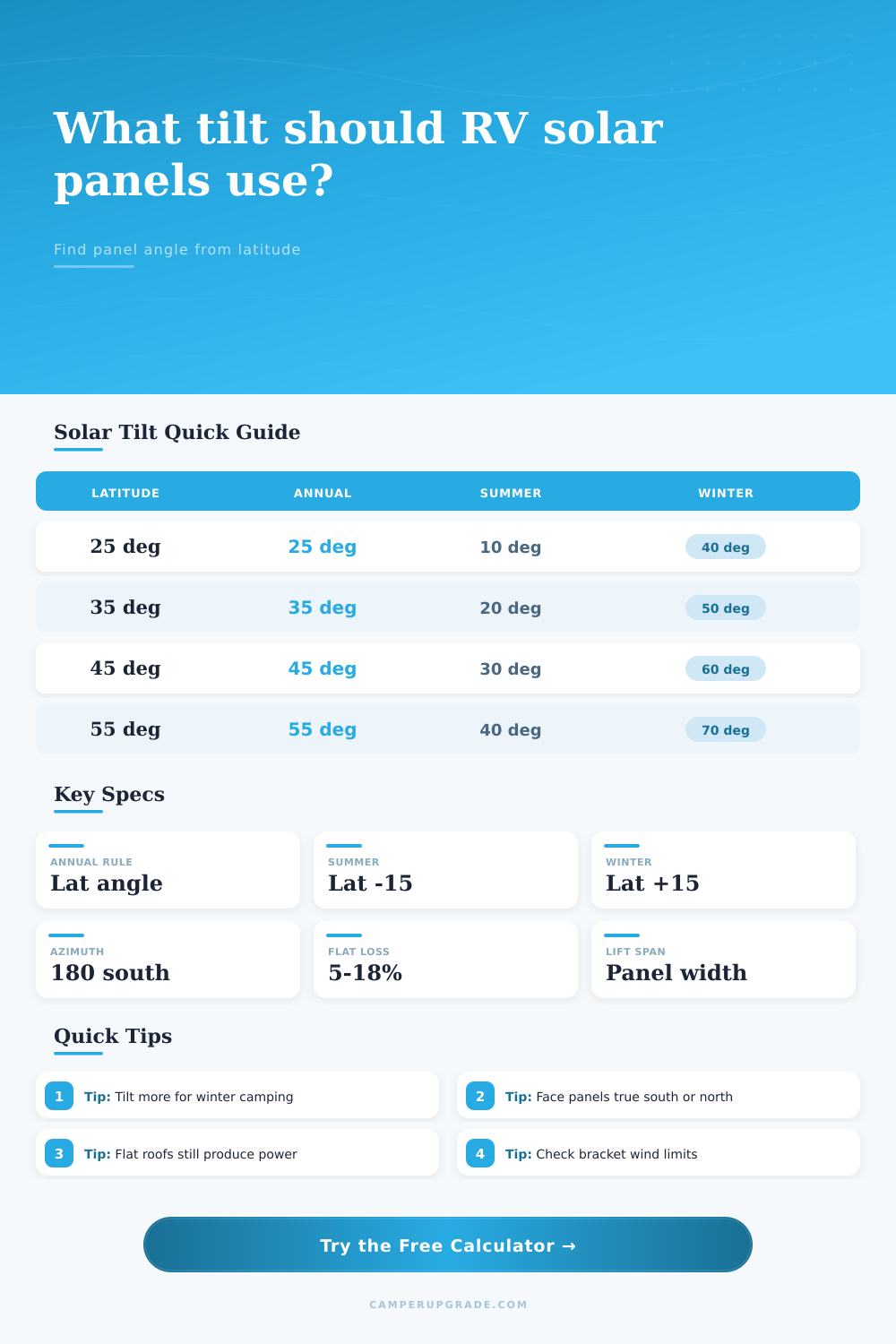
| Latitude band | Annual tilt formula | Summer tilt | Winter tilt |
|---|---|---|---|
| 0–15° | Latitude, minimum 5° | 5–10° | Latitude + 10° |
| 16–30° | Latitude | Latitude - 15° | Latitude + 15° |
| 31–45° | Latitude | Latitude - 15° | Latitude + 15° |
| 46–60° | Latitude | Latitude - 12° | Latitude + 18° |
| 61–66° | 60–65° practical cap | Latitude - 10° | 70° practical cap |
| Mode | Formula used | Best RV use | Practical limit |
|---|---|---|---|
| Annual average | Tilt = latitude | Panels left fixed for months | 5–65° |
| Winter charging | Tilt = latitude + 15° | Low sun, short days, heater loads | 15–70° |
| Summer charging | Tilt = latitude - 15° | High sun, air movement, long days | 5–55° |
| Spring or fall | Tilt = latitude | Shoulder season travel | 5–65° |
| Custom declination | Tilt = latitude - declination | Specific date planning | 5–70° |
| Destination | Latitude | Winter tilt | Summer tilt |
|---|---|---|---|
| Quartzsite, Arizona | 33.7° | 48.7° | 18.7° |
| Moab, Utah | 38.6° | 53.6° | 23.6° |
| Key West, Florida | 24.6° | 39.6° | 9.6° |
| Yellowstone, Wyoming | 44.6° | 59.6° | 29.6° |
| Banff, Alberta | 51.2° | 66.2° | 36.2° |
| Acadia, Maine | 44.3° | 59.3° | 29.3° |
| Tilt angle | Roof pitch equivalent | Lift for 40 in span | Use case |
|---|---|---|---|
| 10° | 2.1 in 12 | 6.9 in | Low summer or wind-prone roof |
| 20° | 4.4 in 12 | 13.7 in | Low-latitude annual setting |
| 30° | 6.9 in 12 | 20.0 in | Mid-latitude fixed bracket |
| 45° | 12.0 in 12 | 28.3 in | Winter portable panel |
| 60° | 20.8 in 12 | 34.6 in | Northern winter charging |
| Pointing error | Approx. factor | Daily effect | RV interpretation |
|---|---|---|---|
| 0–10° | 99–100% | Very small | Good alignment |
| 15° | 97% | Minor | Usually acceptable |
| 30° | 87% | Noticeable | Worth re-aiming portable panels |
| 45° | 71% | Large | Shade may matter less than direction |
| 60° | 50% | Severe | Move or turn the panel if possible |
I pulled into a shaded campground and watched the battery monitor ticking downwards. There’s something more then wattage on the roof; it’s about finding the angle to catch the light that’s there. The sun’s path is driven by latitude, and if you don’t pay attention, you’re leaving free energy on the table each day.
There’s the rule of thumb: For average performance throughout the year, angle your panels parallel to your latitudinal line (i.e., match your latitude). So if you’re parked in Phoenix which has an approximate latitude of about 33 degrees north, set the panels to 33 degrees. That way they’ll be pointing toward where sun sits on average during all four seasons of the year.
How to Angle Your Solar Panels
Life never stands still, and life-on-wheels even less so. Once you input your campsite coordinates into the calculator up top, it will do the math for you. This spare you from doing trigonometry in the hot sun while balancing on a ladder in July.
Everything changes as seasons shift. When the sun is low in winter, you must set the panels steeper to recieve their low rays. The standard maneuver here to increase charging in December: Add 15-degrees to your latitude. That’s enough to keep your heater humming when the days grow cold and short.
Summertime requires the reverse tactic. The sun rises high overhead, so flatten the angle by subtracting 15-degrees. That way the light won’t skim off the glass. You’ll get less in winter and more at summer’s peak, or more in winter and less at summer’s peak. Most RVers choose one approach and live with it, adjusting those bracket twice a year seems like extra work.
But there’s also the issue of orientation, and that’s something folks tend to skip. Ideally, you want to face true south if you’re up north. Otherwise, you’re sacrificing output because of how your roof lines up or trees block view. Even thirty degrees off means a loss of power equal to thirteen percent (which totals up over a long dry spell). The reference table on the page explain it all well; any slight misalignment will chew away at your daily watts. It is a little thing, but it is important when you’re running an air conditioner off-grid.
Reality is that hardware imposes big restrictions. Getting a 40-inch panel tilted 60 degrees from the hinge requires a fair amount of lift height at the hinge. Your rack may not be able to hold that much vertically, so you would of end up lowering the angle to make it stable. Higher angles create tremendous wind loads as well. Flat mounting a panel looks lazy, but it doesn’t fall down during a storm and still makes some electricity… just not as much. It’s an efficiency vs durability/maintenance tradeoff.
The silent killer when estimating solar is system losses. Fifteen to twenty percent can vanish into wiring resistance, charge controller heat, and dirty panels that collect dust. This is where a loss factor affects your final estimate with the tool. Don’t count on getting rated wattage off the panel label to reach your battery bank. Reality always takes a cut in real world physics.
The latitude rule provides a good starting place. Adjust accordingly based of your seasonal camping preferences. A steeper winter tilt helps in Minnesota, while a flatter summer angle makes sense in Arizona. Then tuck in and take note of your compass heading. True north isn’t magnetic north, which means your actual loss or gain may vary by parking spot. The trick is getting the tilt correct, which transforms a passive roof accessory into a power-producing one. It doesn’t have to be perfect. Point roughly in the direction of average position of the sun at your latitude and time of year, and you’ll capture significantly more light than you might expect. The added tilt also extends those lighting hours when days are shortened.