Solar Panel Sizing Calculator
Estimate solar array wattage, panel count, charge current, and battery support from your daily energy use and site conditions.
☀️Quick Setup Presets
⚙Load And Solar Inputs
🔋Component Reference Grid
📘Reference Tables
| Region Profile | Summer PSH | Shoulder PSH | Winter PSH | Design Note |
|---|---|---|---|---|
| Coastal Mild | 5.8 | 4.6 | 3.3 | Use 3.3 for year-round sizing |
| Mountain High | 6.2 | 4.9 | 3.6 | Cold improves voltage but weather swings |
| Desert Dry | 7.1 | 5.8 | 4.5 | Heat raises temp loss at midday |
| Humid Southeast | 5.4 | 4.2 | 2.9 | Add margin for haze and storms |
| Northern Forest | 5.2 | 3.8 | 2.4 | Winter tilt and snow clearing matter |
| Urban Rooftop | 5.0 | 3.9 | 2.7 | Account for nearby shade objects |
| Daily Load (Wh) | PSH 3.0 | PSH 4.0 | PSH 5.0 | PSH 6.0 |
|---|---|---|---|---|
| 500 | 230 W | 175 W | 140 W | 115 W |
| 1000 | 460 W | 350 W | 280 W | 230 W |
| 1500 | 690 W | 525 W | 420 W | 345 W |
| 2000 | 920 W | 700 W | 560 W | 460 W |
| 2500 | 1150 W | 875 W | 700 W | 575 W |
| 3000 | 1380 W | 1050 W | 840 W | 690 W |
| Installed Array | 12V Current | 24V Current | 48V Current | MPPT Min Rating |
|---|---|---|---|---|
| 400 W | 33 A | 17 A | 8 A | 40A at 12V |
| 800 W | 67 A | 33 A | 17 A | 80A at 12V |
| 1200 W | 100 A | 50 A | 25 A | 60A at 24V |
| 1600 W | 133 A | 67 A | 33 A | 80A at 24V |
| 2400 W | 200 A | 100 A | 50 A | 60A at 48V |
| 3200 W | 267 A | 133 A | 67 A | 80A at 48V |
| Array Target | 200W Panels | 220W Panels | 300W Panels | 400W Panels |
|---|---|---|---|---|
| 600 W | 3 | 3 | 2 | 2 |
| 1000 W | 5 | 5 | 4 | 3 |
| 1400 W | 7 | 7 | 5 | 4 |
| 1800 W | 9 | 9 | 6 | 5 |
| 2400 W | 12 | 11 | 8 | 6 |
| 3000 W | 15 | 14 | 10 | 8 |
| Battery Usable Need | 12V Ah | 24V Ah | 48V Ah | Typical Use Case |
|---|---|---|---|---|
| 1000 Wh | 83 Ah | 42 Ah | 21 Ah | Weekend lights and charging |
| 2000 Wh | 167 Ah | 83 Ah | 42 Ah | Van with fan and fridge |
| 3000 Wh | 250 Ah | 125 Ah | 63 Ah | Remote workstation loads |
| 4000 Wh | 333 Ah | 167 Ah | 83 Ah | Small cabin overnight |
| 5000 Wh | 417 Ah | 208 Ah | 104 Ah | Cloudy-day backup planning |
| 6000 Wh | 500 Ah | 250 Ah | 125 Ah | High-demand mobile setup |
To design a solar power system for a van, you first must determine how much energy you will use every day. Many people dont account for energy use corectly when they calculates their energy needs for there van. Most people only account for the energy that small device use.
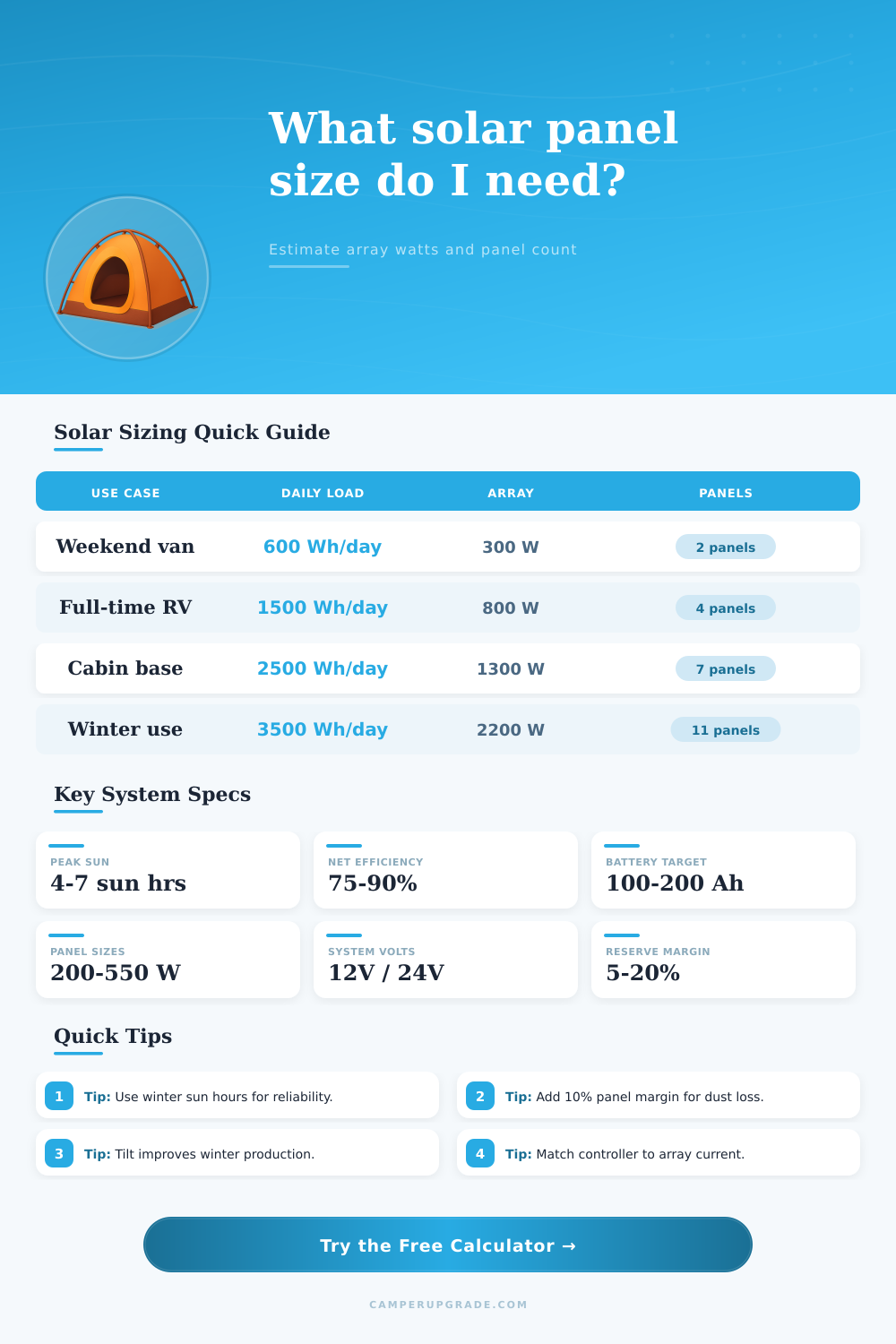
However, an inverter will lose approximately 10 percent of its energy when it converts DC power to AC power. A person using a van for a weekend may use 600 watt-hours of energy. However, a person living in a van full-time will use double or even triple that amount of energy.
How to design a solar power system for your van
The best way to determine your energy needs is to live in a van during a cloudy week and record the energy your van use. Sun hours are not the same as daylight hours. Peak sun hours are the hours that a solar panel will produce the energy that it is rated to produce.
Coastal locations receive five peak sun hours during the summer but only three in the winter. Deserts may have seven peak sun hours but lose 10 to 20 percent of the panels efficiency due to the high temperatures. Design your solar panel array for the leanest season of the year when your solar panels will produce the least amount of energy.
This will prevent a surplus of energy that your solar panel array will produce during the summertime. Solar panel systems do not reach 100 percent efficiency. Solar panels lose 7 percent of their efficiency due to the high temperatures in which they operate.
Additionally, solar panels also lose 6 percent of their efficiency if tree branch or dirt covers them. Other energy losses occur in the wiring of the solar panel system and the charge controller. The efficiency of solar panel systems range between 75 and 90 percent.
Include a reserve margin of 10 to 20 percent in your design to account for the energy lost during dust storm or when you increase your energy loads. The voltage that you choose for your solar power system will impact the wiring of your system. For instance, 12-volt solar systems are simple and inexpensive to construct.
However, a 12-volt system creates high currents that require thick wires to handle the current. If you use a 24-volt or 48-volt system, the amperage that goes through the system will decrease, allowing you to use thinner wires. The charge controller for your solar system also must match the voltage of your solar system.
Additionally, include a 25 percent safety margin in your charge controller for the voltage of solar panels spikes created by the cold temperatures of the morning. Batteries provide the energy storage for your van. Autonomy in a solar power system is the ability of the batteries to provide power to the van even when the sun is not shine on your solar panels.
Choose batteries that will supply your van with energy for at least one and a half days of travel. However, if you will be traveling to remote locations away from solar power access, choose batteries that can last for two or three days of energy. The depth of discharge of the batteries is also critical.
Lithium batteries can discharge 85 percent of their energy but lead-acid batteries can only release as much as 50 percent of their energy without damaging the plates of the battery. If you use batteries that is undersized for the vans energy needs, you will not have any power after dusk each day or you will have to recharge your batteries every day in order to have power to run the van. There are some mistakes that many individuals make when they design a solar power system for their van.
For example, they size the solar panels based on average sun hours. However, this create problems for these individuals during the months with less sunlight. Additionally, these individuals do not account for the energy losses caused by the shade of trees that cover the solar panel system or the dirt that covers the solar panels.
The solar panels may lose 5 percent of their energy output due to the dirt on their surface. These individuals should of cleaned their solar panels every month if they live in a very dusty area. Finally, you should adjust the tilt of the solar panels seasonally to maximize the energy they produce.
The energy output of the solar panels can increase 30 percent during the winter with the proper adjustment of the tilt of the solar panel system. There are some specific components and habits that can improve the efficiency of your solar power system. For example, MPPT charge controllers are 20 to 30 percent more efficient than PWM charge controllers when the solar panels do not have access to full sunlight.
Additionally, you should only use 50 percent of the energy capacity of your batteries each day. Using only 50 percent of the energy capacity of your batteries will allow them to last longer. Finally, if the area in which you live has limited space on the roof for solar panels, you can use flexible solar panel module or even portable solar panels to increase the number of solar panels that you install on your roof.
Following these steps will allow your solar panels to harvest the solar energy and your batteries to retain their charge.