Solar Panel Camp Output Calculator
Estimate usable campsite solar harvest from panel watts, peak sun, shade, tilt, controller type, temperature, cable loss, battery voltage, and daily camp loads.
⚡Camp Solar Presets
🔋Solar Output Inputs
Formula core: panel watts × panel count × peak sun hours × controller factor × weather factor × shade factor × tilt factor × temperature factor × cable factor.
Camp Solar Output Results
⚙Field Loss Comparison Grid
📊Peak Sun Hour Reference
| Camp condition | Peak sun hours | Typical use | Planning note |
|---|---|---|---|
| Cloudy forest camp | 1.5 to 2.5 h | Conservative estimate | Expect battery drawdown |
| Coastal mixed weather | 2.5 to 4 h | Spring or fall trips | Watch morning fog |
| Average summer site | 4 to 5.5 h | Most weekend planning | Use shade factor too |
| High desert open camp | 5.5 to 7 h | Strong harvest days | Heat still reduces watts |
| Winter low sun camp | 1.8 to 3.5 h | Cold season travel | Tilt matters more |
🔆Panel Array Output Table
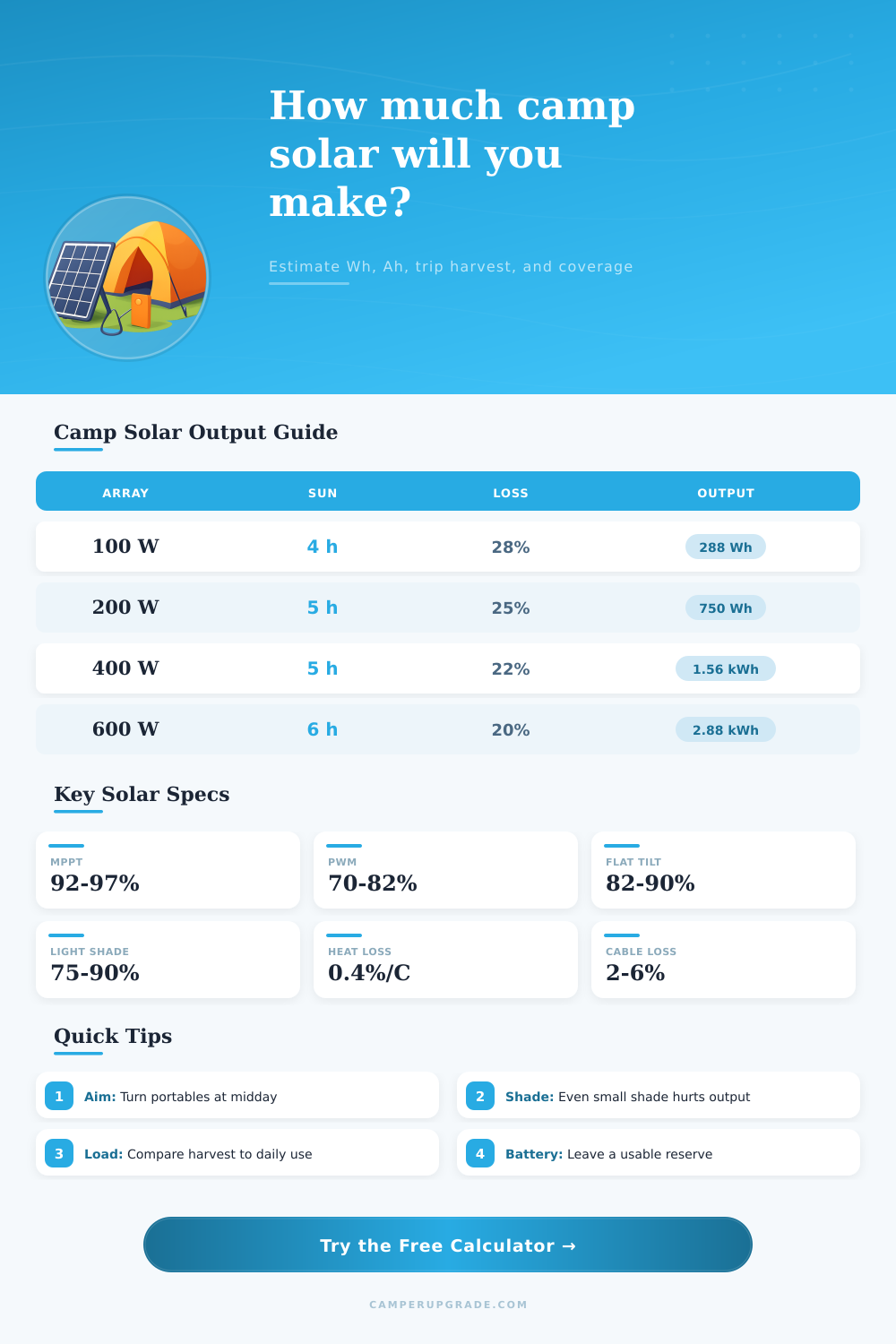
| Array size | 4 sun hours at 75% | 5 sun hours at 75% | 6 sun hours at 75% |
|---|---|---|---|
| 100 W portable | 300 Wh | 375 Wh | 450 Wh |
| 200 W roof pair | 600 Wh | 750 Wh | 900 Wh |
| 300 W van array | 900 Wh | 1.13 kWh | 1.35 kWh |
| 400 W trailer array | 1.20 kWh | 1.50 kWh | 1.80 kWh |
| 600 W base camp | 1.80 kWh | 2.25 kWh | 2.70 kWh |
🔌Controller And Wiring Reference
| Input path | Typical factor | Best camp fit | Output caution |
|---|---|---|---|
| MPPT controller | 0.92 to 0.97 | Roof arrays, series panels | Check voltage limits |
| PWM controller | 0.70 to 0.82 | Small matched 12 V kits | Loses voltage headroom |
| Power station input | 0.85 to 0.93 | Portable folding panels | Input cap may clip watts |
| USB/DC regulator | 0.75 to 0.85 | Phones and small packs | Lower in weak sun |
| Long cable run | 2% to 8% loss | Shaded camp parking | Use heavier gauge leads |
🏕Common Camp Load Benchmarks
| Camp load | Daily Wh range | 12 V Ah range | Solar planning note |
|---|---|---|---|
| LED lights and phones | 80 to 180 Wh | 7 to 15 Ah | Small portable panel is often enough |
| Compressor fridge | 350 to 750 Wh | 29 to 63 Ah | Shade and heat matter a lot |
| Fan, pump, lights | 180 to 420 Wh | 15 to 35 Ah | Good match for 200 W in sun |
| Laptop work camp | 500 to 950 Wh | 42 to 79 Ah | Plan for mid-day charging |
| Group base station | 1.2 to 2.5 kWh | 100 to 208 Ah | Use multiple panels or generator backup |
💡Camp Output Tips
The calculator uses field factors instead of perfect-lab output, so it is better suited for portable panels, roof panels, mixed weather, and real campsite placement.
Solar panels offer the hope of freedom from battery anxiety, but they deliver actual results that depend on much more than the watt rating stickered to the back. How many shade-casting tree are overhead? What’s the panel angle? Will there be significant heat build-up on that metal roof? The type of charge controller you use will also change the amount of useful watt-hours that reach your battery.
When you plug those factors into calculator above, it’ll crunch the numbers for you; and transform a pile of variables into a single workable number you can plan around.
How to Plan Your Solar Power
The second thing most folks screw up is peak sun hours. Just because it’s a twelve hour day in the middle of summer doesn’t mean there are a dozen useful hours of sunlight. The calculator ask for peak sun hours. These are the hours when the sun is high enough to provide maximum output. On a clear day in a forest clearing you may have only two and a half usable hours. Open desert may offer six or seven. Either way: this makes a difference; each hour you overestimate cost you one hour of battery life, quietly draining away.
The same sunlight also acts differently depending on which controller is being used. A simple PWM model will only pull closer to 78 percent of available energy into the batteries; an MPPT controller will get much closer to 92 to 97 percent. And as panels heat up and as the light flickers across swaying branches, the difference expand. So the calculator allows you to choose your controller style and account for those losses in the final harvest, rather than assume a best-case scenario from some lab test.
The thing about heat and angle loss is it sneaks up on you. For each degree over 25 Celsius, your panels’ performance drop by about 0.4 percent. So by midday, when the roof sits at 45 degrees, an array mounted there is down several percent compared to what it was putting out this morning. That’s where the active adjustment options come into play with tilt tool, re-adjusting portable panels to face the sun can help recoup some of that loss. The fixed-roof angles are also included as options within the tool.
After calculating that day’s harvest, the tool then estimates how much power was actualy used in camp (for example, how many hours did you run that compressor fridge?). How long did those LED lights stay on? Did you charge a phone? If you’ve got an array generating 700 watt-hours after all losses, you have a narrow gap… Though the coverage percentage give you a quick look into whether you’re slowly depleting the battery or creating a reserve.
The catch is that watt-hours isn’t the whole story. It doesn’t account for battery voltage or capacity, i.e., an 800 watt-hour looks quite different on a 24 volt bank than it does on a 12 volt one. The calculator also shows the harvest in amp-hours, so you can see how many days of usable battery reserve you will restore each day.
That’s where the rest of the page comes in, with context provided via a set of reference tables. One table show what daily watt-hours correspond to commonly used camp loads. Another table lists typical peak sun hours by season and region. That lets you get a sense of whether the number the calculator spits out seems reasonable for your planned camping destination.
Ultimately, what matters isn’t having the most watts on paper. It’s having enough to reach your destination and find yourself with a comfortabley reserve in the tank. You can get this before leaving home via the calculator, which keeps a running estimate of just how much cushion you’ll have when you arrive. The only surprise left is how early the coffee finishes brewing.