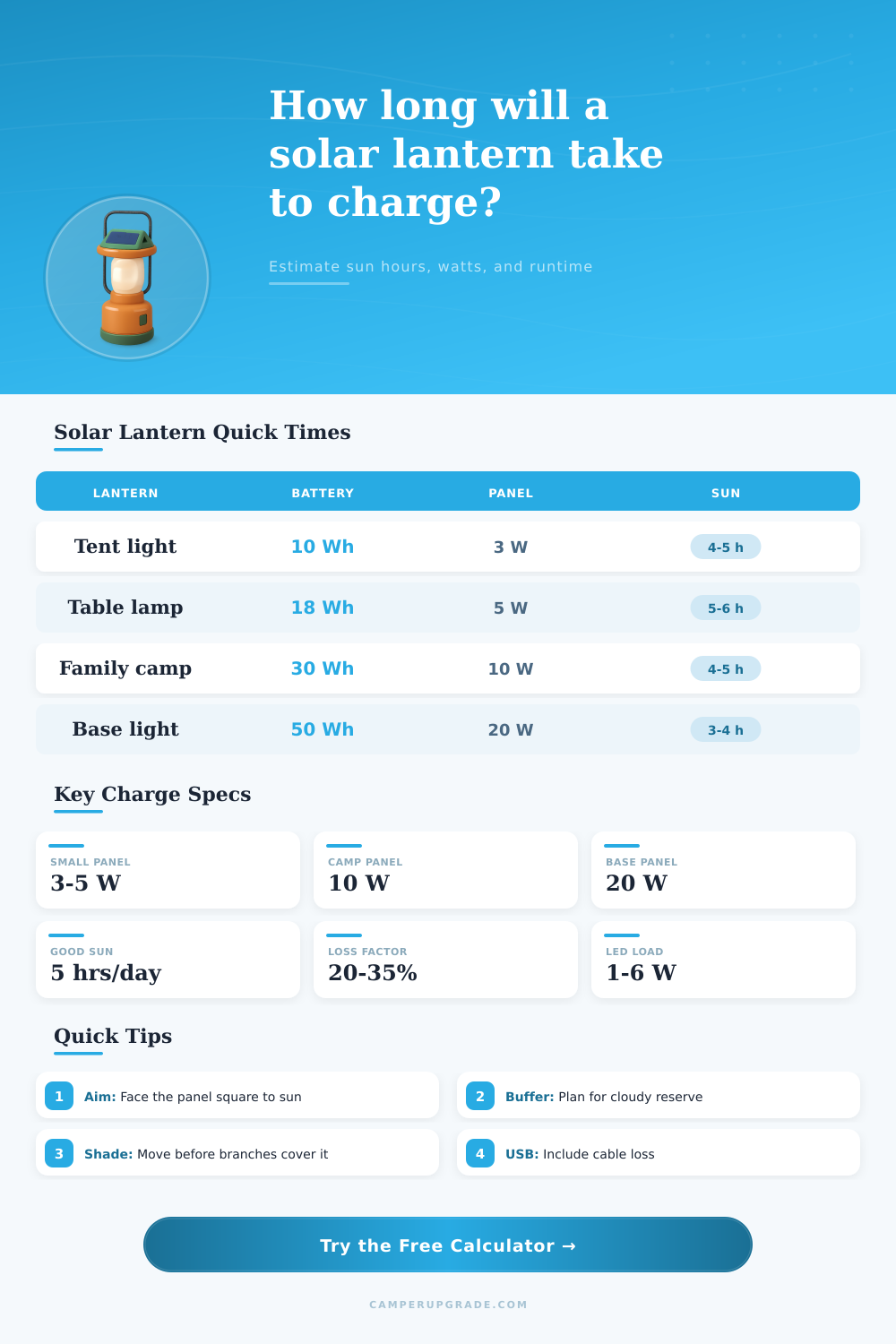
Solar Lantern Charge Time Calculator
Estimate solar lantern recharge time from battery capacity, panel watts, charge efficiency, usable sun, shade loss, LED load, and planned night runtime.
🏕Camping Lantern Presets
☀Solar Panel, Battery, Sun, and Use Inputs
Calculator estimates energy balance only. Confirm your lantern input rating, cable limits, charge controller instructions, and battery safety guidance before leaving gear unattended in sun.
🔋Panel and Battery Spec Grid
📊Charge Time Reference Tables
| Battery | 3 W Panel | 5 W Panel | 10 W Panel |
|---|---|---|---|
| 8 Wh keychain lantern | 4.4 h | 2.7 h | 1.3 h |
| 12 Wh tent lantern | 6.7 h | 4.0 h | 2.0 h |
| 20 Wh table lantern | 11.1 h | 6.7 h | 3.3 h |
| 35 Wh area lantern | 19.4 h | 11.7 h | 5.8 h |
| Sun Window | 3 W Panel | 10 W Panel | 20 W Panel |
|---|---|---|---|
| 2 peak sun hours | 4.3 Wh | 14.4 Wh | 28.8 Wh |
| 4 peak sun hours | 8.6 Wh | 28.8 Wh | 57.6 Wh |
| 6 peak sun hours | 13.0 Wh | 43.2 Wh | 86.4 Wh |
| 8 peak sun hours | 17.3 Wh | 57.6 Wh | 115.2 Wh |
| LED Mode | Draw | 18 Wh Battery | 35 Wh Battery |
|---|---|---|---|
| Night-light low | 0.6 W | 25.5 h | 49.6 h |
| Tent reading | 1.5 W | 10.2 h | 19.8 h |
| Table medium | 3 W | 5.1 h | 9.9 h |
| Area bright | 6 W | 2.6 h | 5.0 h |
| Condition | Factor | 5 W Panel | 10 W Panel |
|---|---|---|---|
| Clear high sun | 100% | 3.6 W | 7.2 W |
| Light haze | 85% | 3.1 W | 6.1 W |
| Mixed clouds | 65% | 2.3 W | 4.7 W |
| Heavy shade | 25% | 0.9 W | 1.8 W |
⚡Camping Solar Planning Tips
When you are planning a trip that will last several nights without electrical outlets, it is necessary to determine whether a solar lantern will provide enough light for your need. Many people will attempt to calculate the battery percentage that the lantern displays in order to determine if it can last the necessary number of nights. However, the battery percentage do not provide a complete calculation of how much energy the solar panel will produce.
Solar panels provide the energy to the lantern, but the amount of energy that the solar panel will produce will depend upon the amount of sunlight that it receive. Therefore, it is necessary to understand the relationship between the solar panel and the lantern in regard to the energy that each device produce. There are several different variables that must be considered in understanding the energy relationship between the solar panel and the lantern.
Plan Solar Lantern Power for Camping Trips
One of the variables to consider is the battery capacity of the lantern. Battery capacity is expressed in watt-hours, and indicates the total amount of energy that the battery can hold. The battery percentage and the current battery level can be used to calculate how much energy must be provided to the battery in order to provide enough energy for the lantern to operate when needed.
In addition, the efficiency setting of the lantern, the amount of shade in which the lantern is placed, and the conditions of the sky can all impact the amount of power that reach the battery; the efficiency setting and the amount of shade in which the solar panel is placed will reduce the amount of power that reaches the battery. Finally, the amount of energy that the lantern’s LED light will draw from the battery, and the amount of hours that the lantern will be used each night, will help to determine how long the battery may last. Finally, the percentage of the battery that is to be reserved for situations other than lantern use can be used to calculate how much energy must be provided each night in order to ensure that the lantern will still have enough energy to operate on a cloudy morning while on the trip.
These various parameters can be used to calculate two different values for the solar lantern system. One calculation will determine the number of hours of sunlight that will be necessary in order to provide enough energy to the battery to provide for the desired number of operation hours for the lantern. The second calculation will determine whether the amount of energy that the solar panel will produce each day is greater then the amount of energy that the lantern will use each night.
If the solar panel produces an amount of energy each day that is greater then the energy that the lantern will use each night, then there will be a surplus of energy that can be used to ensure that the lantern will have enough power after each night of use. However, if the energy that the solar panel produces is less than the energy that the lantern will consume each night, then there will be an energy deficit for that system. The conditions at the campsite in which the lantern will be used may introduce additional complication into the energy calculations for that system.
For instance, if the solar panel is placed flat upon a table, the solar panel will not receive the same angle of sunlight as if it is place upon the ground. Similarly, if there are branches that move in the wind, those branches may cast shade upon the solar panel. If the solar panel becomes too hot, whether from being placed upon a black surface or any dark-colored surface, the voltage of the solar panel will decrease.
Finally, if the solar panel is connected to the lantern through a thin USB cable, some of the voltage from the solar panel may drop. Each of these factor may reduce the amount of energy that is provided to the lantern. Each of these factors may also contribute to the actual hours of sunlight that are provided to the solar panel being less than the amount that was calculated prior to departure for the trip.
When using the lantern, it may be necessary to adjust for some of these factors. For instance, you may forget to move the solar panel to ensure that it is facing the sun. If the solar panel is not facing the sun, the battery will not be charged effective.
Furthermore, it is generally better to operate with a small daily surplus of energy; this surplus may provide enough energy for the lantern to operate even on days when you are particularly busy with other tasks, or when the solar panel is in the shade. The size of the solar panel that is selected for the lantern will depend upon how the lantern is to be used. For instance, a small 3 watt solar panel may be able to supply the energy to a lantern that requires little power for a period of seven day.
However, the same 3 watt solar panel may not contain enough energy to provide light to a larger area for six hour each night. Similarly, a 20 watt solar panel will charge the battery of the lantern very quick, but such a large solar panel may not be efficient if it is only used to charge a single lantern. The reference tables provided on this page will allow you to understand the relationship between these various factor without having to calculate each night for each item.
These tables will help you to understand the amount of time that it will take for batteries of different capacities to charge when using solar panels of different size. Additionally, the tables will allow you to understand how different LEDs will impact the life of the battery, as well as how the condition of the sky will impact the amount of watts that reach the battery. These tables will allow you to more easy understand the tradeoffs that can be made between the different item in this solar lantern system.
In addition to using the lantern as provided by the manufacturer, there are additional step that can be taken to improve the system. One improvement that could be made is to ensure that the battery level is checked at the same time each day. By checking the battery at the same time each day, it will be possible to determine if the battery is gaining or losing power.
By monitoring the battery over time, it will be possible to determine if any change to its use or placement occur. This type of monitoring will allow for a better understanding of the relationship between the lantern, the battery, and the solar panel. Overall, a reliable solar lantern system is one that continues to provide light to the user, even when the sun isnt perfect.
Providing a margin for error in the system and maintaining a realistic percentage of the battery that is to be reserved for situations other than lantern use will ensure that the system is both reliable and efficient.