Solar Charge Controller Sizing Calculator
Estimate MPPT or PWM controller amps, cold-corrected PV voltage, array short-circuit current, and a practical controller class for RV solar arrays.
Controller sizing estimate
| Controller check | MPPT sizing basis | PWM sizing basis | What to verify |
|---|---|---|---|
| Current rating | Array watts / battery charge volts | Array Isc from parallel strings | Controller amp rating exceeds required amps |
| PV voltage rating | Panel Voc x series x cold factor | Usually battery-matched panels only | Corrected Voc stays below max PV input |
| Series panels | Helpful for lower wire current | Usually limited or not supported | Do not exceed controller PV voltage limit |
| Parallel strings | Adds PV current into controller | Directly increases PWM current | Fuse and wire each string when required |
| Best RV use | Roof arrays, higher Voc, longer wire runs | Small portable panels near battery | Match controller type to wiring layout |
| Lowest panel temperature | Simple correction | Use case | Example on 80 V Voc |
|---|---|---|---|
| 50°F / 10°C | 5% | Mild coastal camping | 84 V corrected |
| 32°F / 0°C | 10% | Light frost mornings | 88 V corrected |
| 14°F / -10°C | 15% | Cold shoulder season | 92 V corrected |
| -4°F / -20°C | 20% | Winter RV storage sun | 96 V corrected |
| -22°F / -30°C | 25% | Severe cold locations | 100 V corrected |
| Solar array watts | 12 V bank | 24 V bank | 48 V bank |
|---|---|---|---|
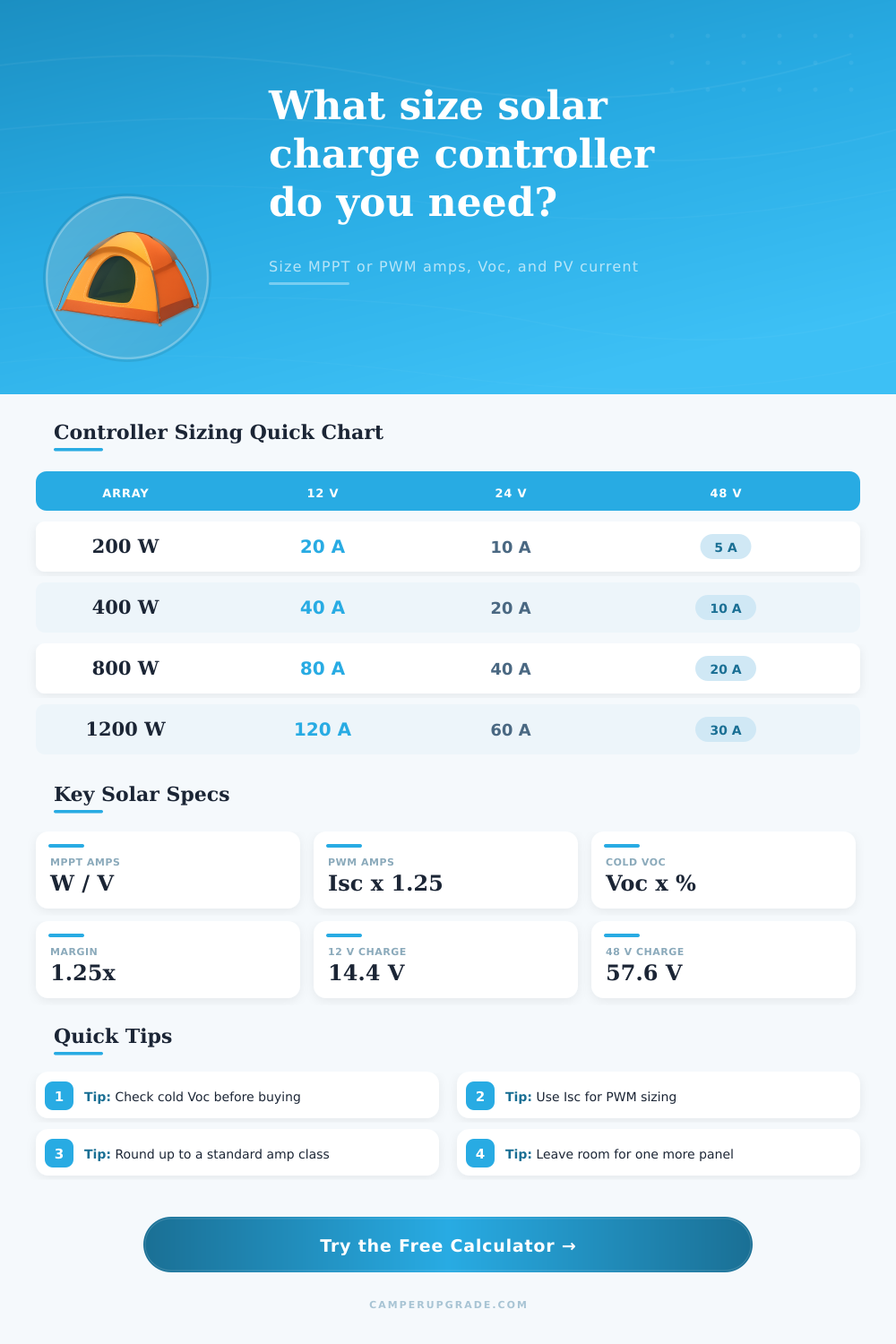
| 200 W | 18 A raw / 25 A class | 9 A raw / 15 A class | 4 A raw / 10 A class |
| 400 W | 35 A raw / 50 A class | 18 A raw / 25 A class | 9 A raw / 15 A class |
| 600 W | 52 A raw / 70 A class | 26 A raw / 40 A class | 13 A raw / 20 A class |
| 800 W | 69 A raw / 90 A class | 35 A raw / 50 A class | 18 A raw / 25 A class |
| 1200 W | 104 A raw / 150 A class | 52 A raw / 70 A class | 26 A raw / 40 A class |
| Array layout | Voltage formula | Current formula | Controller note |
|---|---|---|---|
| 1S1P | Panel Voc x 1 | Panel Isc x 1 | Small PWM or MPPT systems |
| 2S1P | Panel Voc x 2 | Panel Isc x 1 | Common MPPT roof string |
| 3S1P | Panel Voc x 3 | Panel Isc x 1 | Check cold Voc carefully |
| 2S2P | Panel Voc x 2 | Panel Isc x 2 | Balanced RV roof layout |
| 3S2P | Panel Voc x 3 | Panel Isc x 2 | Often needs 150 V MPPT |
A solar charge controller is a device that sits in between the solar panels and the battery bank, and it perform two specific tasks. A solar charge controller will protect the battery bank from overcharging, and it will ensure that the solar panels has the power that they are capable of producing. If you choose a solar charge controller that is not of the appropriate size, you may find that there is a lack of power supplied to the solar panels itself, or that your electrical equipment is being damaged as a result of the solar charge controller’s inability to handle the power levels that the solar panels are creating.
When you are planning your solar system, you must take into consideration the electrical characteristics of the solar panels, not there wattage alone. Electrical characteristics such as open circuit voltage will increase if the temperature of the solar panel decreases, and the short circuit current of a group of solar panels will increase if more string of solar panels are added in parallel with each other. These characteristics are factors that you must consider when you determine whether you will use an MPPT solar charge controller or a PWM solar charge controller.
How to Choose the Right Solar Charge Controller
If you use an MPPT solar charge controller, the solar panels can convert the excess voltage to current, and you will determine the amp rating of the solar charge controller by dividing the watts of the solar panels by the voltage of the battery bank. However, if you use a PWM solar charge controller, the voltage cannot be converted to current, so the PWM solar charge controller will be sized according to the current create by the solar panels. The temperature of the solar panels will impact the voltage of those panels, and those voltages may reach limits of the solar charge controller.
The voltage created by solar panel strings will increase if the temperature of the panels decreases, meaning that the solar panel banks may not be within the limits of the solar charge controller during warm temperatures, but may be over the limit in colder temperature. Electrical installers typically create a percentage increase to the voltage calculations to allow for these limits in the coldest temperatures to be provided to the solar charge controller so as to prevent it from entering an emergency shutdown mode. Another factor that will impact the function of the solar charge controller is the chemistry of the batteries that are to be used in the solar system.
For example, lithium batteries will have lower voltage than flooded lead acid batteries. Furthermore, because the lithium batteries will have a lower voltage, the solar panel array will produce more current into those batteries than lead acid batteries. The solar battery calculator that is used to calculate the solar charge controller requirements must select the chemistry of the batteries, as the voltage of the batteries will impact the charge voltage that is selected for the solar charge controller.
In addition to the factors described above, you can also add a safety margin to your solar charge controller sizing calculations. The safety margin can allow for future expansion of the solar panel array, or account for days when the solar panels are exposed to more sunlight than the standard test conditions of the solar panels. While some individual will size the solar charge controller to the calculated requirement based on the solar panel array, most will add between 25 and 35% to that calculation to create a safety margin for the system.
Additionally, the layout of the wiring in the solar system will impact the sizing of the solar charge controller. If the solar panels are wired in series strings, the voltage will be increased and the current decreased; in parallel strings, the voltage will be decreased and the current increase. Many individuals make mistake when installing a solar system’s charge controller.
For instance, many individuals will make a mistake by treating the solar charge controller as an afterthought in the installation process. Additionally, many individuals will make a mistake in sizing the solar charge controller according to the nominal voltage of the battery bank. Rather than sizing according to the nominal voltage, the individuals will tend to underestimate the power that the solar panel array will exert upon the solar charge controller.
If, however, you correctly determine the size of the solar charge controller, then the wire gauges for the solar system will be correctly determined, as will the size of the fuses that will be used in the solar system. Furthermore, correctly sizing the solar charge controller will allow the solar panels and the battery bank to function as a well balanced power source.