Sock Count Per Trip Calculator
Estimate how many sock pairs to pack for hiking days, damp campsites, laundry stops, sleep pairs, and emergency dry backups.
📍Camping Trip Presets
🧦Trip Sock Inputs
Your Sock Packing Estimate
⚙Sock Material Spec Grid
📊Sock Reuse Reference
| Material | Typical clean reuse | Dry time range | Best camping role |
|---|---|---|---|
| Merino wool | 1-2 daytime wears | 6-10 hours | Hiking, cool nights, odor control |
| Synthetic blend | 1 daytime wear | 3-6 hours | Fast drying trail rotation |
| Cotton | Single wear | 12-24 hours | Dry RV camp only |
| Bamboo viscose blend | Single wear | 8-14 hours | Camp comfort in mild weather |
| Compression travel | 1-2 travel wears | 6-12 hours | Driving days and flight legs |
| Waterproof outer socks | Outer-layer reuse | 10-18 hours | Wet footwear backup |
| Toe socks | Single trail wear | 4-8 hours | Blister-prone hiking days |
| Liner socks | 1-2 liner wears | 2-4 hours | Layering and friction control |
📏Trip Length Planning Table
| Trip style | Typical length | No-laundry solo count | Notes for carrying fewer |
|---|---|---|---|
| Overnight state park | 1 night / 2 days | 3-4 pairs | One daytime pair, one sleep pair, one spare |
| Long weekend RV site | 2-3 nights | 4-6 pairs | Merino can reduce camp rotation |
| Weeklong national park | 6-7 nights | 8-12 pairs | Hand-wash every 3-4 days to cut bulk |
| Humid beach campground | 4-7 nights | 9-14 pairs | Sand and sweat reduce reuse comfort |
| Backcountry section hike | 5-10 nights | 7-11 pairs | Rotate trail, drying, sleep, and sealed spare |
| Family RV loop | 7-14 nights | Per-person cycle | Use laundry interval instead of total trip length |
🎒Packing Load Conversion Table
| Sock type | Weight per pair | Packed volume per pair | 10-pair bundle |
|---|---|---|---|
| Light liner socks | 0.9 oz / 26 g | 0.05 L | 9 oz / 0.5 L |
| Synthetic hiking socks | 1.8 oz / 51 g | 0.10 L | 18 oz / 1.0 L |
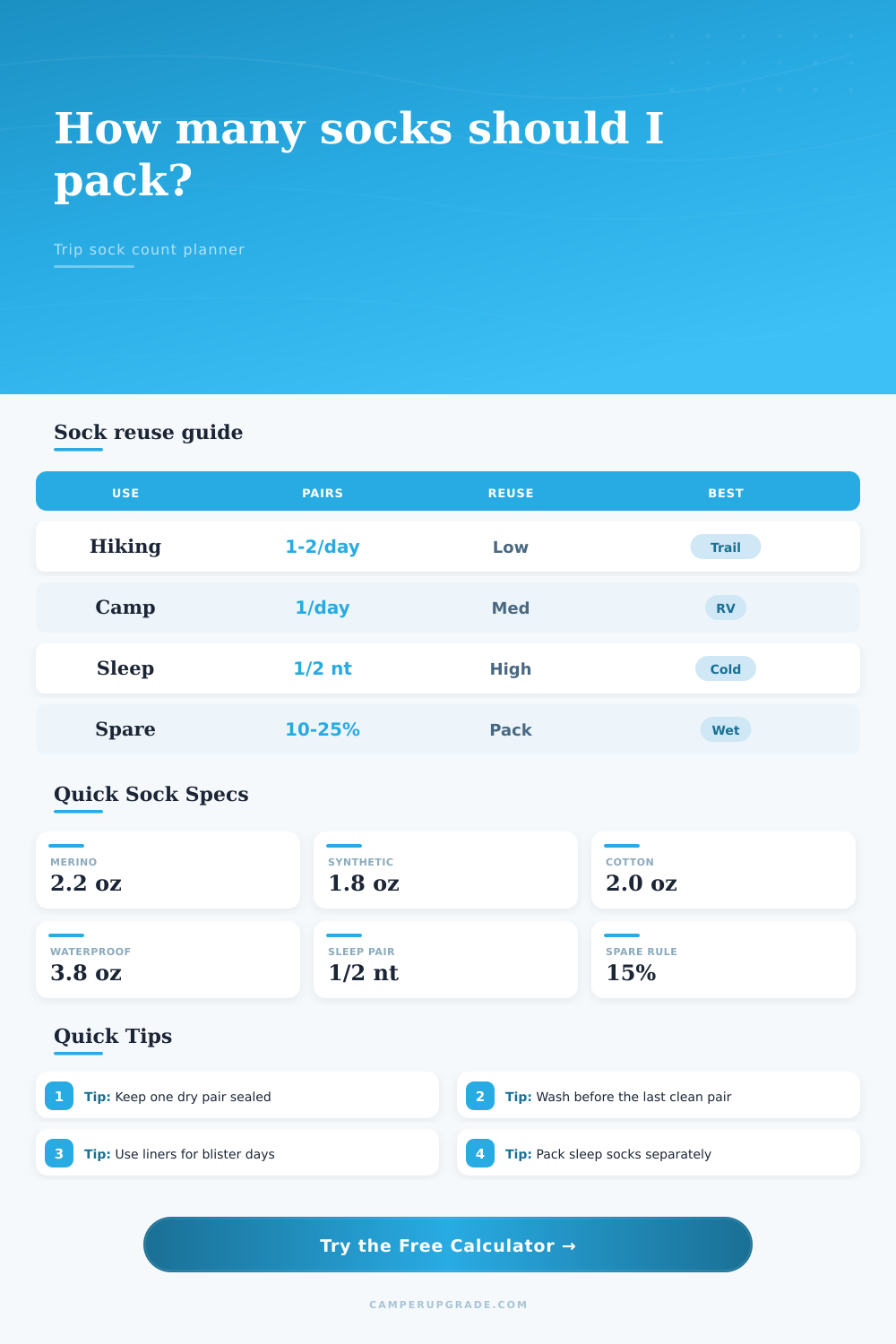
| Merino hiking socks | 2.2 oz / 62 g | 0.12 L | 22 oz / 1.2 L |
| Compression travel socks | 2.4 oz / 68 g | 0.12 L | 24 oz / 1.2 L |
| Heavy sleep socks | 3.0 oz / 85 g | 0.16 L | 30 oz / 1.6 L |
| Waterproof outer socks | 3.8 oz / 108 g | 0.20 L | 38 oz / 2.0 L |
🗂Common Camping Scenario Counts
| Scenario | Days carried | High-use days | Likely solo pairs |
|---|---|---|---|
| Moab dry weekend | 3 days | 2 days | 5-6 pairs |
| Yosemite shuttle-and-hike week | 4-day wash cycle | 3 days | 7-9 pairs |
| Pacific Coast rain camp | 5 days | 3 days | 9-11 pairs |
| Boundary Waters portage | 6 days | 5 days | 10-13 pairs |
| Quartzsite winter boondock | 7 days | 1 day | 7-8 pairs |
| Florida Keys humid campground | 4-day wash cycle | 4 days | 8-10 pairs |
💡Calculation Tips
Socks get overlooked a lot: they’re usually an afterthought of your meal planning and gear list optimization. Maybe you spent too much time agonizing over pack weight or boots. By the end of the day, you have wet feet and you don’t have enough to dry out overnight.
Truth is, socks is the single most important piece of clothing that connects you to the trail. Get them wrong and you’ll be uncomfortable quicker different than anything else.
How to Choose the Right Socks
Tell us about your activity style, how long your trip lasts, and your laundry situation. Our sock calculator will do the number crunching for you so you can stop wondering if it’s three or twelve.
Secondly, consider what your real schedule will be, not how many nights. If you’re going on a four day trip with three big days of hiking, that’s different than staying in an RV four days but walking around a lot. This separates out the high activity days (hiking) from camp days (not hiking much).
Your hiking socks will get muddy and sweaty. Your camp socks will mostly remain dry. Piling them together into one bag will result in wet feet. When you spend a whole day hiking, those socks are toast. It is time to wash them or at least let them air dry. You’ll want another pair for evenings and maybe even a third for sleeping. The tool shows you how many pairs you actualy need so you don’t run out by nighttime.
The greatest variable affecting how much you can pack is how often you do laundry. If you want to wash and dry your socks after three days, then you only need as many socks as will get you through three days, not the whole two weeks. That’s what I call the laundry-cycle rule. When you go out, you aren’t taking an inventory; you’re taking a rolling stock. The reference table on the page illustrates just how big of a difference a weekly wash makes in terms of pack weight versus no laundry at all.
On very short turnaround trips, synthetic blends (often drying in 3-6 hours) is best. Merino wool offers better odor control, allowing one or two wears before washing. For longer term, merino wool offers better odor control (allowing one or two wears), but won’t dry as fast than synthetic blends. Cotton is a trap: it doesn’t warm when wet, retains moisture, and grows bacteria. Save cotton for flat, dry RV camping.
There’s also a special section for sleep socks. A good set of warm dry feet at the end of the day can go a long way towards helping you sleep better and recover faster. Don’t hike in your sleeping socks. The calculator allows you to specify different pairs for sleeping, which recognizes that what keeps your feet happy on the trail isn’t necessarily the same as what makes them comfortable at night. Thick merino sleep socks really do helps in cold conditions. Lightweight synthetics prevent feet from going clammy in humid conditions.
Lastly, carry an emergency dry pair. Pack them in a plastic bag, sealed away from all other clothes. Something’s going to happen. You’re not going to cross that creek right. A shoe will leak. Or you’ll lose those spare socks. Then the rain will mess up what you had. This sealed pair will be your backup plan. And that’s why we add a buffer percentage with the tool; so there’s something truly dry when stuff gets wet.
There’s no “magic number” of packs of socks. Socks aren’t a pair of flip flops where one extra or missing pair doesn’t matter. Rotating your socks, managing moisture, and controlling heat ensures good hygiene. You should of planned better. When you learn the material differences and how washing frequency reduces your pack weight, the math just works out. Aim for light quick-drying while minimizing odor. The last pair stays dry and ready. The pack will be lighter on your back and your feet will love you.