Snowshoe Size Calculator
Dial in deck length, flotation, and traction class from your full winter load.
🧊 Quick Presets
📏 Trip Inputs
📊 Snowshoe Spec Grid
📘 Reference Tables
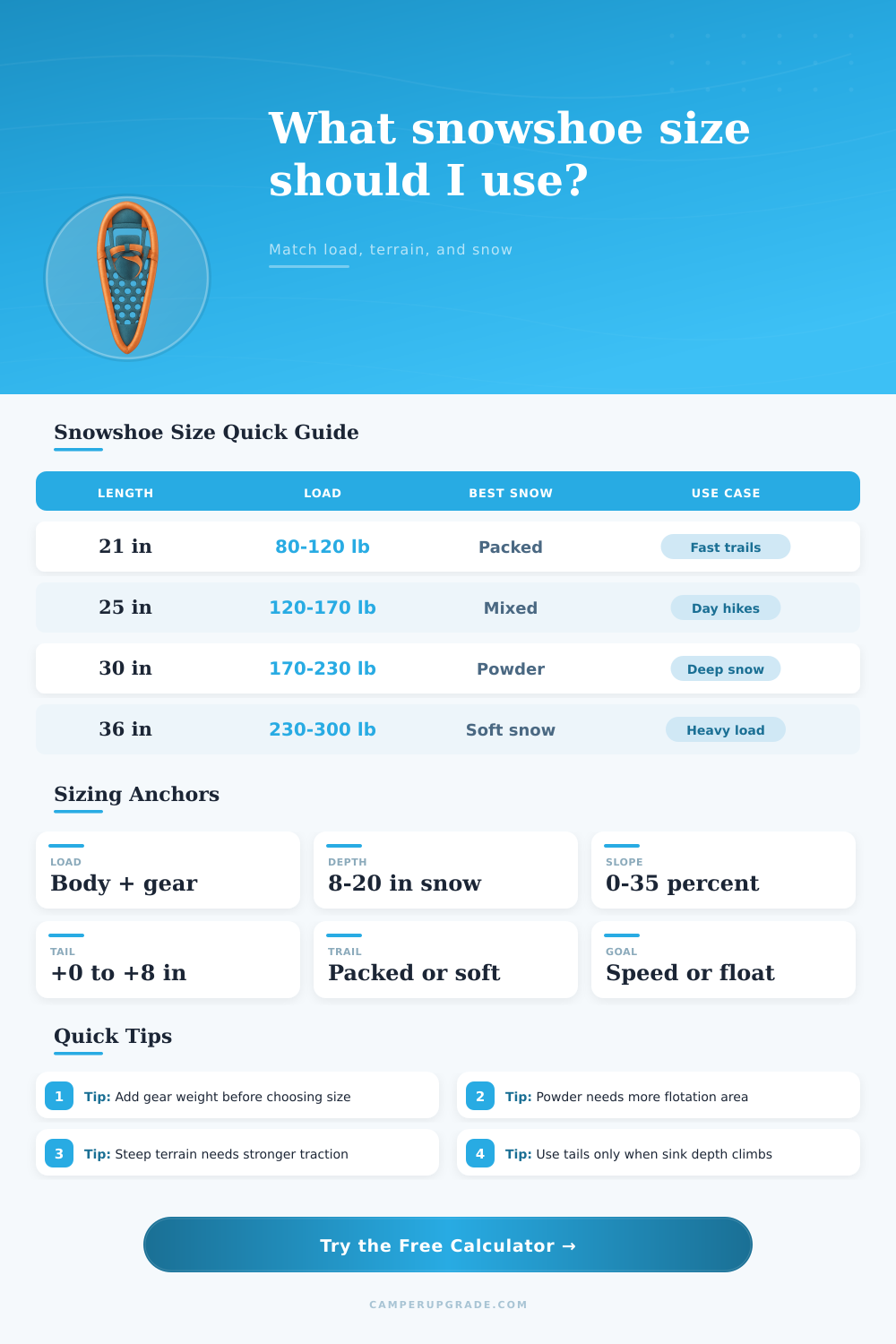
| Deck Length | Typical Load | Surface Area | Best Conditions |
|---|---|---|---|
| 21 in | 80–120 lb | 190–220 in² | Packed, groomed, quick cadence |
| 25 in | 120–170 lb | 230–270 in² | Mixed trail and rolling terrain |
| 27 in | 160–200 lb | 250–295 in² | Mixed snow with short soft zones |
| 30 in | 180–230 lb | 290–350 in² | Powder days and loaded hiking |
| 36 in | 230–300 lb | 360–430 in² | Deep unconsolidated snow |
| Snow Type | Flotation Multiplier | Sink Risk | Sizing Direction |
|---|---|---|---|
| Packed Trail | 0.90× | Low | Size down if agility needed |
| Mixed Snow | 1.00× | Medium | Use baseline size |
| Cold Powder | 1.18× | High | Size up one class |
| Wet Heavy Snow | 1.10× | Medium-high | Use wider deck option |
| Wind Crust | 0.96× | Variable | Maintain traction focus |
| Terrain Class | Traction Level | Heel Lift Need | Frame Advice |
|---|---|---|---|
| Mostly Flat | Level 1 | Not required | Recreational or running frame |
| Rolling Trail | Level 2 | Optional | Trail frame with toe crampon |
| Steep Climb/Descent | Level 3 | Recommended | Backcountry frame and rails |
| Off-Camber Traverse | Level 3 | Optional | Aggressive side rails |
| Dense Forest Turns | Level 2 | Not required | Shorter agile platform |
| Total Load | Boot Length | Primary Size Band | Use Tail? |
|---|---|---|---|
| Under 120 lb | Up to 11 in | 21 in deck | No |
| 120–170 lb | 10–13 in | 25 in deck | Optional +5 in |
| 170–220 lb | 11–14 in | 27–30 in deck | +5 in helpful |
| 220–270 lb | 12–15 in | 30–36 in deck | +8 in often useful |
| 270–320 lb | 13 in and up | 36 in deck | +8 in strongly advised |
Snowshoes usually measure themselves in inches. Length of snowshoe affect how much flotation it gives. Main sizes range of 20 until 36 inches.
They answer according to body size and depth of fluffy snow. For instance, 20-inch youth model lasts maximum 80 pounds. 21-inch snowshoes bear until 125 pounds.
How to Pick the Right Snowshoe Size
Models of 22 inches go until 150 pounds. 25-inch shoes answer for 175 pounds. 30-inch models last 220 pounds.
Snowshoes of 35 or 36 inches suit for more than 220 pounds.
Well choose the right size are important. Good mode is add weight of body and pack, for get the right snowshoe size. That includes you together with everything carried, for instance gear or bag.
When sizes like, bigger snowshoes help if legs are long, pack weighs a lot or you commonly make ways. Less big shoes ease walk. More little and lightweight one favours for already walked way.
Doubts you, choose the most little size, that bears the weight. Little snowshoes help to surpass ice and sharp slopes, that is not powdery.
Women mostly require no this big snowshoes, because many from them are less big and heavy than men. Also stride at them are narrow. For help, models as Yukon have tapering tails for women.
Like this little boot size sets himself flatly and comfortably in the binding. MSR bindings answer for American men’s 6, 13 and women’s 5, 13. If shoe is bigger or boot has a large shell, as plastic mountaineering boot, TriFit either DuoFit bindings on some models needs.
In snow-packed trail the snowshoe size matters little for walk comfort. Shorter snowshoes carry easily when not use and maneuver well. Some favours them, when you does not plan hit fresh trails after snowfall.
In deep powder add-on tails are useful. Some entry-level models have such appendices for casual deep snow. For trail breaking with heavy bag, as adult man, 30-inch shoes well serve.