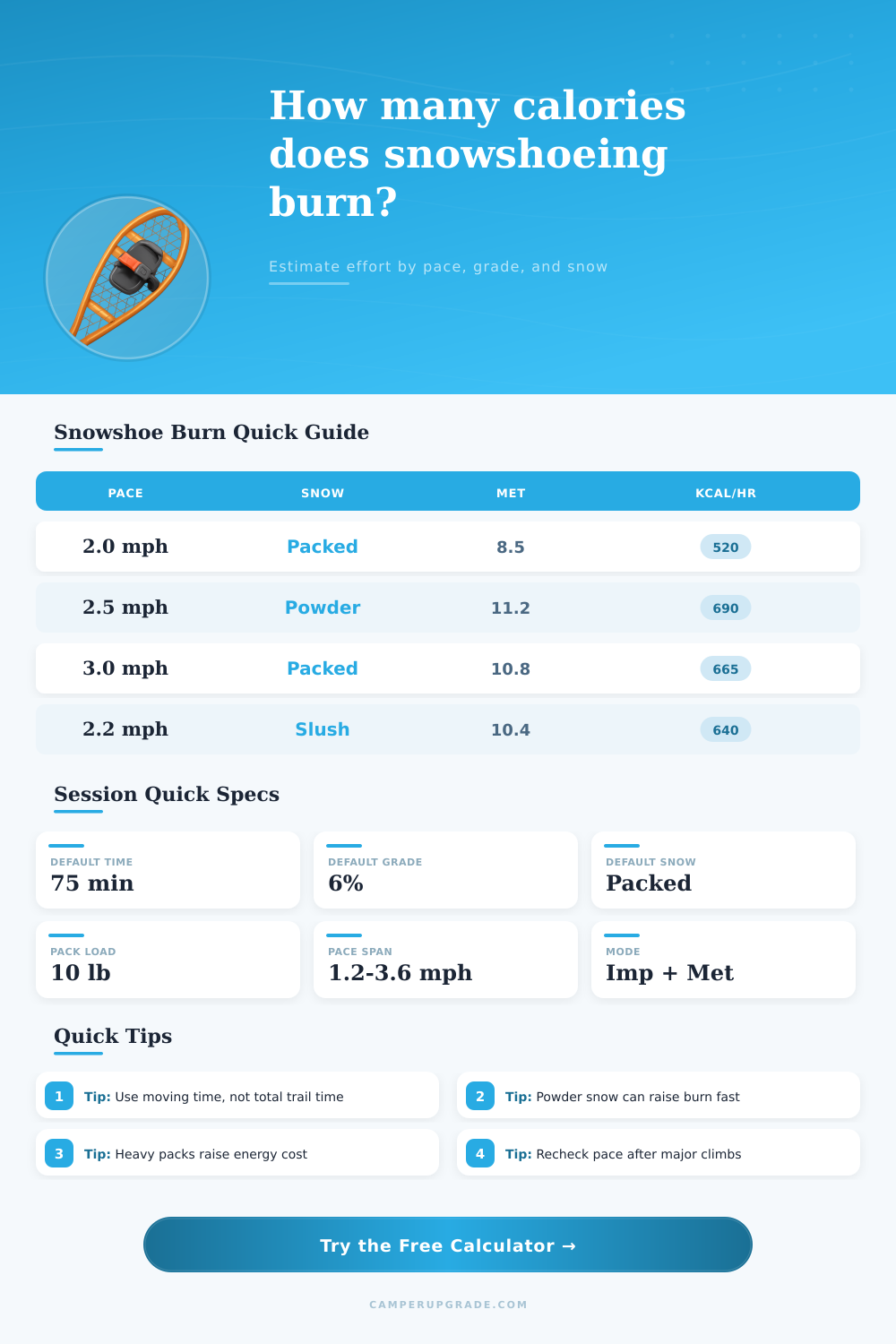
Snowshoe Calorie Calculator
Estimate winter energy burn using pace, gradient, snow conditions, load, and duration with side-by-side reference data.
🧭Session Presets
📝Calculator Inputs
📊Snowshoe Effort Spec Grid
📑Pace to MET Table
| Pace Band | mph | km/h | Base MET | Session Style |
|---|---|---|---|---|
| Easy | 1.2-1.7 | 1.9-2.7 | 6.2 | Scenic rolling trail |
| Steady | 1.8-2.2 | 2.9-3.5 | 7.8 | Aerobic base pace |
| Brisk | 2.3-2.7 | 3.7-4.3 | 9.2 | Fitness focused session |
| Tempo | 2.8-3.2 | 4.5-5.1 | 10.8 | Strong uphill output |
| Hard | 3.3-3.6 | 5.3-5.8 | 12.4 | Intervals and climbs |
🌨Snow Condition Multipliers
| Condition | Multiplier | Energy Shift | Typical Feel |
|---|---|---|---|
| Packed Trail | 1.00 | Baseline | Consistent stride |
| Deep Powder | 1.27 | High increase | Leg lift resistance |
| Wind Slab | 1.11 | Moderate increase | Variable support |
| Wet Slush | 1.22 | High increase | Heavy step release |
| Breakable Crust | 1.17 | Moderate increase | Uneven punch-through |
| Icy Firm Base | 0.95 | Slight decrease | Short controlled steps |
⛰Grade and Altitude Adjustment Table
| Grade | MET Add | Altitude Band | Altitude Add | Combined Note |
|---|---|---|---|---|
| 0-3% | +0.1 to +0.5 | 0-4000 ft | +0.00 | Mostly aerobic |
| 4-7% | +0.7 to +1.3 | 4001-7000 ft | +0.02 to +0.05 | Steady climbing load |
| 8-12% | +1.4 to +2.2 | 7001-9000 ft | +0.06 to +0.08 | Heavy breathing demand |
| 13-20% | +2.3 to +3.5 | 9001-11000 ft | +0.09 to +0.11 | Frequent pacing checks |
| 21-35% | +3.6 to +4.8 | 11000+ ft | +0.12 | Near max output |
📈Sample Burn by Weight and Intensity
| Body Weight | Moderate 60m | Brisk 60m | Hard 60m | Hard 90m |
|---|---|---|---|---|
| 140 lb (64 kg) | 430 kcal | 520 kcal | 650 kcal | 975 kcal |
| 165 lb (75 kg) | 505 kcal | 615 kcal | 770 kcal | 1155 kcal |
| 185 lb (84 kg) | 565 kcal | 690 kcal | 865 kcal | 1295 kcal |
| 210 lb (95 kg) | 640 kcal | 780 kcal | 975 kcal | 1460 kcal |
Snowshoeing is among the best winter activities outside for burning calories. Usually, you burn 400 to 600 calories during one hour of snowshoeing with average effort. Rule of thumb points around 600 calories per hour Meze.
Studies of Ball State University and the University of Vermont show that snowshoeing can burn 420 to 1,000 calories each hour.
Calories Burned While Snowshoeing
Walking on a flat path for an hour burns around 369 calories. While snowshoeing with the same pace over flat, packed snow you burn around 450. Snowshoeing burns double the calories than walking with the same speed.
It can even beat walking or running by more than 45 percent. If you can walk, you can snowshoe wthout problem.
The exact amount depends on several things. Terrain matters, flat against hills makes a big difference. Snow state also affects, whether packed or powder.
Poles change the effort, using them or not. Naturally, walking against running changes the result. According to the hardness of terrain, pace and snow depth, the range is 400 to 900 calories each hour.
Someone around 120 pounds walking on packed snow on flat terrain for an hour burns typically around 360 calories. A 180-pound person burns between 455 and 857 calories in 60 minutes of snowshoeing according to effort. With average effort for 60 minutes you burn around 454 calories.
Snowshoeing happens a bit more slowly, so the burn probably stays at the bottom end, close to 400 to 500 calories each hour.
Compared with running on flat terrain at 570 calories or mountain biking on rolling terrain at 550 calories, snowshoeing is really efficient winter exercise. It requires around 50 percent more energy than walking. Some experiences point even to double.
Snowshoeing opens areas that are hard to reach in summer. With much snow you walk over places with such brush that you can not cut through it in warm months. It is more fun and more challenging than hiking.
The calories burn huge, so wear several non-cotton layers including a waterproof shell, and bring enough water and snacks. For cold winter snowshoeing trips, high-fat and high-protein food like canned beef works well; filling and lasting in freezing temperatures.