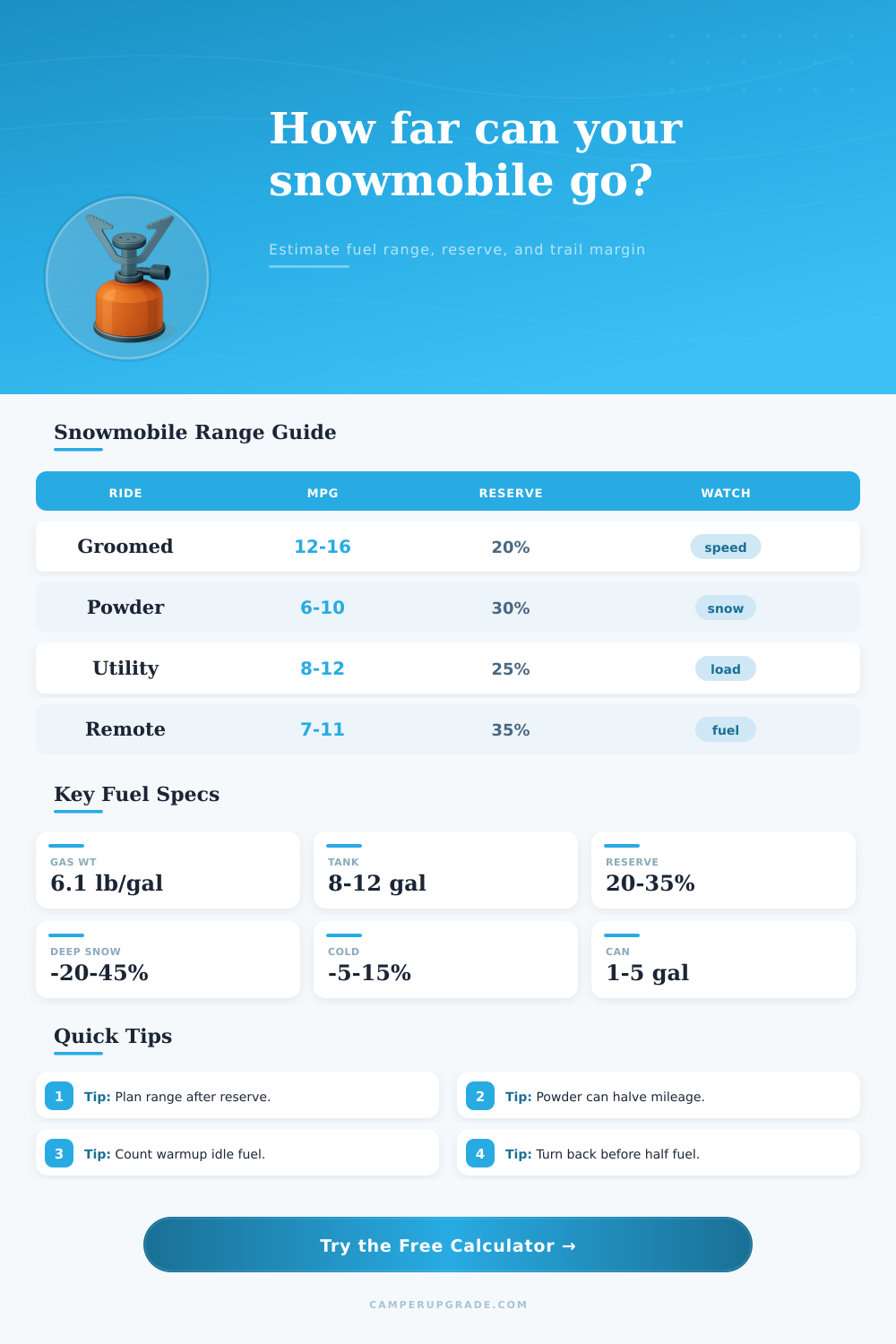
Snowmobile Fuel Range Calculator
Estimate how far a sled can travel after tank size, usable fuel, reserve, carried fuel, snow depth, cold starts, payload, elevation, and riding conditions are included.
1Riding presets
2Fuel and ride inputs
Snowmobile fuel range estimate
3Snowmobile fuel spec comparison grid
4Sled class fuel economy reference
| Sled class | Typical mpg | Typical L/100 km | Planning note |
|---|---|---|---|
| Trail touring | 11 to 16 mpg | 14.7 to 21.4 | Best on packed, steady trail speed. |
| Mountain deep snow | 6 to 10 mpg | 23.5 to 39.2 | Track load, climbing, and throttle bursts dominate. |
| Utility or work sled | 8 to 12 mpg | 19.6 to 29.4 | Towing, low speed, and cargo lower range. |
| 2-up touring | 9 to 13 mpg | 18.1 to 26.1 | Passenger weight makes reserve more important. |
| Performance trail | 7 to 12 mpg | 19.6 to 33.6 | Range depends heavily on throttle discipline. |
| Youth or light sled | 14 to 22 mpg | 10.7 to 16.8 | Small tanks still limit total distance. |
5Riding condition range factors
| Condition | Range factor | Use when | Fuel planning cue |
|---|---|---|---|
| Groomed trail | 1.00x | Firm base, predictable corners | Base economy can be realistic. |
| Open lake cruise | 1.08x | Low resistance, steady throttle | Do not apply to drifted lakes. |
| Mixed trail | 0.88x | Soft shoulders and loose sections | Good default for casual rides. |
| Wet heavy snow | 0.76x | Slush, thawed snow, heavy track load | Increase reserve before remote legs. |
| Deep powder | 0.68x | Frequent carving, climbs, stuck pulls | Use mountain reserve or more. |
| Breaking trail | 0.55x | No packed route ahead | Plan for half range or less. |
6Reserve and carried fuel table
| Route type | Suggested reserve | Carried fuel note | Turnaround rule |
|---|---|---|---|
| Short marked loop | 10% to 15% | Usually tank only if trail is open. | Turn before half of usable fuel. |
| Normal trail day | 20% | Add a can when fuel stops are uncertain. | Use the calculator safe range. |
| Cold mixed route | 25% | Count warmup and idle minutes. | Shorten stops between fuel points. |
| Mountain powder | 30% | Extra fuel may be worth more than speed. | Turn when snow gets deeper. |
| Remote expedition | 35% to 40% | Carry fuel in approved containers only. | Protect enough fuel to return. |
7Fuel container and weight reference
| Fuel item | Volume | Approx fuel weight | Range effect at 10 mpg |
|---|---|---|---|
| 1 gallon fuel | 1.0 gal / 3.8 L | 6.1 lb / 2.8 kg | About 10 miles before reserve. |
| 10 liter fuel can | 2.6 gal / 10 L | 16 lb / 7.3 kg | About 26 miles before reserve. |
| 2.5 gallon can | 2.5 gal / 9.5 L | 15 lb / 6.9 kg | About 25 miles before reserve. |
| 5 gallon can | 5.0 gal / 18.9 L | 31 lb / 13.8 kg | About 50 miles before reserve. |
| Common tank | 9 to 12 gal / 34 to 45 L | 55 to 73 lb / 25 to 33 kg | About 90 to 120 miles before reserve. |
8Fuel range tips
This calculator is a planning aid, not a guarantee of actual snowmobile range. Fuel quality, engine tune, clutching, belt condition, track setup, wind, trail closures, and rider behavior can change real consumption quickly.
Never run out of gas when you’re far from civilization. Knowing how far your sled will go are essential to planning your day. The most common mistake people make is underestimating gas mileage on un-groomed terrain. How do you know? Because soft snow is an entirely different animal than groomed trails. Knowing exactly what your sled can and cannot handle is key.
To make things work, first enter in your tank’s size and conditions. Then you get the numbers from the calculator, but what do they mean? Maybe your tank holds ten gallons of fuel. But you can’t use all of it. When you turn, some goes to the side. You’ll want to say how much is actualy usable by the tool. Typically this will be about ninety percent. What’s left over, say ten percent. Is your buffer for gauge inaccuracies.
How to Plan Your Snowmobile Fuel
It’s fine to base your ride plans on ninety percent availability, but don’t plan based off the assumption you have a hundred percent just because you feel like it. That’s basing it on hope, not data. The largest variable of all is snow condition. When riding on groomed trails, you has an efficient surface for gliding with a solid base. In deep powder, it feels like you are moving through the weight of water that resist your motion. To account for this drag, the calculator includes a penalty factor for loose snow depth. Going from fluffy to packed can result in a loss of up to forty percent or more of your mileage. It’s physics, not a glitch. Expecting trail numbers on mountain terrain without considering this penalty results in riders gets stranded.
And don’t forget your idling time. Even while sitting still, your bike is burning through fuel. If you’re cranking away in the cold, those gallons are burning up without moving an inch. Stopping to tie a belt on or check out a map will add up fast. This tool allows you to plug in how many idle and warmup minutes you have so it can deduct that fuel before computing distance traveled. Experienced riders track mileage but often overlook how long they’ve been stopped when they should of being riding.
Fuel is your insurance policy; reserve 20-30 percent of your tank capacity as a buffer against unexpected circumstances such as headwind, getting turned around, etc. If you’re out on a day trip, running low won’t be a problem. Just keep filling up until you hit your safe range and then tap the reserve to ensure a safe return. When traveling, you don’t want to run yourself down into “the red,” except when riding back home. Additional jerry cans of fuel will extend your range, but come at the cost of increased weight and harder handling. Your goal is to have enough range for the journey plus a comfortable cushion.
Planning is all about managing uncertainty. You have no control over the snow pack density or the weather, but you do have control of your fuel reserves. With fair assumptions as input, it will provide you a base line guess instead of an overly optimistic one. It won’t let you go until you consider things like weight, depth and temperature. It changes your thinking from leaving driveway to becoming a safer rider. Knowing what your sled can actualy do in real conditions puts you at ease and increases your confidence while riding.
Next time you pack up for a weekend getaway, take 5 minutes to punch in some numbers. Estimate how much snow there will be, check your payload, set your reserve. It’s faster then losing your trail markers at dark. And when you roll into your driveway with more fuel than necessary, you’ll know exactly why that felt good. Planning is boring until it saves your day.