Snow Water Equivalent Calculator
Estimate SWE, meltwater volume, snow load, and drainage-adjusted runoff from snow depth, density, crust layers, field tube samples, and temperature.
| Snow depth | 10% density | 20% density | 30% density | 40% density |
|---|---|---|---|---|
| 6 in | 0.6 in SWE | 1.2 in SWE | 1.8 in SWE | 2.4 in SWE |
| 12 in | 1.2 in SWE | 2.4 in SWE | 3.6 in SWE | 4.8 in SWE |
| 24 in | 2.4 in SWE | 4.8 in SWE | 7.2 in SWE | 9.6 in SWE |
| 36 in | 3.6 in SWE | 7.2 in SWE | 10.8 in SWE | 14.4 in SWE |
| 48 in | 4.8 in SWE | 9.6 in SWE | 14.4 in SWE | 19.2 in SWE |
| SWE depth | Gallons per sq ft | Gallons per 100 sq ft | Water load | Common use |
|---|---|---|---|---|
| 0.5 in | 0.31 gal | 31 gal | 2.6 psf | Light cover |
| 1.0 in | 0.62 gal | 62 gal | 5.2 psf | Storm check |
| 2.0 in | 1.25 gal | 125 gal | 10.4 psf | Roof review |
| 4.0 in | 2.49 gal | 249 gal | 20.8 psf | Heavy pack |
| 6.0 in | 3.74 gal | 374 gal | 31.2 psf | Deep melt |
| Snow temperature | Pack state | Density tendency | Meltwater note |
|---|---|---|---|
| Below 15 F | Cold dry | Low to moderate | Little liquid water |
| 15 to 28 F | Settling | Increasing slowly | Drainage usually low |
| 28 to 32 F | Ripe snow | Moderate to high | Runoff can begin fast |
| Above 32 F | Melting | High if compacted | Apply drainage loss carefully |
| Tube diameter | Core area | 24 in core at 20% | Field note |
|---|---|---|---|
| 1.5 in | 1.77 sq in | 8.5 cu in water | Small probe |
| 2.0 in | 3.14 sq in | 15.1 cu in water | Common tube |
| 2.5 in | 4.91 sq in | 23.6 cu in water | Stable core |
| 3.0 in | 7.07 sq in | 33.9 cu in water | Large cutter |
Snow water equivalent or SWE calculate the depth of water within the snowpack. The water contained by the snowpack can be difficult to estimate prior to the snowpackmelting. The depth of snow that falls from a storm will contain different amounts of water due to the snow density.
The density of the snowflakes can alter based on the type of snowfall and settling of the snow. These different amount of water within the snowpack can have an impact upon the need to clear snow off of roofs, the need for snowmelt to become streams, or the need to provide sufficient water to a cistern. To calculate the depth of water within the snowpack, the ratio of depth to snow density is utilized.
How Much Water Is in a Snowpack
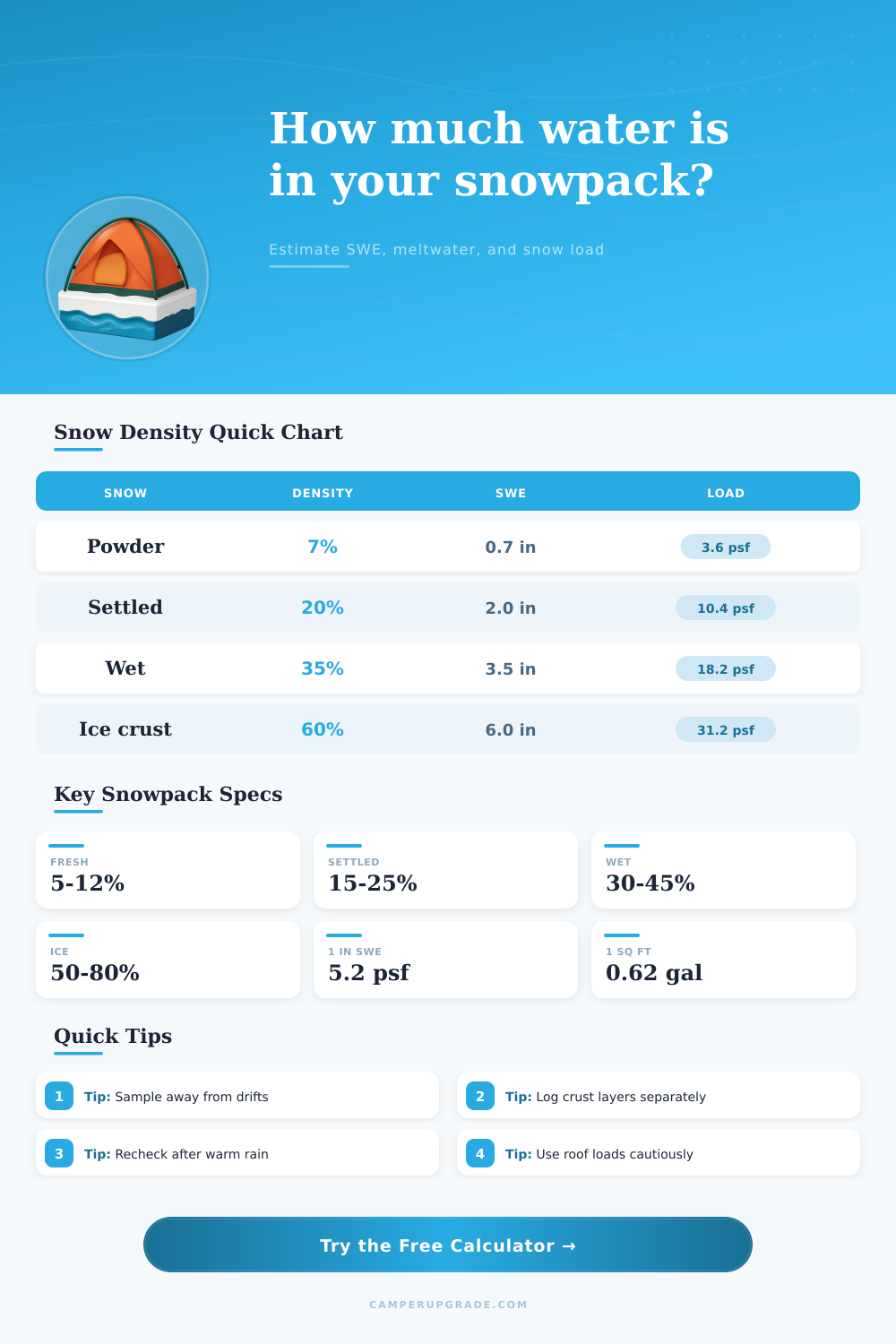
The depth of the water that would remain once the snowpack melts can be calculated by multiplying the depth of the snow by the percentage of the snow density. For instance, snow with a depth of 24 inches and a snow density of 20 percent will contain 4.8 inches of water. Snow with a depth of 24 inches and 35 percent density will contain more than 7 inches of water.
Because density can change due to numerous factor, the calculation of SWE will never yield a specific value for a given snowpack. Fresh snowpacks will have a density of around 8 percent but snowpacks that are exposed to the wind will have a density that reaches 30 percent or more. By calculating these factors, it is possible to calculate the depth of water within the snowpack.
A calculator can be used to determine the depth of water by entering the depth of snowpack and density percentage. Field crews will not utilize this calculation based off a single measurement. The field crew can expect inaccuracies in a single measurement of depth of snowpack and density.
Therefore, the field crews will measure depth in several different locations to avoid drifts in the snowpack. Additionally, a small tube will be utilized to sample the snowpack to determine the density of the snowpack. The diameter of the tube will be utilized to calculate the depth of the snowpack and the depth that the tube penetrated the snowpack will determine the amount of snow that is to be weighed.
Additionally, the temperature of the environment will help to determine the depth of water that will result from the melting of the snowpack. If the temperature is below 15 degrees the snowpack will remain dry. If the temperature is near 30 degrees the snowpack will begin to ripen allowing the water within the snowpack to begin to melt.
The formation of crust layer will complicate the calculation of SWE. The crust layers will add to the weight of the snowpack but will not contribute to the depth of the snowpack. It is possible to enter a separate measurement for the crust layer to calculate the density of the entire snowpack.
Finally, compaction factor will affect the density of the snowpack. If there is a compaction factor of 1.0 or above, it is possible that the wind compacted the snowpack. Once the depth of water from the snowpack is calculated it is up to the individual to determine the significance of that measurement.
One of the most common use is to calculate the weight of the snowpack upon the roof. One inch of water weighs 5.2 pounds per square foot. Therefore, four inches of snow will add more than 20 pounds per square foot to the roof.
Such calculations can be used to determine if the roof needs to be shoveled prior to the arrival of a warm front. Those who use snowpacks for water or gardens will want to calculate the snowpacks in terms of gallons of water. One inch of snow water equivalent will yield 62 gallons of water over an area of 100 square feet.
The other portion of the snowpack will remain as snow, some of the water will evaporate and some will enter the soil prior to reaching a point of collection. Therefore, a percentage is applied to account for the amount of water that will reach the collection point. One of the most common mistake is to assume that the snowpack is the same throughout its entire area.
Instead, three to four measurements of the depth will provide an average snowpack depth. It is possible for the crust to be much more denser than the portion of the snowpack beneath it. Therefore, if the entire snowpack is not considered as one density, the amount of water will be underestimated.
Additionally, temperature will continue to impact the snowpack. If the temperature remains between 0 and 15 degrees the snowpack will remain dry. However, if the temperature reaches 30 degrees the snowpack will begin to melt.
Any temperature above 32 degrees will cause the snowpack to melt rapid. Common reference tables will show the density of the snowpacks based upon the type of snow. For instance, settled seasonal snowpacks will have densities between 18 and 28 percent.
Wind slabs will be above 28 percent. Wet snowpacks near the melting point will have densities above 30 percent. These percentages can be referenced without having to measure the snowpack in the field.
Sample calculations with tubes allow for the snowpack to be measured in direct measurements. A volume of the snowpack can be weighed with the use of a tube. The weight of the snowpack in ounces can be calculated.
This can be scaled to represent the weight of the snowpack over a large area. The value of the calculation of snow water equivalent is in its use. For instance, snow water equivalent can indicate whether or not the roof should be shoveled.
The same measurement can be used to determine whether or not the cistern will have enough water for the garden. Additionally, using the calculation of snow water equivalent can allow for the prediction of flooding in specific areas. While precise measurements of the snowpack are not necessary, having a number to replace the guesswork of the depth of snow will be benificial to those individuals or communities.