Snow Trench Dimensions Calculator
Size a winter camping snow trench by occupant count, sleeping system, clearances, wall thickness, cover span, snow hardness, and drift buffer.
Dimension Breakdown
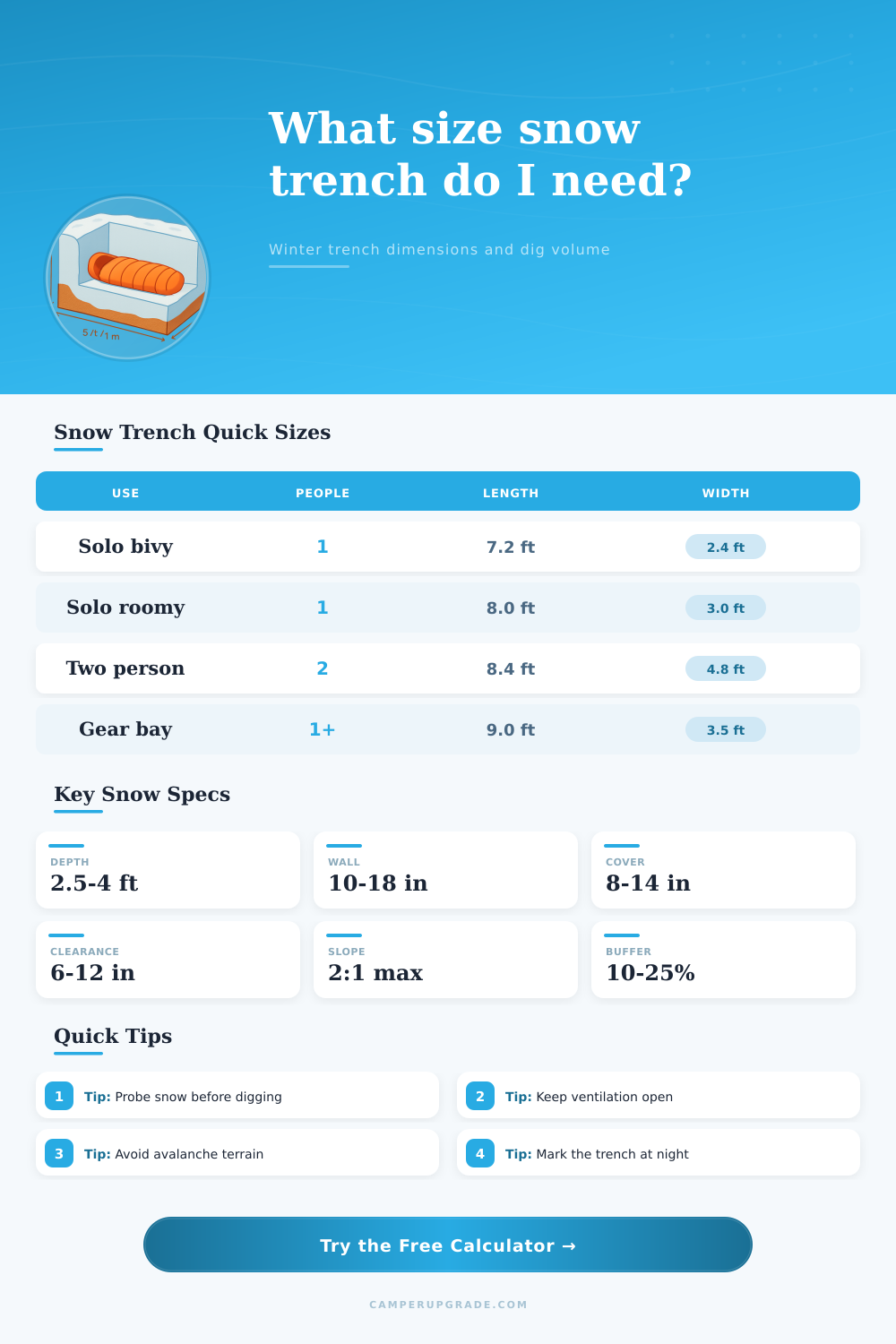
| Trench Type | Typical Interior Length | Typical Floor Width | Interior Depth | Best Use |
|---|---|---|---|---|
| Emergency wind slot | 6.5 to 7.2 ft | 1.8 to 2.4 ft | 24 to 30 in | Short rest, wind break, fast digging |
| Solo bivy trench | 7.2 to 8.0 ft | 2.4 to 3.0 ft | 30 to 38 in | Winter sleeping pad and bivy sack |
| Two person trench | 8.0 to 8.8 ft | 4.4 to 5.4 ft | 34 to 44 in | Two pads side by side with shared wall |
| Gear trench | 7.5 to 9.5 ft | 2.5 to 3.8 ft | 20 to 32 in | Pulka, packs, skis, cooking kit staging |
| Clearance Item | Lean Setup | Comfort Setup | Storm Setup | Calculator Use |
|---|---|---|---|---|
| Side clearance | 3 to 4 in each side | 5 to 8 in each side | 8 to 12 in each side | Adds to each occupant width |
| Head and foot clearance | 10 to 14 in total | 16 to 24 in total | 24 to 36 in total | Adds to interior length |
| Wall thickness | 8 to 10 in | 10 to 14 in | 14 to 20 in | Sets outside trench footprint |
| Cover thickness | 0 to 6 in | 8 to 12 in | 12 to 18 in | Estimates cap block reserve |
| Interior Depth | Use Case | Dig Volume at 7.5 x 2.8 ft | Metric Volume | Notes |
|---|---|---|---|---|
| 24 in | Low wind slot | 42 cu ft | 1.19 m3 | Fast but limited sitting room |
| 30 in | Lean bivy trench | 52.5 cu ft | 1.49 m3 | Works with low cover or tarp |
| 36 in | Sleeping trench | 63 cu ft | 1.78 m3 | Common winter camping depth |
| 42 in | Storm shelter trench | 73.5 cu ft | 2.08 m3 | More spoil and stronger walls needed |
| Snow Type | Block Quality | Suggested Wall | Suggested Cover | Digging Factor |
|---|---|---|---|---|
| Fresh low density | Poor | 14 to 20 in | Avoid heavy caps | 0.78x resistance |
| Settled powder | Fair | 12 to 16 in | 6 to 10 in | 0.90x resistance |
| Firm wind slab | Good | 10 to 14 in | 8 to 14 in | 1.00x resistance |
| Hard shovel blocks | Very good | 8 to 12 in | 10 to 16 in | 1.25x resistance |
interior length = tallest sleeper length + head/foot clearance
floor width = occupants x pad width + side clearances + shared shoulder allowance
dig volume = average trench footprint x depth x drift buffer
block reserve = interior length x floor width x cover thickness x snow condition factor
Measure the actual sleeping pad, bivy, and boots. Snow trenches feel smaller after walls are shaved smooth and insulation is placed on the floor.
Use this as a layout estimator only. Check snow stability, keep vents open, avoid cornices and avalanche runouts, and mark covered edges clearly.
A few inches of snow on top is misleading. It may appear to be fluff when you first take shovel to it, but then you hit a wind slab buried beneath surface. And it’s as hard as concrete. Suddenly, you’re not digging a hole; you’re building a shelter.
Geometry is everything, which means getting the measurements correct are vital. Snow isn’t light. If you make the cover too wide, it will collapse inwards and need constant reinforcement. Get it too narrow and it’ll crack under its own weight. Enter the dimensions of your gear and body size into calculator, and let it do math for you so you don’t have to guess at coefficients while you’re shivering.
How to Calculate Your Snow Shelter Size
Begin by measuring how long it should be inside. It’s not as simple as your height; you also want some wiggle room for your feet (booties) and a little pocket of gear up top where you can stash a small pack close to your head. If you cut this too short to save digging time, you will been constantly moving your gear around all night long. Snow compresses under your weight so make sure to add clearance at each end. While the calculator does this for you automatically based off your height, the larger the space, the more comfortabley it is. A two-person bivy trench for side-by-side sleeping need to be longer than a solo one.
Width matters just as much. You have to account for distance between one wall and your body. You also have to account for extra space required for your pad. Without it, the snow insulation will melt around you (since your body is so warm) creating an ineffective weak point in the wall. Water would of seeped into the wall without this insulation. Structural strength would then decreases quickly.
People sometimes go cheap on wall thickness. Ten inches of snow, yeah, that’s plenty to hold roof up. In fresh low-density powder? Ten inches is asking for trouble. It adjusts your reserve volume according to snow condition. Choose dense drifted snow and the math accounts for blocks holding shape. Pick fresh powder and it cautions that walls must be thicker than support any cover. You can’t cheat density. A thin wall in wet snow will act as a wedge under pressure and shear. The calculator lets you know exactly how much more volume to set aside to make those thicker walls without running out of snow when patching a leak.
So: Digging deep seems good, like it’s doing some work. But the deeper you dig, the more spoil and the more work and more effort you’ve got hauling out. A 34-inch-deep trench provide enough protection from wind yet doesn’t involve an enormous earth-moving job. Beyond four feet, you begin feeling pretty claustrophobic unless you incorporate proper benching. As depth goes up, there’s an exponential spike in volume (see the table on the page), creating a steep curve. You’re making a trade-off between comfort and labor. For a one-night trip, most of us will tell you that thirty inches is the sweet spot, but for a longer stay as a multi-day storm shelter, go deeper, and think about slope you want for your walls. In hard snow you can get away with vertical walls; in softer stuff, slope them back just a bit to help the entire structure stay stable.
You don’t want it to be cold, but you won’t realize there’s a problem until you get sluggish from carbon dioxide buildup. That’s why ventilation isn’t negotiable: Make room for airflow by planning vents at both ends of the trench. They’re small holes, so the calculator doesn’t count them against your estimated digging area, but remember to account for them when making your plan.
Lastly, draw a marker on your entry point. A collapsed overhanging structure can bury your entire trench. If a storm blows down everything else, bright tape or branches marking the spot will let you know where the door is. Measure twice, dig once, and leave enough snow behind to build a door. A standing shelter is always the best shelter…even if only until the sun comes out.