Snow Stake Surface Area Calculator
Estimate exposed stake surface, snow-facing projected area, and reflective band coverage for winter driveway, RV pad, campsite, and plow-route marking.
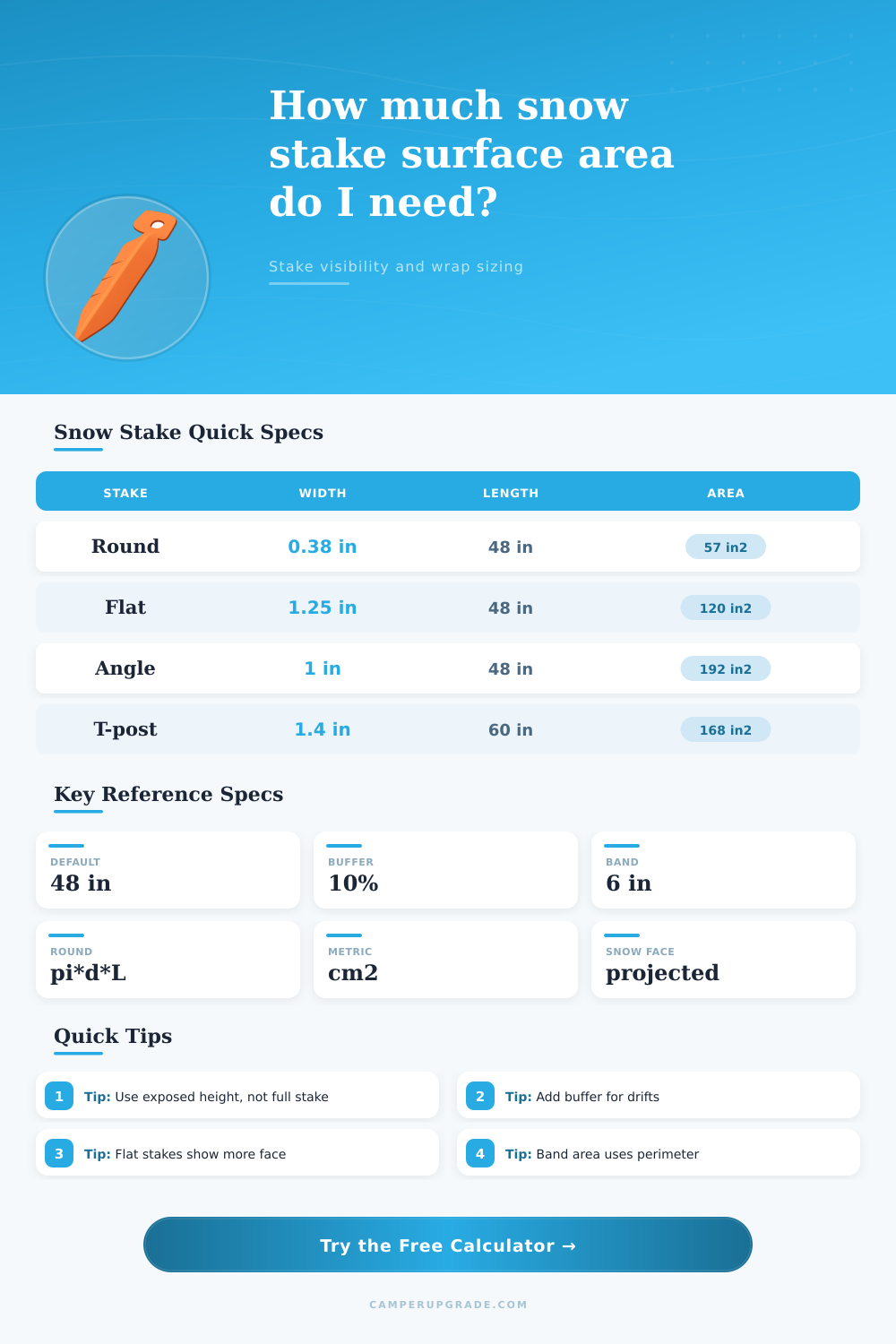
| Stake profile | Typical dimensions | Area formula per stake | Best calculation use |
|---|---|---|---|
| Round fiberglass rod | 3/8 in diameter, 48 in exposed | π × diameter × length | Driveway edges, RV pad corners |
| Round PVC marker | 1/2 in diameter, 48 in exposed | π × diameter × length | Flexible camp access paths |
| Flat steel blade | 1.25 in wide, 0.08 in thick | 2 × (width + thickness) × length | High-visibility plow guides |
| Wood lath stake | 1.5 in wide, 0.25 in thick | 2 × (width + thickness) × length | Temporary cabin or campsite layout |
| Angle aluminum stake | 1 in legs, 48 in exposed | 4 × leg width × length | Large face area without a wide flat panel |
| Light T-post marker | 1.4 in face width, 60 in exposed | 2 × face width × length | Deep snow corridors and storage rows |
| Profile example | 36 in exposed | 48 in exposed | 60 in exposed |
|---|---|---|---|
| 3/8 in round rod | 42.4 in² | 56.5 in² | 70.7 in² |
| 1/2 in round marker | 56.5 in² | 75.4 in² | 94.2 in² |
| 1.25 in flat blade | 95.8 in² | 127.7 in² | 159.6 in² |
| 1.5 in wood lath | 126.0 in² | 168.0 in² | 210.0 in² |
| 1 in angle stake | 144.0 in² | 192.0 in² | 240.0 in² |
Values are geometric side surface, before snow contact factor and layout buffer.
| Stake profile | One 4 in band | Two 6 in bands | Three 6 in bands |
|---|---|---|---|
| 3/8 in round rod | 4.7 in² | 14.1 in² | 21.2 in² |
| 1/2 in round marker | 6.3 in² | 18.8 in² | 28.3 in² |
| 1.25 in flat blade | 10.6 in² | 31.9 in² | 47.9 in² |
| 1.5 in wood lath | 14.0 in² | 42.0 in² | 63.0 in² |
| 1 in angle stake | 16.0 in² | 48.0 in² | 72.0 in² |
| Layout | Typical count | Common profile | Why surface area matters |
|---|---|---|---|
| RV pad corners and sides | 10 to 14 stakes | 3/8 in fiberglass rod | Enough visible area for backing and plow edging |
| Residential driveway edge | 16 to 24 stakes | Round PVC or fiberglass | Consistent snow-facing marker area along curves |
| Campsite perimeter | 12 to 18 stakes | Wood lath or flat blade | Wider face area helps mark soft snow boundaries |
| Storage lot row | 24 to 40 stakes | T-post or U-channel | Higher projected area stays visible in berms |
| Cabin trail flags | 20 to 36 stakes | Bamboo or PVC marker | Band coverage is often more important than total area |
In a blizzard that buries your driveway, it’s possible to lose visual clues. So you go by what you see in rear view camera and pray. How much of the reflective material shows up against white snow? That’s where calculating surface area comes into play. Input your measurements into calculator and let it do math for you.
You won’t have to guess whether three stakes will work or if you need a dozen. It is a matter of visibility, which reveals the core idea: most folks assume they are measuring the full length of their stake but they do not understand that the bottom half will be buried in snow. What matters is what sticks up above the anticipated level of a possible snowdrift. On a forty-eight inch long fiberglass rod with twelve inches embedded in frozen earth, you’ve got just thirty-six inches of usable surface to work with.
How to Calculate Snow Stake Surface Area
By prompting for exposed length alone, the tool enable you to focus on this issue. It forces you to consider not how much plastic you purchased but how much marker is actualy visible. This difference totally changes math. The second thing I look for is shape, how well a marker will stand out. Sure, a round stick is sleek, but when someone approaches from the side, it’s presenting narrow profile. Angle aluminum stakes or flat steel blades provides more face area with less height.
According to the reference table, even at the same height, a flat stake offers two or three times more visible surface area then a skinny rod does. Why? Because eyes finds contrast and look for width; they don’t just seek vertical lines. On a curve where the plow might hit a marker, the wider face can absorbs small impacts without snapping off completely. It’s about redundancy in visibility as much as durability.
The reflectors are also made more difficult by their position. They should of been wrapped around top few inches, but beyond that, they will vary depending on how many bands you want to apply and where. To account for this, the calculator let you tweak both height and number of bands. This lets you guess at your final total wrap area to estimate material costs.
This saves you money on excess tape, and also saves time by helping you budget for materials accurately without buying too little. You don’t need enough reflection to merely appear clean up-close; you need enough to pick it out from 50-yards away in a headlight beam. The other wildcard is drift exposure. Snow doesn’t land everywhere even; wind blows it around piling up here and there.
One stake might be half-buried while another stay clear, depending on whether it is on the sheltered side of a mound or the windward side. That’s where adjusting by contact factor help predict how much area stays exposed under heavy loads. You might want more stakes on the north edge if your area has regular northerly winds, and maybe taller markers to rise above drift line. You can tweak those percentages here so that your final count reflects real world variability not ideal conditions.
Logistics is just common sense with a Buffer twist. Markers tear, markers get pulled up by lawnmowers in the spring, markers dissapears down into some deep drift and are gone forever. Extra markers allow for that margin of error. This helps you avoid needing to get more supplies while it is still winter. Three spares is cheaper than digging in snow at 2AM for replacement parts.
How big should your markers be? Cost vs. Confidence. A low-traffic driveway does not require signage like an interstate highway; however, it must have enough surface area so that you never feel panicked as to where the pavement leaves off and the ditch picks up. Before the first flake falls, get the math correct, less time shoveling uncertainty, more time enjoying the winter view.