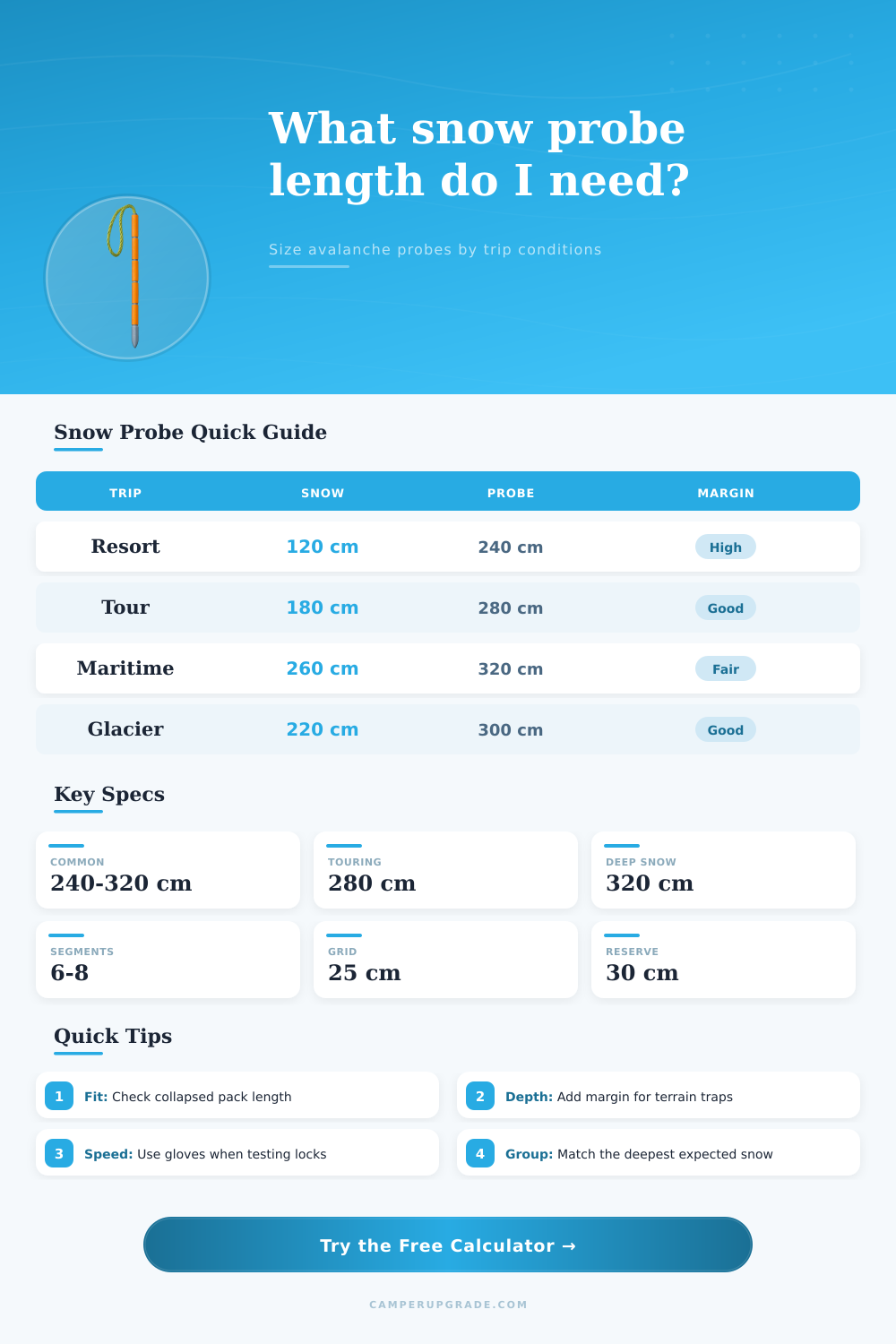
Snow Probe Length Calculator
Estimate a practical avalanche probe length from expected burial depth, snowpack, terrain traps, probing style, pack fit, and probe construction.
| Standard length | Best use | Approx. inches | Planning note |
|---|---|---|---|
| 240 cm | Resort sidecountry, shallow tours | 94 in | Compact but limited margin in deeper debris |
| 260 cm | Light touring with moderate snowpack | 102 in | Middle ground when pack space is tight |
| 280 cm | Common recreational touring size | 110 in | Good baseline for many winter routes |
| 300 cm | Guiding, hut trips, glacier travel | 118 in | More margin with a modest pack penalty |
| 320 cm | Deep maritime snow or sled access | 126 in | Maximum standard reach for deep deposition |
| Condition | Added length | Why it matters | Typical result |
|---|---|---|---|
| Planar slope | 0-20 cm | Less debris stacking | 240-280 cm |
| Small gully or road bank | 20 cm | Moderate deposition pocket | 260-300 cm |
| Creek bed or tree feature | 40 cm | Burials can be locally deeper | 280-320 cm |
| Large deposition zone | 60-80 cm | Deep debris pile concern | 300-320 cm |
| Probe length | Common segments | Estimated collapsed | Pack fit note |
|---|---|---|---|
| 240 cm | 6 sections | 43-46 cm | Fits most compact avalanche pockets |
| 260 cm | 6-7 sections | 42-49 cm | Check short day packs carefully |
| 280 cm | 7 sections | 45-49 cm | Common touring pack fit |
| 300 cm | 7-8 sections | 43-51 cm | Look for 8-section models if compactness matters |
| 320 cm | 8 sections | 45-52 cm | Deep reach with larger tool pocket demand |
| Spec choice | Strength | Tradeoff | Best match |
|---|---|---|---|
| Aluminum tube | Durable field feel | Moderate weight | Most recreational users |
| Carbon tube | Very light carry | Less impact tolerance | Weight-focused tours |
| Steel-cable tension | Positive deployment | Slight weight increase | Frequent practice kits |
| Oversize diameter | Stiffer probing | Bulkier in pack | Rescue drills and guides |
| Pull-cord lock | Fast assembly | Must be glove tested | Companion rescue priority |
| Trip type | Depth input | Allowance | Likely probe |
|---|---|---|---|
| Lift-access sidecountry | 120-150 cm | Low | 240-260 cm |
| Weekend ski tour | 150-190 cm | Medium | 280 cm |
| Hut trip or guide kit | 180-230 cm | Medium-high | 300 cm |
| Deep coastal storm | 230-300 cm | High | 320 cm |
| Snowmobile terrain | 220-300 cm | High | 320 cm |
“Stand up at the tree line. Scan down a seemingly manageable slope. The forecast mentions three feet of snow in the gully below. And then your partner take a fall. Now it’s not about views. It’s about finding someone who may be buried beneath a set of drifts that don’t conform to any simple shape. Here’s when gear matters, specifically how long that gear is, and whether it will get you out quickly or send you into a panic. Most folks buying for the backcountry purchase a probe that comes bundled with their beacon or one that fits nicely in the new backpack they just purchased. This is usually a bad decision. Size your tool for worst-case scenario, not the average conditions you’d like to encounter.”
Stack in some reasonable variables and the calculator will help you determine that figure (above). That begins with burial depth… The most difficult variable to estimate. Many people assumes it’s whatever amount of snow fell recently. The snow drifts and compresses, which creates a bigger pile of debris then was there before. To estimate burial for where you ski, consider the maximum possible burial. For example, if you ski around road cuts or creeks, those naturaly occurring catch basins hold more volume. The device include a buffer for such traps. But this isn’t just wild guessing. This buffer reflects the fact that loose powder becomes a tight block which has the potential to bury someone further than expected.
Why Probe Size Matters for Safety
And don’t get me started on how to balance pack fit against safety. More segments mean a longer tool. This results in a longer collapsed length, which generally requires more space in a pack. How do you make a thirty-two-centimeter tool fit in your little daypack? Well, you can probably make it work if you orient it properly. But does it? Do many of the new packs have long, narrow sleeves for just such an occasion? Probably. And if you cut your probe down because your pack is too short to accommodate the full length, it won’t work either. Or if you simply leave it at home because it doesn’t fit, then it also won’t work. So the math here is extended reach versus what physically fits in your backpack. Comfort may suffer slightly for that added reach.
You should of also consider what the material is like. Most folks use an aluminum one as they bend a little bit without snapping and have some stiffness to them. A carbon fiber one will be lighter (important if you’re going uphill for 6 hours on tour) but brittle after kicking on a rock or slamming it in a crevice of icy debris. And then there’s those steel-cable ones that is heavy but durable. So figure out where you’ll take it, how much you’ll practice with it and go from there. Do you guide lots of people? Will you do a lot of rescue drills? Then maybe get the larger diameter to make sure it’s super rigid. Doing just rec tours on weekends, most aluminum will do fine. Just make sure when you bang it on the ground it feels solid.
Avalanche gear is often considered a fixed collection: purchase a beacon, a shovel, a probe, and leave it at that. However, this mindset overlooks how your travel style change over time. The farther out-of-bounds you go or the more deeply maritime the snow becomes, the more your starting line need to adjust. That lightweight springtime tour around the resort with just enough snow for a 24-cm probe? Not so much when deep powder days on the coast have you probing through more than a meter of snow. Reassess your size each season, particularly if your terrain selection has changed.
Enter your specific needs into the calculator, which then performs the math for you. It calculates margin buffers, pack constraints, and burial estimates, all of which it uses to recommend a feasible size so you can take some of the emotion out of the equation. When every second matters, you don’t need any doubts about your gear. Having clear reasons for your chosen length will give you confidence. And that confidence enables you to concentrate on assessing terrain and spacing out travel instead of wondering if your gear will hold up. It is all about minimizing variables before they create issues.
Having a size-appropriate probe lets you cross that no-man’s land when it matters most without worrying about distance. It connects you to your partner; it fills the void between two adult-sized sofa. And, as the adrenaline subsides and the snow comes down, you’ll thank yourself for doing the math ahead of time. You prepared for the deep stuff, just in case.