Snow Melt Water Yield Calculator
Estimate usable water from snow by footprint, depth, density, melt completeness, capture efficiency, and camp demand.
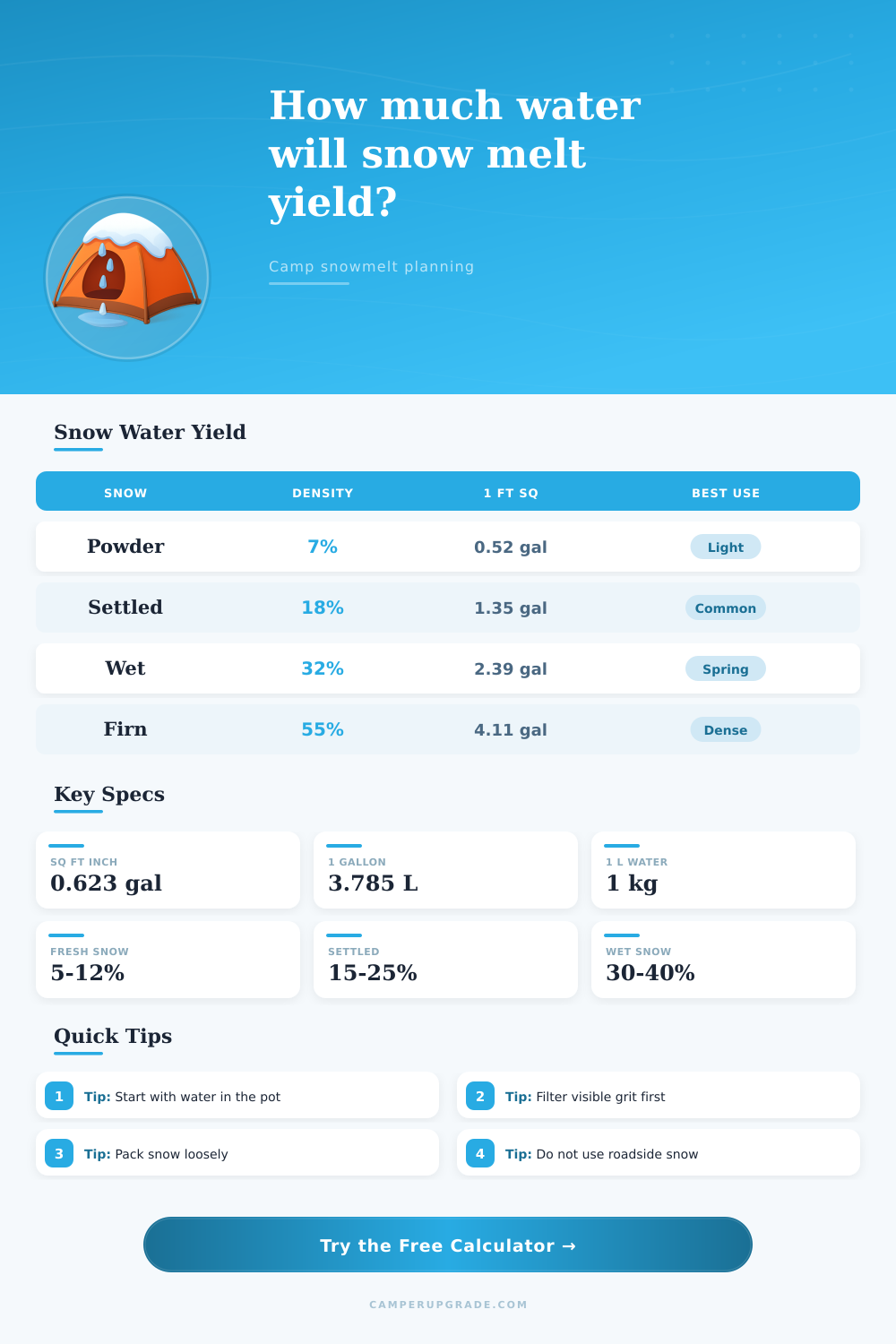
| Snow profile | Density vs water | Water from 12 in over 1 sq ft | Field cue |
|---|---|---|---|
| Dry powder | 5% to 10% | 0.37 to 0.75 gal | Fluffy, hard to pack |
| New average snow | 8% to 12% | 0.60 to 0.90 gal | Fresh storm layer |
| Settled snow | 15% to 25% | 1.12 to 1.87 gal | Holds a loose block |
| Wind packed snow | 25% to 35% | 1.87 to 2.62 gal | Firm slab, dense drift |
| Wet spring snow | 30% to 45% | 2.24 to 3.37 gal | Heavy grains, damp glove |
| Old firn | 45% to 65% | 3.37 to 4.86 gal | Granular old snow |
| Depth and density | 1 sq ft water | 10 sq ft water | Metric equivalent |
|---|---|---|---|
| 4 in at 10% | 0.25 gal | 2.49 gal | 9.4 L |
| 6 in at 18% | 0.56 gal | 5.61 gal | 21.2 L |
| 8 in at 25% | 1.04 gal | 10.39 gal | 39.3 L |
| 12 in at 35% | 2.62 gal | 26.18 gal | 99.1 L |
| 18 in at 18% | 1.68 gal | 16.83 gal | 63.7 L |
| Capture setup | Typical capture | Cleanliness loss | Best camp use |
|---|---|---|---|
| Clean tarp with low corner | 75% to 88% | 5% to 10% | Planned camp melt |
| RV or shelter roof gutter | 70% to 85% | 8% to 15% | Large footprint runoff |
| Black solar sheet | 60% to 78% | 5% to 12% | Daytime passive melt |
| Pot-only scooping | 90% to 98% | 3% to 8% | Stove melting small batches |
| Snow bag squeeze | 65% to 80% | 8% to 18% | Emergency collection |
| Melt source | Effective watts | Time for 1 gal from -5°C | Planning note |
|---|---|---|---|
| Canister stove | 900 to 1400 W | 0.35 to 0.55 hr | Fast, fuel-limited |
| White gas stove | 1300 to 1900 W | 0.25 to 0.38 hr | Reliable in cold |
| Small wood stove | 500 to 1100 W | 0.45 to 1.00 hr | Variable heat feed |
| Black solar sheet | 100 to 300 W | 1.7 to 5.0 hr | Needs sun angle |
| Warm shelter ambient | 30 to 80 W | 6.3 to 16.8 hr | Slow overnight thaw |
| Surface or material | Runoff behavior | Durability | Calculator setting |
|---|---|---|---|
| Silnylon or polyester tarp | Good if tensioned | Good, slippery | Clean camp tarp |
| RV roof or hard shelter roof | High area, edge loss | Excellent | RV or shelter roof |
| Black polyethylene sheet | Warms quickly in sun | Moderate | Black solar sheet |
| Metal pot or basin | Nearly all retained | Excellent | Cook pot only |
| Dry bag or snow bag | Squeeze and drain loss | Good if clean | Snow bag or dry bag |
| Sled, pulk, or tote pan | Good shallow basin | Good | Sled or basin pan |
You wake up and find out your water filter has frozen rock hard and the closest stream is a half mile uphill through three feet of drifts. You’re staring out the tent window at a white world containing everything that could possibly quench your thirst…but you see only ice. And then the panic begins: It’s not that there isn’t any water. It’s the math of density that gets everybody every time. A foot of freshly fallen powder might impress your eyes, but what happens when it comes time to boil it down into dinner? Much of that visual volume is…air. Use the calculator above to convert snow depth into actual liters and stop making guesses; fill up those water bottles with confidence.
The mistake most folks make is assuming all snow is created equal; and then they’re left with a half-tank and an empty pot. The thing you want to pay attention to are the density of the snow. Wet spring slush can run upwards of 35% water content, by volume, whereas dry powder could be just seven percent. That is a fivefold difference between those two figures. You’ll need five times more fluffy snow to achieve the same thing. When you choose the snow density profile in the tool, you’re effectively instructing the engine what it’s working with in terms of how heavy the snow is. Fresh storm powder will give you one number; settled camp snow another (as the crystals has had time to compact and bond together).
How to Plan Water for Winter Camping
That’s where the physics of your campsite enter the picture; specifically the capture area input. Sure, maybe you’re standing on a square acre of deep drifts, but if your tarp sits at an angle with just two by four feet catching water and draining down into a bucket, that’s all that matters. The calculator factors in real and annoying things to consider in the field, such as filter waste and runoff losses. Tarp edges leak. You carry pans around and they spill. Snow gets caught in your fabric. Ice also forms on your pot bottoms before the snow even melts into liquid. This lowers melting efficiency. Deduct a couple of percentage points for those inefficiencies so you don’t wake up thirsty after overestimating your output.
There’s one silent restraint to every winter water strategy: Fuel management. Not only does it take energy to melt ice, it takes energy to bring frozen water above 32 degrees (freezing) and up to boiling. Depending on what kind of heat source you have… Passive solar absorption or a high-output canister stove, the tool will estimate how long it’ll take to melt. That’s important stuff, because if you have ten gallons of possible water, but you only have enough fuel to boil two, well, the other eight are just going to be slow-down wet insulation inside your tent. Knowing the energy cost per gallon also allows you to determine if it’s worth humping heavy wet snow so you can have coffee in the morning, or save that gas for cooking dinner tonight.
The biological aspect of winter camping is just as important. Bad water planning throws off this internal rhythm, making dehydration more likely (dehydration feels colder) and tiring you out quicker. This turns a hike that was once manageable into one where survival are the goal. You don’t have to guess at your daily water requirements and camp size. Plug those numbers into the supply estimator to determine whether they’ll all be covered with a single morning melt or if you’ll have to break it up and make several batches over the course of the afternoon. An unseen resource becomes a solid inventory list.
For those times where you can’t pause to take an exact measurement of everything, the device also comes with handy reference tables to compare against for quick benchmarks. For example, you don’t need a lab to know that fresh snow produces less than wind-packed snow. The answer is typically right in your gloved hand from a simple squeeze test. Does it hold a shape? Then it’s dense. Does it scatter like dust? It’s light. Those qualitative checks correlate well with their presets for a reasonable amount of accuracy without any special equipment.
When you’re collecting winter water, it’s not so much the gathering as it is the process of making something usable out of what you found. It’s not panning for gold, it’s refining ore into an ingredient for a meal. That changes your perception on how you configure your camp. You orient tarps toward the sun. You prep pots. Instead of simply tallying the number of cups, you figure out how much extra fuel you need to ration. This is based off the amount of time needed to turn ice into a drinkable form.
The bottom line is. It’s nice to know what’s in that white heap. It is no longer this insurmountable wall, but a reservoir full of warmth, ready to be used. Knowing what it will produce and how dense that material is helps you feel less like you are fighting the cold and more like a problem solver: With a calculator and some knowledge, you’ll solve the riddle.