Snow Depth Water Content Calculator
Estimate snow water equivalent, snow density, meltwater yield, catchment volume, roof load, and melt timing from measured snow depth, layered snowpack observations, or a simple snow-core sample.
❄Snowpack Presets
⚙Measurement Method and Site Inputs
🧊Layered Snowpack Inputs
📋Calculation Breakdown
⚙Snowpack Spec Grid
📘Snow Water Reference Tables
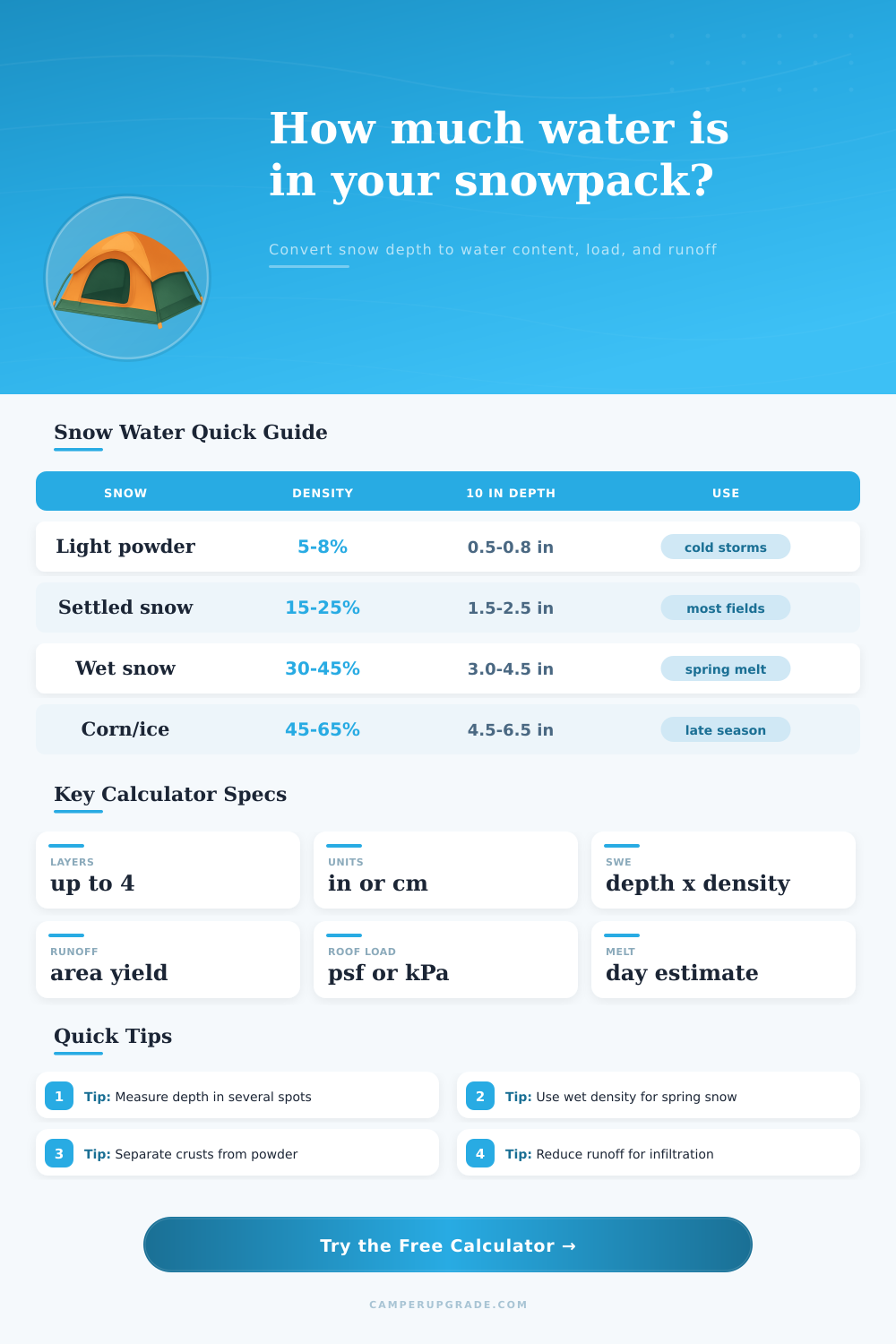
| Snow condition | Typical density | 10 in snow gives | Planning note |
|---|---|---|---|
| Very light cold powder | 4-7% | 0.4-0.7 in water | Common after dry, windy, low-temperature storms. |
| Fresh powder | 8-12% | 0.8-1.2 in water | The classic rough 10:1 snow-to-water range. |
| Settled snowpack | 15-25% | 1.5-2.5 in water | Use for snow that has compacted for several days. |
| Wet spring snow | 30-45% | 3.0-4.5 in water | Expect heavy shoveling, ponding, and faster runoff. |
| Corn, slush, or icy layers | 45-65% | 4.5-6.5 in water | Separate this layer if it is only part of the pack. |
| SWE depth | Load | Per 100 sq ft | Use case |
|---|---|---|---|
| 1 in water | 5.2 psf | 62 gal | Light roof or campsite water estimate. |
| 3 in water | 15.6 psf | 187 gal | Moderate packed snow load. |
| 6 in water | 31.2 psf | 374 gal | Heavy snowpack, watch weak structures. |
| 10 in water | 52.0 psf | 623 gal | Large runoff or serious roof-load review. |
| Measurement approach | Strength | Weakness | Best practice |
|---|---|---|---|
| Single density estimate | Fast | Misses crusts and wet base layers | Use when snowpack is uniform and recent. |
| Layered estimate | Captures storm history | Requires judgment by layer | Separate powder, slab, wet, and icy layers. |
| Core sample | Direct mass estimate | Sampler loss can bias low | Weigh the snow only and measure tube ID. |
| Snow pillow/SNOTEL | Instrumented SWE | Site may not match your slope | Use as a nearby check, not a perfect match. |
| Runoff factor | Typical range | Lower when | Higher when |
|---|---|---|---|
| Roof or tarp capture | 80-95% | Leaks, wind loss, ice dams | Smooth surface and direct guttering |
| Frozen campsite ground | 60-85% | Uneven terrain or snow storage | Hard frozen soil and slope |
| Forest or meadow | 35-75% | Canopy, sublimation, deep soils | Saturated ground or rain-on-snow |
| Small watershed | 25-70% | Long melt window and infiltration | Rapid warmup over frozen ground |
💡Snowpack Measurement Tips
How much does it weigh? That’s what every Northeast homeowner asks themselves when they look out at two feet of snow on their roof. Knowing how deep the snow is won’t tell you much by itself. Wet spring snow are as heavy as concrete; a foot of freshly fallen powder hardly weighs anything. This is called Snow Water Equivalent (SWE). The calculator above combines depth with density to estimate SWE, which, translated, is just amount of mass that can be converted into useful measurements such as meltwater volume or roof load. It lets you know precisely how much liquid water are soaking into your meadow or sitting on your shingles.
And then there’s the snow density factor. Most times, fresh snow will be in the range of ten percent density; it’s got all that trapped air in it. So you’re shoveling away at an hour for every few inches of actual mass. Over time, the snow densifies further as it settle and re-freezes. If it’s wet spring snow, it might hit thirty to forty-five percent density. That can change a doable drift into a structural hazard in the blink of an eye.
Why Snow Weight Matters More Than Depth
With the tool, you can model that variable with ability to input multiple layers. There might be a layer of light powder on top and a layer of dense crust closer to the ground. It makes a difference, because snowpacks aren’t uniform. Every storm stamp its own density pattern. Not accounting for those layer results in bad math.
If you have a snow sampler (or access to one), a core sample is the next best way to get a direct reading. You extract a vertical column of snow, weigh it, and let the tool calculate the rest. It factors in the size of your tube and re-estimates the percentage of snow that got lost in the process. This eliminates all the ambiguity from visual estimates. Instead of guessing at how fluffy a snowpack might be, you just measure its mass. When you’re figuring out total water weight over a big area like a watershed or on a large roof, the difference between an estimate and a measured sample can be considerable.
But what does it all mean? That physics turns into real-world results. In terms of snow load, it’s translated as pounds per square foot… The language of building codes. Depending on that amount, you make the decision: Should I begin shoveling myself, or is it time to hire a pro roofer? For those who count on meltwater to fill their cisterns or irrigate gardens, there’s the runoff volume, how much water will ultimately reach the ground (or end up in your cistern).
The calculator uses a runoff factor, allowing you to tweak for things like canopy loss, or increased infiltration and drainage efficiency. (A spongy forest floor gives less runoff than a frozen field.) Tweak that percent to suit your own terrain.
Most people measure depth in one spot and assume it represent the whole area. Wind blows and forms deep pockets next to barren ridges. Tree wells pull the snow down. Open areas catch more. Taking multiple readings around the location add a great deal of confidence. The tool has a box where you can put how many samples were collected. That will help show the accuracy or lack thereof from the reading. The more, the better, lessening the margin for error. It’s a small detail, but it makes the final number more trustworthy.
When spring arrives, the melt rate input becomes your timeline tool. Based off predicted temperatures, you input how many inches of melt (in terms of water equivalent) you anticipate per day. The calculator estimates duration of pack, which lets you predict peak streamflow in a small watershed or plan when to leave campsites. Static depth translate to dynamic timing.
Snow’s weight appears light, but looks are deceiving. Visuals distract from pressure and mass. The story of weight is not in quantity but what’s inside. Pay attention to the water and not just the bulk; shift guesswork to know-how. The math is done for you, the tool calculates it by combining depth, density, and other factors. How you decide determines how exact your measurements for conditions and density are. Do it right by measuring carefully and being honest about how you layer up. When melting starts, trust the number of water equivalent, not surface depth.