Sleeping Pad Inflation Volume Calculator
Estimate sleeping pad air volume from length, width, thickness, taper, and baffle shape, then convert it into breaths, pump-sack fills, mini-pump minutes, and valve-loss allowance.
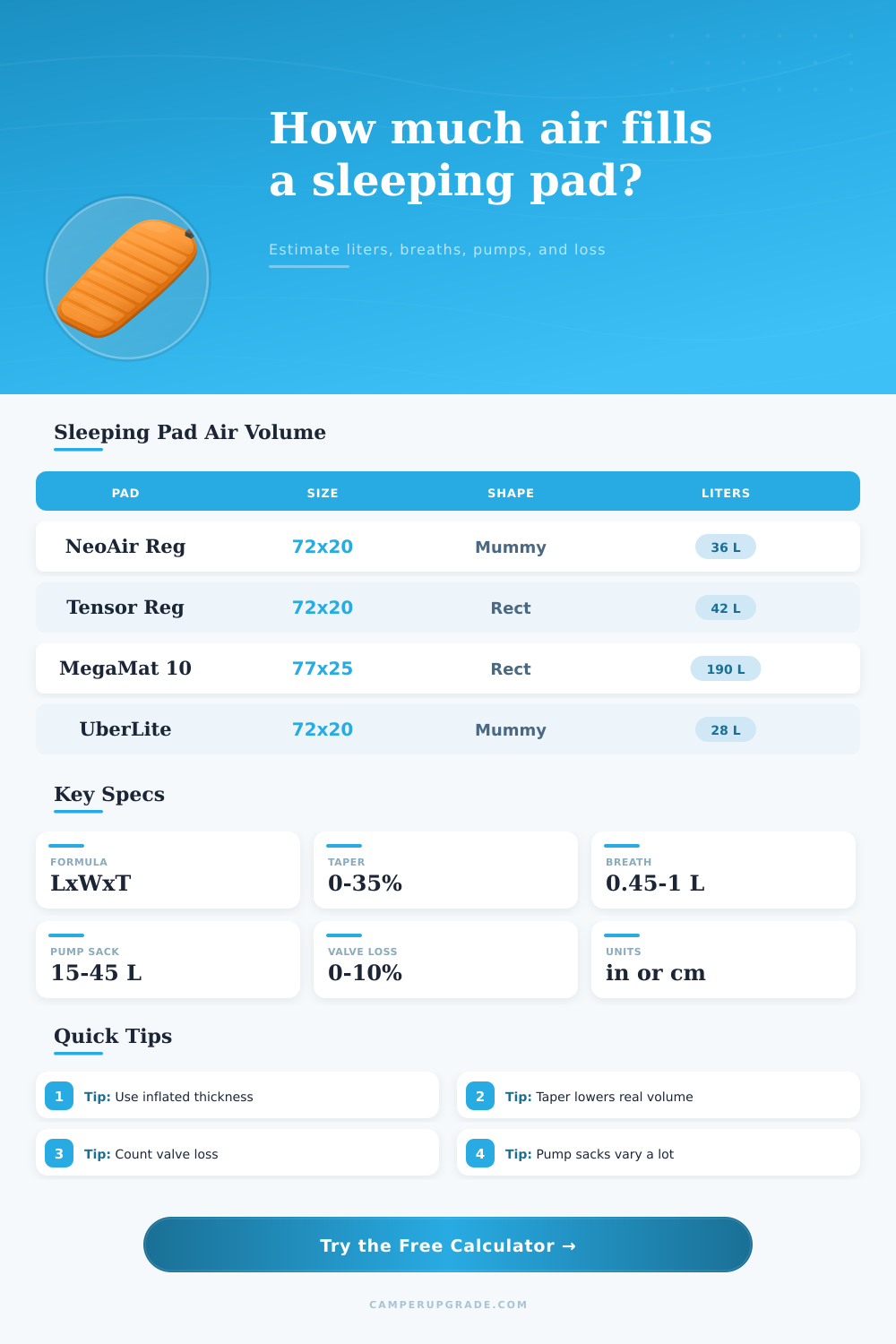
| Sleeping pad preset | Nominal size | Model shape | Approx full volume |
|---|---|---|---|
| Therm-a-Rest NeoAir XLite Regular | 72 x 20 x 3 in | Mummy taper | About 34 to 38 L |
| Therm-a-Rest NeoAir XTherm Large | 77 x 25 x 3 in | Wide mummy | About 48 to 54 L |
| Therm-a-Rest NeoAir UberLite Regular | 72 x 20 x 2.5 in | Mummy taper | About 26 to 31 L |
| NEMO Tensor Insulated Regular | 72 x 20 x 3.5 in | Rectangular | About 43 to 48 L |
| Sea to Summit Ether Light XT Regular | 72 x 21.5 x 4 in | Semi-rectangular | About 51 to 57 L |
| Big Agnes Rapide SL Regular | 72 x 20 x 3.5 in | Rectangular rail | About 42 to 48 L |
| Exped Dura 5R M | 72 x 20.5 x 2.8 in | Rectangular | About 34 to 39 L |
| Klymit Static V | 72 x 23 x 2.5 in | Body mapped | About 31 to 38 L |
| Exped MegaMat 10 MW | 77.6 x 25.6 x 3.9 in | Rectangular foam core | About 175 to 195 L |
| Method | Usable volume assumption | Best use | Calculator input |
|---|---|---|---|
| Comfortable breath | 0.45 to 1.0 L per breath | Small backpacking pads and top-off | Breath volume in liters |
| Integrated pump sack | 15 to 35 L before efficiency loss | Most insulated air pads | Pump volume and transfer efficiency |
| Large dry-bag style pump | 35 to 60 L before efficiency loss | Wide pads and double pads | Pump sack volume in liters |
| Battery mini pump | 80 to 220 L per minute | Thick pads and camp mattresses | Liters per minute as pump volume |
| Self-inflating foam pad | Top-off varies by foam recovery | Exped MegaMat style pads | Use lower fill percent or top-off breaths |
| Pad shape | Area approach | Typical volume effect | When to use it |
|---|---|---|---|
| Rectangular | Length x shoulder width | Highest volume for same dimensions | Boxy pads, camp mattresses, wide rectangles |
| Semi-rectangular | Length x average width x 0.96 | Small corner and contour reduction | Most rounded backpacking rectangles |
| Mummy or tapered | Length x average of shoulder and foot width | Often 15% to 30% less air | Narrow-foot ultralight pads |
| Wide shoulder, narrow foot | Weighted shoulder and foot average | Moderate taper reduction | Pads that stay wider through the torso |
| Raised side rails | Use edge rounding reduction | Can reduce center air volume | Rails, quilted cells, and deep baffles |
| Step | Formula | Input used | Result |
|---|---|---|---|
| Plan area | Length x adjusted average width | Length, shoulder width, foot width, shape | Square inches or square centimeters |
| Raw volume | Plan area x thickness | Inflated thickness | Cubic inches or cubic centimeters |
| Air chamber correction | Raw volume x (1 - edge percent) | Baffle and edge rounding | Practical chamber volume |
| Target fill | Chamber volume x firmness percent | Target firmness | Preferred air volume |
| Valve allowance | Target fill / (1 - loss percent) | Valve and purge loss | Air to move into the valve |
| Breaths | Total liters / usable breath liters | Breath volume | Estimated breath count |
When you are choosing a sleeping pad, it is possible to feel that calculating the air volume isnt necessary. However, calculating the air volume will be important when planning a trip that lasts for several days. The air volume will affect how long you will spend inflating the sleeping pad.
Furthermore, air volume will also impact the physical effort that you will have to use to inflate the sleeping pad. If you know the air volume, you can decide if you will need a pump sack or an mini pump. The thickness of the sleeping pad is the most important factor of the packed size of the sleeping pad.
How Much Air Does a Sleeping Pad Need
The inflated thickness will determine how much air is inside the sleeping pad. For example, a sleeping pad that is three inches thick will contain more air than a sleeping pad that is two and a half inches thick. Both sleeping pads could have the same length and width, but the thickness will make a difference in the amount of air that will be required to inflate the sleeping pad to provide comfort for the sleeper.
Another factor that will impact the air volume of the sleeping pad is the shape of the sleeping pad. Rectangular sleeping pads will have a full width from the head to the feet of the sleeper, whereas mummy shaped sleeping pads will be narrowest at the feet of the sleeper. Because the sleeping pad will be narrower at the feet, there will be less air inside of the sleeping pad.
Two sleeping pads could have the same width and thickness, but the shape will make a difference in the amount of air that will be required to inflate the sleeping pad. Valve loss is the final factor to consider when determining air volume. Every time you open or close the valve on the sleeping pad, some of the air will escape from the sleeping pad.
As you adjust the sleeping pad to ensure that you are lying in a comfortable sleeping position, the sleeping pad will lose air. To avoid losing sleep because the sleeping pad doesnt have enough air to provide comfort, you should of added a small percentage of extra air to your sleeping pad calculations. The inflation method will affect how you use the air volume calculations.
If you use only your breath to inflate the sleeping pad, you can calculate how many breath you must take to fill the sleeping pad. If you use a pump sack, you can calculate how many squeezes of the pump sack is needed to inflate the sleeping pad. A sleeping pad calculator will help you determine these values, allowing you to decide if the weight of a pump sack is something that you would like to carry on your sleeping pad.
Thicker sleeping pads will contain more air than sleeping pads that are meant for backpacking. The air volume will be several times greater for a camp mattress than for a sleeping bag sleeping pad. This amount of air means you will have to spend more time inflating the sleeping pad.
Furthermore, since there is so much air in the sleeping pad, you will have to pay more attention to the sleeping pad valve. This increased air volume means that the sleeping pad will retain more warmth and be more comfortabley for the sleeper. Knowing the number of liters of air in a sleeping pad will help you to decide if a pump sack will be large enough for the sleeping pad.
The firmness of the sleeping pad is the last factor to consider regarding air volume. Depending on your preferences, you could want a sleeping pad that is soft or rigid. By changing the firmness of the sleeping pad, you will change the amount of air that you must move into the sleeping pad.
Therefore, the firmness of the sleeping pad will change the number of breath that you take or the number of times that you pump a pump sack into the sleeping pad. By understanding how each of these factors impacts the air volume, you can better understand the sleeping pad and the effort that you will need to put in to inflate the sleeping pad.