Sleeping Pad Thickness Calculator
Match body weight, sleep position, ground roughness, R-value, pad construction, comfort target, pressure sensitivity, packed size limit, and temperature to a practical sleeping pad thickness.
Sleeping pad recommendation
| Pad type | Typical thickness | Typical R-value | Packed-volume behavior |
|---|---|---|---|
| Thin closed-cell foam | 0.3-0.5 in | 0.7-1.5 | Very bulky for comfort, but light and simple |
| Folding closed-cell foam | 0.6-0.8 in | 1.5-2.2 | Bulky outside-pack carry, reliable on rough ground |
| Self-inflating foam-core pad | 1.0-2.0 in | 2.0-5.0 | Moderate roll size with stable foam support |
| Backpacking air pad | 2.0-3.0 in | 1.5-4.5 | Small packed size, comfort depends on pressure |
| Insulated air pad | 2.5-3.5 in | 3.5-7.0 | Compact for warmth, slightly heavier internals |
| Foam plus air stack | 2.8-4.0 in | 4.0-8.0 | Warmer and safer, but uses two packed volumes |
| Camp mattress | 3.5-5.0 in | 4.0-8.0 | Best comfort, largest packed volume |
| Expected low | Suggested R-value | Insulation read | Thickness note |
|---|---|---|---|
| 60°F / 16°C and warmer | R 1.0-2.0 | Summer only | Cushion matters more than warmth |
| 45-60°F / 7-16°C | R 2.0-3.0 | Mild three-season | Most 2-3 in air pads feel adequate |
| 32-45°F / 0-7°C | R 3.0-4.5 | Cool three-season | Add cushion if the ground is packed or rocky |
| 15-32°F / -9-0°C | R 4.5-6.0 | Cold weather | Insulated air or foam-plus-air works well |
| Below 15°F / -9°C | R 6.0+ | Winter ground | Stacking pads improves warmth and backup |
| Sleep style | Starting thickness | Pressure concern | Best adjustment |
|---|---|---|---|
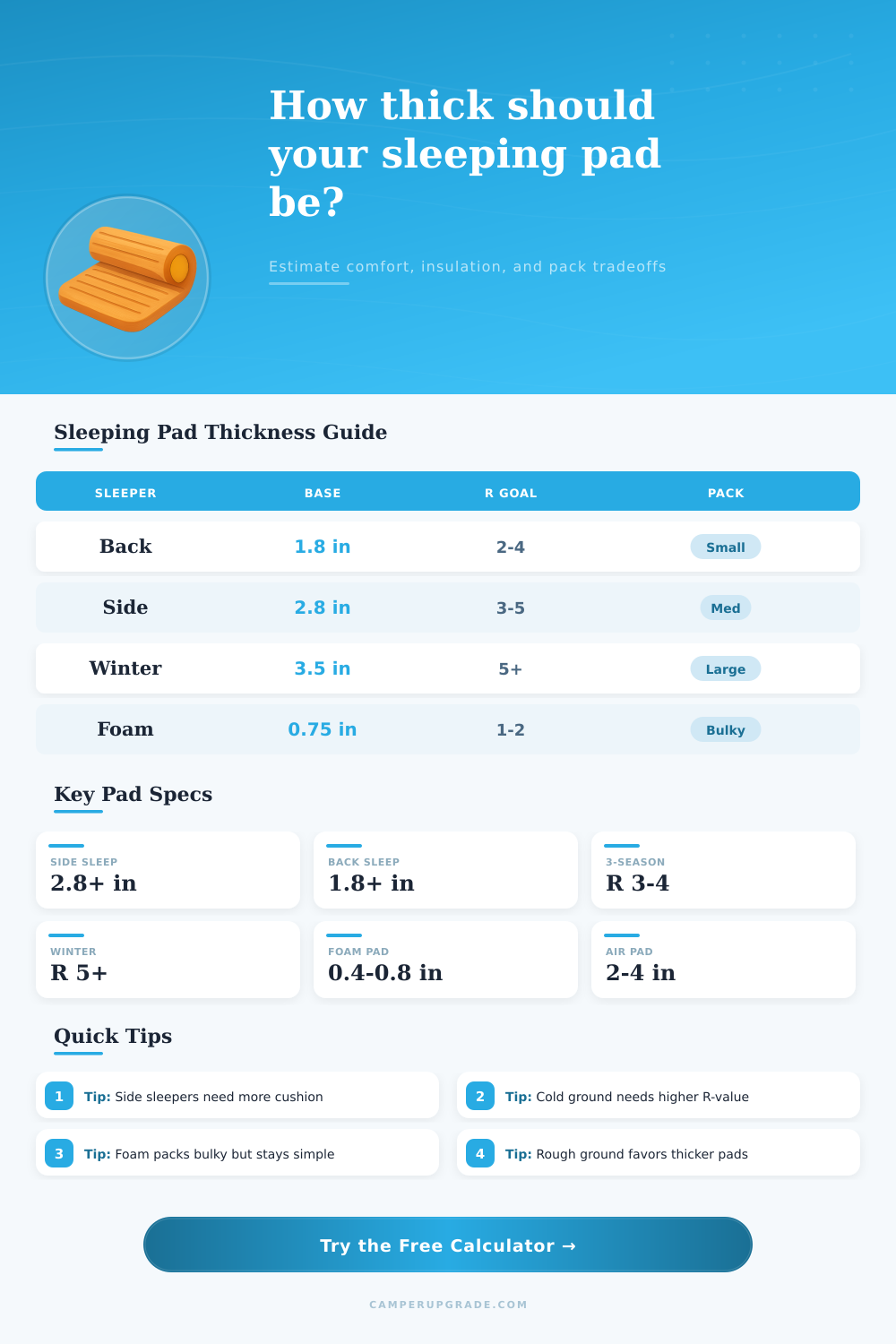
| Back sleeper | 1.5-2.2 in | Shoulders and lower back | Raise thickness for rough ground or higher body weight |
| Side sleeper | 2.5-3.5 in | Hip and shoulder bottoming | Favor air or thick self-inflating pads |
| Stomach sleeper | 1.5-2.3 in | Pelvis pressure and pad wobble | Use stable foam-core or lower air pressure |
| Combination sleeper | 2.2-3.2 in | Rolling off narrow pads | Consider wide pads before adding more thickness |
| Estimated packed volume | Backpacking fit | Common pad style | Tradeoff |
|---|---|---|---|
| Under 2 liters | Very packable | Minimal air pad or thin foam | Lower cushion or lower warmth |
| 2-4 liters | Good pack fit | Regular air or insulated air pad | Balanced comfort for most trips |
| 4-7 liters | Manageable but noticeable | Wide air or self-inflating pad | Comfort improves, pack space tightens |
| 7-12 liters | Bulky backpack carry | Thick self-inflating or foam stack | Useful for comfort or cold but harder to pack |
| Over 12 liters | Car-camp friendly | Camp mattress or wide foam-core pad | Comfort wins over compact storage |
| Preset | Input style | Typical thickness | Planning use |
|---|---|---|---|
| Minimal foam | Thin closed-cell foam | 0.4 in | Supplemental warmth or emergency cushion |
| Folded foam pad | Closed-cell folding pad | 0.75 in | Durable solo camping on smoother ground |
| Ultralight air pad | Regular air pad | 2.0-2.5 in | Small pack size with moderate comfort |
| Side-sleeper air pad | Thicker air pad | 3.0-3.5 in | Hip and shoulder relief on trail |
| Self-inflating camp pad | Foam-core pad | 1.5-2.0 in | Stable cushion for tents and campers |
| Winter air pad | Insulated air pad | 3.0-4.0 in | Cold ground with high R-value target |
Choosing the thicknesses of a sleeping pad is an important process. The thickness of a sleeping pad determine how much cushioning exist between your body and the ground below your sleeping pad. If your sleeping pad is too thin, your body will experience discomfort from the ground.
When choosing the thickness of the sleeping pad to purchase, you must consider your sleep positions, your body weights, and the conditions of the ground you will sleep on. Your sleep position is one of primary factors to consider when purchasing a sleeping pad of a specific thickness. Depending on the position in which you sleep, you will place your weight on different part of your body.
How to Choose the Right Thickness for Your Sleeping Pad
For instance, if you are a side sleeper, you will place most of your weight on your hips and shoulders. For this reason, side sleepers require sleeping pads that are thicker so that their hips and shoulders do not experience any discomfort from the ground. Back sleepers, in comparison, distribute their weight over a larger portion of the sleeping pad, so they require sleeping pads of less thickness than side sleepers.
Finally, stomach sleepers are in the middle of the range of sleeping positions in terms of thickness requirements. However, stomach sleepers must still find support for their stomachs so that they do not feel unstable during sleep. The calculator tool will ask for your sleep position so that we can calculate the thickness of a sleeping pad that will work best for your sleep position.
The other factor to consider is the condition of the ground. If the ground that you will sleep on is smooth, such as a tent platform, then you will not require a sleeping pad that is very thick. However, if the ground feature rocks or is frozen, you will require a sleeping pad that is of a thick construction so that you are not experiencing discomfort from the ground pressing against your body.
However, it is important to understand that thickness and insulation are two different measurements of sleeping pad quality. The thickness of the sleeping pad refers to how thick the sleeping pad will be when you are lying on it. The insulation of the sleeping pad is represented by its R-value and indicates the amount of warmth that the sleeping pad will provide.
The thicker the sleeping pad, the more insulation it will feature, but it may still provide little warmth if its R-value are low. For these reasons, it is also important to consider the R-value of the sleeping pad you are considering. You need to consider both the thickness and the R-value of the sleeping pad to ensure that it is comfortable and warm enough for your sleeping need.
The packed size of a sleeping pad is a third factor to consider when selecting a sleeping pad of the appropriate thickness. The packed size of a sleeping pad determine whether or not the sleeping pad will fit inside your gear. A sleeping pad may be the most comfortable sleeping pad in the world, but if it will not fit in your sleeping pack, you will not be able to use it.
The calculator tool will ask for the width and thickness of the sleeping pad that you intend on purchasing. Based off your answers, the calculator tool will provide you with an estimation of the packed size of the sleeping pad. You may have to sacrifice some of your comfort requirements for your sleeping pad so that it will be more easier for you to carry.
Or, you may have to purchase a sleeping pad that is larger and heavier than what you would prefer for sleeping. A fourth factor to consider when purchasing a sleeping pad of the appropriate thickness is your pressure sensitivity. Pressure sensitivity is a description of how your body reacts to the ground beneath you while sleeping.
If you have high pressure sensitivity, you will feel when the ground press against certain parts of your body. If you have high pressure sensitivity, you will require a thicker sleeping pad so that you can experience an increase in your comfort score. Additionally, if you have high pressure sensitivity, you may also want to seek out sleeping pads that are wider so that your body does not feel like it is placing all of its weight on specific part of the sleeping pad.
Finally, there are different type of sleeping pads with different features and benefit. Closed-cell foam sleeping pads are durable and relatively simple in their make-up, but they may not feature enough thickness to provide enough comfort for side sleepers. Air sleeping pads can be made to be very thick and take up very little space when you pack them for travel, but they may feel unsteadily on the sleeping surface.
Lastly, self-inflating sleeping pads are in between the two in terms of features and benefit. They include a foam layer in the middle of the sleeping pad for stability, but they take up more space when you pack them for travel than air pads do. There does not exist a type of sleeping pad that is better than all of the other.
Each has its benefits and drawbacks. Based on your sleeping needs, you may have to make certain compromise to purchasing a sleeping pad that will meet your sleeping requirements.