🛏 Sleeping Pad R-Value Checker
Find the right insulation rating for your sleeping pad based on camping conditions, temperature, and sleeper type
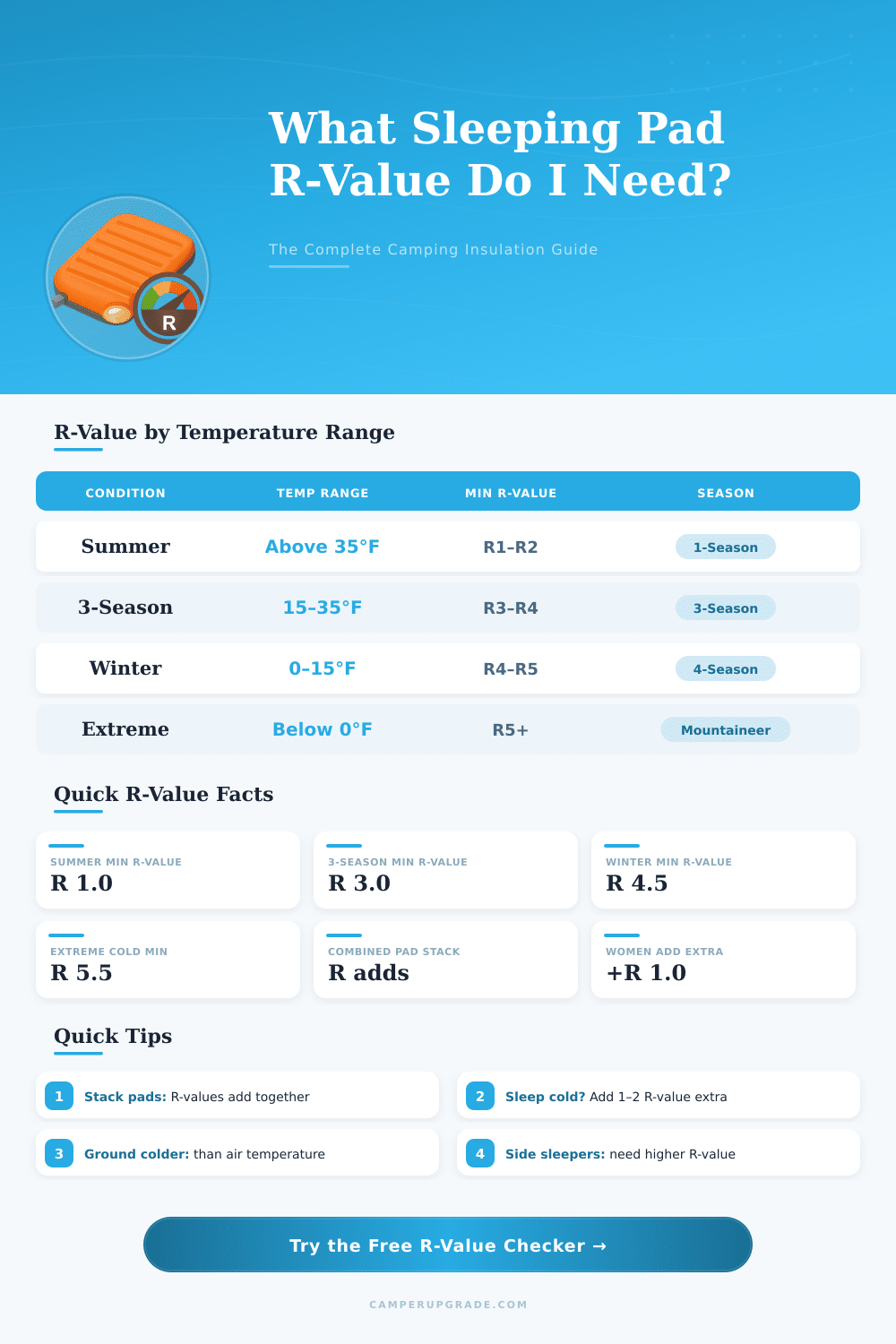
| Season / Condition | Temp Range (°F) | Temp Range (°C) | Min R-Value (Male) | Min R-Value (Female) |
|---|---|---|---|---|
| Hot Summer | 55°F+ | 13°C+ | R 1.0 | R 2.0 |
| Summer | 35–55°F | 2–13°C | R 2.0 | R 3.0 |
| Early Spring / Late Fall | 25–35°F | −4 to 2°C | R 3.0 | R 4.0 |
| 3-Season / Shoulder | 15–25°F | −9 to −4°C | R 4.0 | R 5.0 |
| Cold Winter | 0–15°F | −18 to −9°C | R 5.0 | R 6.0 |
| Extreme / Alpine | −20 to 0°F | −29 to −18°C | R 6.0 | R 7.0 |
| Arctic / Expeditions | Below −20°F | Below −29°C | R 7.0+ | R 8.0+ |
| Pad Type | Typical R-Value | Weight | Best Use |
|---|---|---|---|
| Basic Foam (closed-cell) | R 1.0 – R 2.0 | 12–18 oz | Summer / backup pad |
| Ridgerest Classic (foam) | R 2.1 | 14 oz | 3-season lightweight |
| Self-Inflating (1" thick) | R 2.0 – R 3.0 | 20–28 oz | Backpacking 3-season |
| Self-Inflating (2" thick) | R 3.5 – R 5.0 | 28–40 oz | Car camping / 4-season |
| Inflatable (uninsulated) | R 1.0 – R 1.5 | 10–18 oz | Summer only |
| Inflatable (synthetic fill) | R 3.5 – R 5.0 | 16–28 oz | 3-season to winter |
| Inflatable (down fill) | R 5.0 – R 7.0 | 18–30 oz | Winter / alpine |
| Double-wide foam | R 2.0 – R 3.0 | 30–50 oz | Car camping / families |
| Stacked (foam + inflatable) | R 4.0 – R 7.0 | Combined | Winter / budget winter |
| Sleep Location | R-Value Modifier | Why It Matters |
|---|---|---|
| Bare Ground (soil) | +0 (baseline) | Standard reference point |
| Tent Floor (ground cloth) | +0 to +0.2 | Minimal added insulation |
| Snow Surface | +1.0 to +1.5 | Ground much colder than air |
| Hammock | +0.5 to +1.0 | Air circulates under pad |
| Cot (elevated) | −0.5 to +0.5 | Depends on insulation below cot |
| RV / Van (insulated floor) | −0.5 to −1.0 | Warmer floor surface |
| Concrete / Hard Floor | +0.5 | High thermal conductivity |
| Pad 1 (Bottom) | Pad 2 (Top) | Combined R-Value | Suitable Down To |
|---|---|---|---|
| Foam R 2.0 | Inflatable R 1.5 | R 3.5 | ~25°F (−4°C) |
| Foam R 2.0 | Inflatable R 3.5 | R 5.5 | ~10°F (−12°C) |
| Foam R 2.0 | Inflatable R 5.0 | R 7.0 | ~0°F (−18°C) |
| Foam R 3.0 | Inflatable R 3.5 | R 6.5 | ~5°F (−15°C) |
| Self-Inflate R 3.0 | Inflatable R 4.5 | R 7.5 | −5°F (−21°C) |
Sleeping pads rank between the most important parts of any camping gear. After sleeping bags, that should be the first purchase for every camper, come the sleeping pad as second priority. It perfectly works with the bag, ensuring comfort and protection against cold.
One can use them in many more occasions than many imagine. Whether about camping, car trips or other activities under the open sky, sleeping pads always are useful.
How to Choose a Sleeping Pad for Camping
Pads from closed-cell foam cost the least. One almost can not destroy them. Their weakness is lack of real softness.
In the foam they carry tiny air pockets, that help to insulate. Not all of them are thick even so they do their task. For instance, the Therm-a-Rest Z Lite are cheap, always practical and almost not possible to destroy.
One rates sleeping pads by means of something called R value. When the number is higher, that gives stronger protection against the cool soil. This matters especially for campnig in cold seasons.
Some campers combined two sleeping pads with R value of four and stayed warm even in minus thirty-five degrees Fahrenheit.
Other options give self-inflating pads. The Exped Megamat one considers among the most pleasant supports for sleep, and some reckon, that it beats many home beds. It comes in various sizes.
To shrink it, simply open the valve and role upward. There is even a two-person version, the Megamat Duo, that covers the whole floor of a car bed or the inside of an SUV.
Now, some models include insulating material. Exped adds goose down and wool in some of theirs. Marmot and Pinnacle offer light pads with Thermolite synthetic stuffing, a mix of hollow and dense fibers, that keeps the warmth when the pad inflates.
Many campers like natural stuffing more than those from synthetic. In the end, everything depends on personal taste.
For car campers well serve the Therm-a-Rest LuxuryMap. The Therm-a-Rest BaseCamp are thick, broad and reach R value of six, although it passes a hundred dollars. Side sleepers sadly need something soft and quite thick to escape pressure on spots.
The HEST Dorma System answers for those, that want the most high-end comfort, withoutcare about price or weight. Comfort does depend on individual choices, and the ideal pads differ according to folks.