Sleeping Pad Packed Size Calculator
Estimate packed liters, stuff-sack fit, warmth per liter, and carry weight for air pads, self-inflating mats, and folded foam pads.
Calculation Breakdown
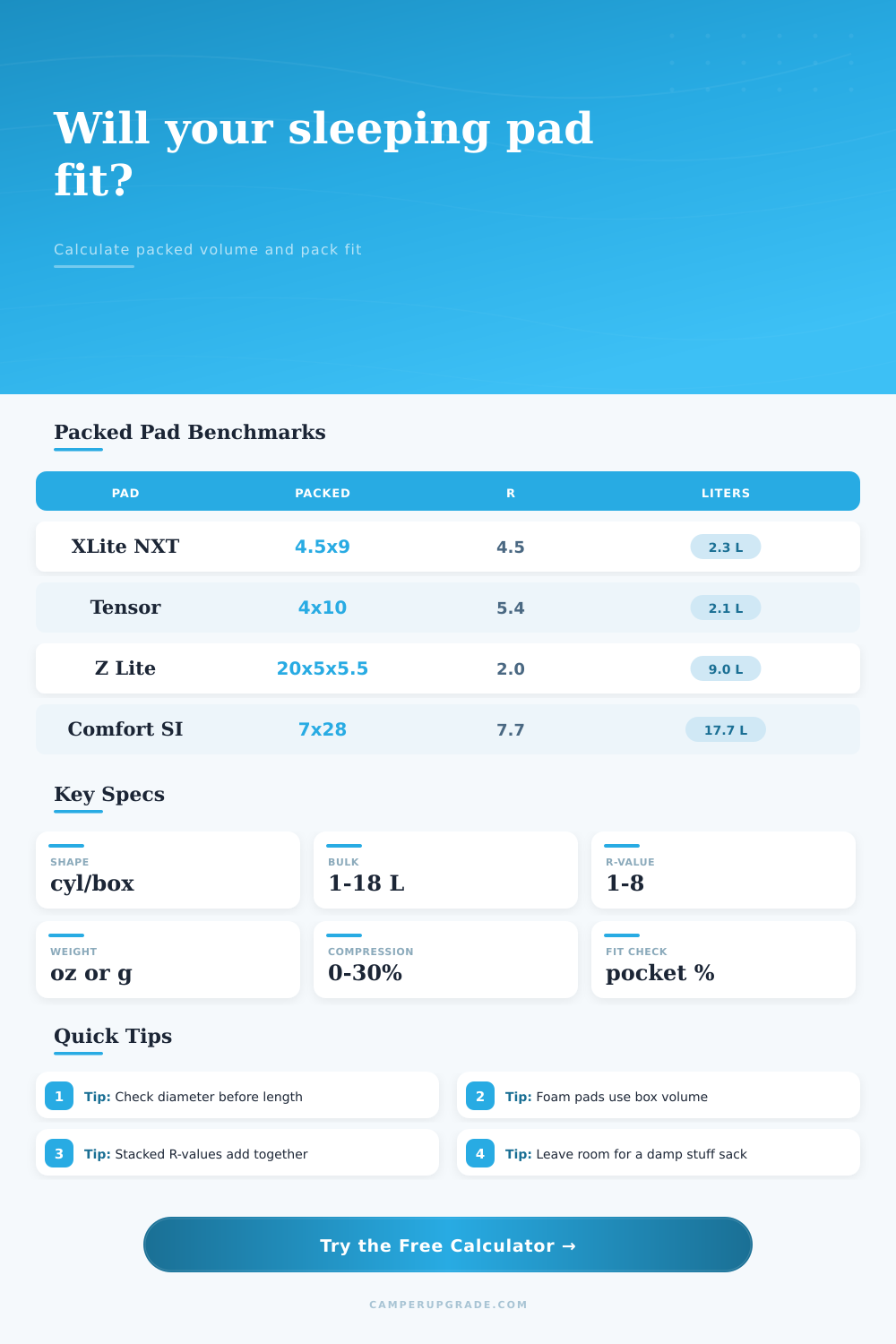
| Model preset | Packed size used | Volume formula result | R-value | Weight used |
|---|---|---|---|---|
| Therm-a-Rest NeoAir XLite NXT Regular | 4.5 x 9 in roll | 2.35 L | 4.5 | 13 oz |
| Therm-a-Rest NeoAir XTherm NXT Regular | 4.5 x 9 in roll | 2.35 L | 7.3 | 15.5 oz |
| NEMO Tensor All-Season Regular Mummy | 4 x 10 in roll | 2.06 L | 5.4 | 14.1 oz |
| Sea to Summit Ether Light XR Pro Regular Mummy | 4.7 x 8.3 in roll | 2.36 L | 7.4 | 20.4 oz |
| Exped Ultra 3R Medium | 4.3 x 9.1 in roll | 2.17 L | 3.2 | 15.9 oz |
| Big Agnes Rapide SL Insulated Regular | 3.5 x 7 in roll | 1.10 L | 4.8 | 17 oz |
| Klymit Static V Base | 3 x 8 in roll | 0.93 L | 1.3 | 18.7 oz |
| Klymit Insulated Static V Peak Regular | 5.5 x 7.5 in roll | 2.92 L | 4.2 | 22 oz |
| Therm-a-Rest Z Lite SOL Regular | 20 x 5.5 x 5 in box | 9.01 L | 2.0 | 14 oz |
| Sea to Summit Comfort Deluxe SI Regular Wide | 7 x 28 in roll | 17.65 L | 7.7 | 69.5 oz |
| Packed shape | Formula | Best for | Fit caution |
|---|---|---|---|
| Cylinder roll | pi x (diameter / 2)^2 x length | Air pads and self-inflating rolls | Diameter usually blocks side pockets first |
| Folded box | width x height x depth | Closed-cell folding pads | Try all orientations against locker dimensions |
| Two identical rolls | single volume x pad count | Couples, family kits, backup pads | Stacked diameter grows by square root of count |
| Compression allowance | total volume x (1 - compression %) | Soft stuff sacks inside a pack | Use 0% for foam and hard storage bins |
| Pad system R-value | Typical use | Compact target | Planning note |
|---|---|---|---|
| R 1 to 2 | Warm summer ground | Under 2 L air, 7 to 10 L foam | Small and light, but low cold-ground margin |
| R 3 to 4 | Three-season backpacking | About 2 to 3 L | Good balance for most compact camp kits |
| R 4.5 to 6 | Cold shoulder season | About 2 to 4 L | Look for high R/L rather than only low weight |
| R 7+ | Winter or snow camping | About 2.5 to 6 L | Stacking a foam pad adds both R-value and bulk |
| Storage location | Useful opening | Works well with | Calculator setting |
|---|---|---|---|
| Backpack side pocket | 4.5 to 6 in diameter | Compact air pad rolls | Round pocket diameter and length |
| Top lid or brain | 8 to 12 in length | Short rolls under 10 in | Round pocket length |
| RV dinette bench cubby | 18 x 8 x 12 in | Foam folds and self-inflating rolls | Rectangular width, height, depth |
| Bikepacking dry bag | 5 to 7 in diameter | Low-volume air pads | Use 0 to 5% compression |
If this sounds familiar, you’ve probably stood in a trailhead, zipped up your pack, and realized that your sleeping pad won’t fit in space provided. Maybe it’s a couple millimeters too wide. Or maybe you’re rolling it too long so that it bulges out the sides and throw off the fit of hip belt. Every backpacker have had that brief moment of minor panic. What goes on floor?
Most of the time, the issue isn’t the weight. You spend years trimming back food packaging and hunting down lighter zippers because you obsess over the ounces, but then what happens when a sleeping pad weigh 15 ounces? That doesn’t sound like much, but if it fits in a nine-inch wide cylinder, it determines how many other thing you can carry. After entering pocket size and roll dimensions, the calculator above do all the math for you; saving you time guessing about conversions and coefficients.
Why Sleeping Pads Are Hard to Pack
And contrary to popular belief, warmer doesn’t necessarily equal bulkier. Thanks to innovations in insulation technology, moddern padding has separated bulk from warmth. Manufacturers now use reflective films to fit high heat resistance into thin air chambers, adding no extra thickness to the roll. That’s why today you’ll see winter-ready pads that pack-down almost as small as summer ones. Typically, there is a tradeoff between durability and weight, but not volume. When going for compactness on a fast-and-light trip, consider the warmth-to-bulk index different than simply total R-value. This tell you how many liters of pack space you’re getting for each ounce of insulation.
Packing geometry depend on material choice. Cheap and indestructible closed-cell foam pads fold up into a box which does not compress; they’re rigid boxes. There’s no way to squeeze a foam pad smaller than it was when folded up. On the other hand, air pads can be manipulated; that’s why there’s a compression percent in the tool where you set how much your volume estimate should of shrink when packed. A load of gear in a soft mesh stuff sack will squash down further then one stuffed into a hard plastic bin in an RV. Get real with that number. Do you have the pad thrown into a side pocket already filled with a water bottle and some wet clothes? That really reduces the volume. Overestimate compression, and you’ll fail at the trailhead.
The type of pack is also important. Most packs now come with some sort of specific compartment for sleeping pads (either in the lid at the top, or underneath hip belts). But these compartments are not infinitely variable. They are specific sizes: though diameter matter more then length. For example, ultralight designs tend to restrict pad widths to no more than 5 inches, meaning anything wider than that won’t fit into their dedicated sleeves, no matter how lightweight. See the chart below from the page, which illustrates how various sleeping pads will fit in most sleep pad pockets. Note that cylindrical storage has more to do with width then length: if something is too wide, you won’t be able to squeeze it through hole; if it’s too long, you might be able to bend it around slightly.
Another popular technique for cold weather camping is stacking pads. Placing a thin piece of foam underneath an air pad adds some puncture protection and some additional R-Value. However it also effective doubles the amount of bulk you’ll carry in that area of your pack. So if you’re already running tight on room for clothing or other items in your pack, do you really want to take up all that space for something you’re not sure will be warm enough? A good quality insulated air pad can be more efficient at packing than two pads, but again that depends based off the space available in your bag versus the margin needed over ground chill.
What is the main point? Packing is a game of give-and-take. There is no such thing as the warmest, lightest, and smallest at the same time. Pick two, or be ready to sacrifice one aspect. And if you do measure your packed gear (rather than just go by marketing specs), then you’ve removed the guessing game from the equation. Now you know EXACTLY how much space your pad take up in a bag; and you’ll feel confident filling out the rest of the loadout. That’s what separates a feeling of organization from a pack that never quite fits together.