Sleeping Bag Warmth to Weight Ratio Calculator
Compare a bag or quilt by field-adjusted comfort rating, packed weight, fill efficiency, pad support, sleeper profile, and trip safety margin.
📍Named Trip Presets
⚙Bag, Sleep System, and Trip Inputs
The model converts all entries to imperial internally, changes ISO lower-limit and manufacturer ratings to comfort-equivalent values, then adjusts for pad insulation, drafts, moisture, clothing, and sleeper profile.
Warmth-to-Weight Results
🧵Material and Spec Comparison Grid
best loft per ounce
premium backpacking
strong efficiency
durable value fill
damp penalty buffer
wet-weather reliable
soft compressible fill
stable car-camp fill
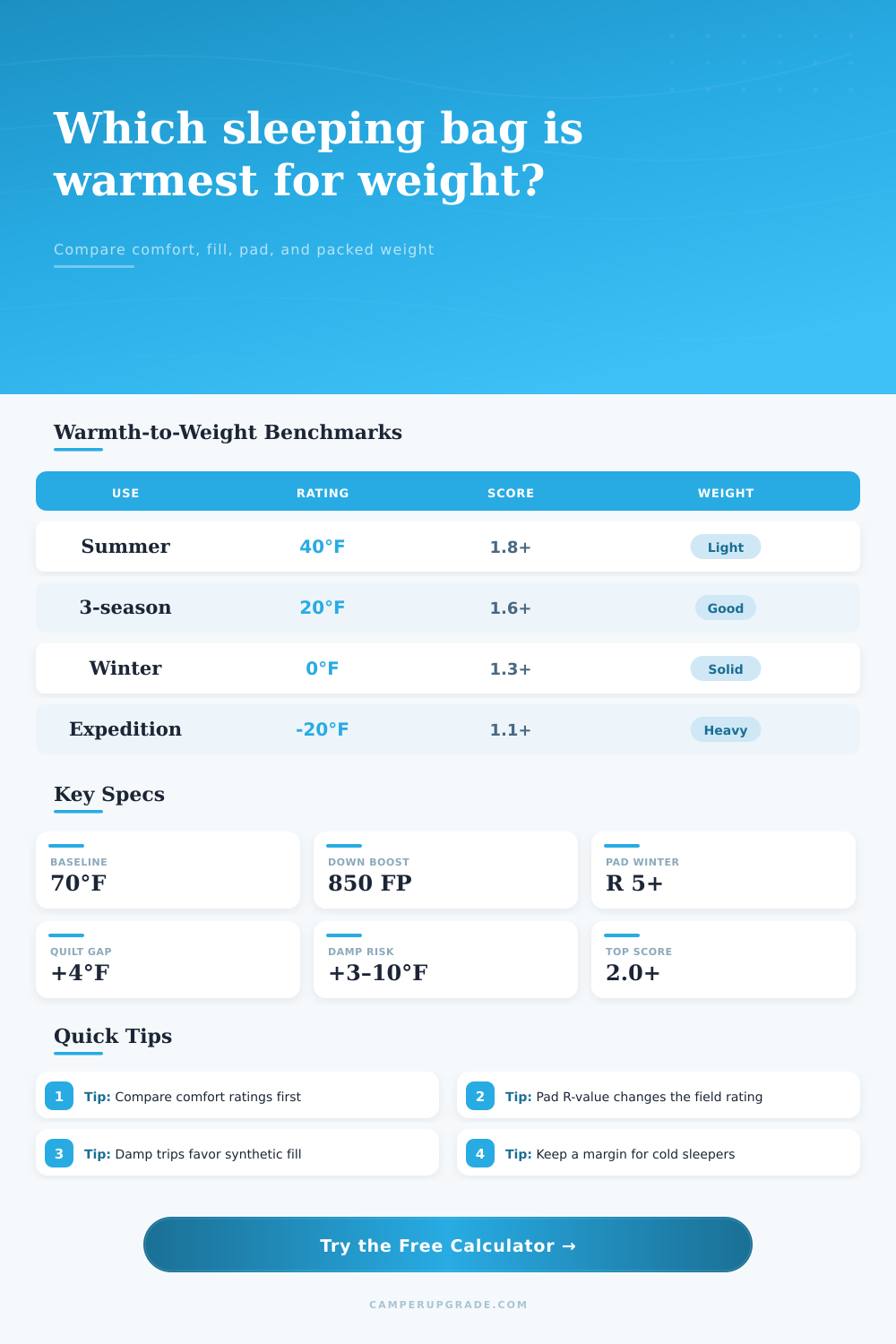
📊Warmth-to-Weight Benchmarks
| Score range | Typical meaning | Common gear profile | Best use |
|---|---|---|---|
| 2.20+ °F/lb | Excellent warmth for carried weight | High-fill-power down quilt or trim mummy | Long-distance backpacking with good moisture control |
| 1.75 to 2.19 °F/lb | Efficient and trail-friendly | 800 to 850 FP down or optimized synthetic quilt | Three-season mountain trips and shoulder-season hiking |
| 1.25 to 1.74 °F/lb | Warm but weight-conscious | Mid-fill down, damp-weather synthetic, or roomier bag | Canoe camping, guided trips, and mixed forecast camps |
| 0.85 to 1.24 °F/lb | Robust warmth with a weight penalty | Heavy synthetic, rectangular winter bag, or expedition system | Basecamp, pulk travel, vehicle-supported cold camps |
| Below 0.85 °F/lb | Comfort-prioritized rather than carry-prioritized | Oversized camp bag, older insulation, or very cold rating | Car camping and short carries where packed mass matters less |
🌡Temperature Rating Interpretation
| Rating basis | Calculator adjustment | Why it changes | Use in ratio |
|---|---|---|---|
| ISO/EN comfort | 0°F | Comfort rating already reflects a conservative warm-sleeper-neutral value | Best direct comparison across bags |
| ISO/EN lower limit | +10°F | Lower limit is commonly colder than many campers can sleep comfortably | Converted upward before scoring |
| Manufacturer lower rating | +8°F | Non-comfort ratings often assume ideal layers, pad, tent, and sleeper tolerance | Moderately conservative field estimate |
| Quilt estimate | +5°F before draft checks | Open-back systems depend heavily on strap setup and pad coverage | Then modified by shape and exposure |
🛏Pad R-Value Interaction Table
| Expected low | Suggested pad R-value | Penalty if below target | Calculator effect |
|---|---|---|---|
| 40°F / 4°C and warmer | R 2.0+ | About 4°F per R-value short | Low pad insulation raises field comfort temperature |
| 30°F / -1°C | R 3.0+ | About 4°F per R-value short | Common three-season correction |
| 20°F / -7°C | R 4.0+ | About 4°F per R-value short | Important for frozen ground or snow patches |
| 10°F / -12°C | R 5.0+ | About 4°F per R-value short | Winter-capable pad strongly affects usable warmth |
| 0°F / -18°C and colder | R 6.0 to 7.0+ | About 4°F per R-value short | Stacked pads may outperform one thin high-loft bag |
⚖Typical Rating and Weight Reference
| Comfort rating | Efficient down range | Synthetic range | Realistic note |
|---|---|---|---|
| 45°F / 7°C summer | 12 to 18 oz / 340 to 510 g | 18 to 30 oz / 510 to 850 g | Draft control often matters more than raw loft |
| 30°F / -1°C three-season | 20 to 28 oz / 570 to 790 g | 32 to 48 oz / 910 to 1360 g | Good target for shoulder-season backpacking |
| 20°F / -7°C mountain | 26 to 36 oz / 740 to 1020 g | 44 to 62 oz / 1250 to 1760 g | Pad R-value and hood design become decisive |
| 0°F / -18°C winter | 44 to 60 oz / 1250 to 1700 g | 70 to 96 oz / 1980 to 2720 g | Weight rises quickly because loft depth must surround the whole body |
| -20°F / -29°C expedition | 64 to 90 oz / 1810 to 2550 g | Often 100 oz+ / 2830 g+ | Basecamp comfort may outrank carry efficiency |
💧Fill Material Field Behavior
| Fill type | Loft efficiency index | Damp penalty used | Best comparison context |
|---|---|---|---|
| 950 FP goose down | 1.18 | Medium when wet, low when dry | Fast-and-light trips with careful moisture management |
| 850 FP goose down | 1.10 | Medium when wet, low when dry | Premium backpacking bags and quilts |
| 800 FP duck down | 1.03 | Medium when wet, low when dry | Efficient three-season systems |
| 650 FP duck down | 0.88 | Medium when wet, low when dry | Durable general camping with moderate carry distance |
| Hydrophobic treated down | 1.05 | Reduced by about 2°F in damp settings | Humid mountain trips and tents with condensation |
| Climashield Apex synthetic | 0.76 | Small moisture penalty | Wet forests, packrafts, and simple quilt construction |
| PrimaLoft Gold synthetic | 0.82 | Small moisture penalty | Compressible synthetic bags for variable conditions |
| Hollowfiber synthetic | 0.62 | Small moisture penalty but heavier bulk | Vehicle camping, scout trips, and loaner gear |
💡Calculation Tips
Use this calculator to find your sleeping bag’s warmth-to-weight ratio. If you’ve ever been cold in a sleeping bag that was way too heavy (or just never felt right), then you know what I’m talking about. It’s also why I hate doing the math…until I do. Then I realize how much easier life is with this handy dandy warmth-to-weight calculator. Now, instead of suffering under an uncomfortable weight, you can find a comfortable balance that won’t break your back.
Weight and temperature ratings don’t always translates directly into performance: I’ve seen bags rated down to 20°F that weigh thirty ounces and thought “That sounds perfect,” but there’s no consistency across brands about how their rating are calculated. That’s where the calculator come in. As long as you enter your gear information into the calculator, it do the math for you. So if you find a bag with a lower-limit rating but wonder if it’ll keep you warm, you don’t need to wonder. It translates those ratings to one universal standard, allowing you to compare which bag gets more bang for its buck per ounce.
How to Find the Best Sleeping Bag for You
The other thing most folks don’t acknowledge is that different materials retain heat differently. Down retains more heat per pound because it is fluffy. Heavier weights trap heat better (duh). Higher fill powers traps heat even with lower weights. Synthetics are heavier for the same warmth, but they won’t lose effectiveness if it get moist. This can be a huge factor in forest humidity and coastal fog. They’ll change how warm the system really is.
It’ll also adjust your efficiency score depending on which fill material you choose; because down will lose its insulating properties fast once wet, yet those synthetics still retain their form and function even when soaked.
A sleeping pad isn’t just a nice-to-have; it’s part of your insulation system. When insulation is squished under two adult-sized sofa, it no longer works very well so heat radiates out through the ground even more easily than it does through the air. On a cold night, your bag might be rated for 20 degrees. However, if your pad has an R-value of two and you’re on frozen ground, cold creeps upward into the bottom of the bag. This kills off its loft from below. To provide a realistic field rating, the calculator take your pad’s R-value into account. When the temperature fall, it makes low R-values a bigger problem, that’s where the thermal bridge occurs. Having a good bag doesn’t mean much if your pad sucks: A heavy pad can ruin the ratio as bad as a poor one.
Your own physiology and draft control can also contribute to keeping you warmer. For instance, a mummy shaped bag will keep you warmer than a rectangular sack, as it holds warm air closer to your body. Additionally, there is the issue of being a cold or hot sleeper. In that case, the rating need a larger margin of safety. With this tool, you can enter how you sleep (cold or hot) and what margin of comfort you want. Then, final number shows you how much buffer you really require for a good night’s sleep.
It also takes into account shelter exposure, as wind chill does affect the temperature outside your system even when in a tent. These help you understand how to select gear that works well for your trip instead of just looking good in a brochure. The warmth-to-weight score indicates efficiency of the bag in terms of mass. The higher the score, the more efficiently it keep you warm. The lower the score, the heavier it will be for the amount of warmth it gives you, so the more dead weight you’ll carry. It’s the common language of comparing synthetic, down bags, and quilts on a level playing field. Don’t worry about the brands anymore; focus on thermal performance per ounce instead.
After doing this a couple times, you’ll have a better idea of how your own body heat (or lack thereof) interact with your pad and fill, and how that impacts those published ratings. So you can feel confident in picking up that lightweight bag when your R-value is high and you’re sleeping in a dry tent. Or you could of splurge on that extra heavy synthetic when the prediction says the wind and rain will be coming down.
At the end of the day, it’s all about carrying enough to keep yourself warm without hindering your ability to move around on the trail. And that sweet spot where you get to stay both light and alive, yeah, that’s totally worth the few minutes it takes to do this prior to purchase.